

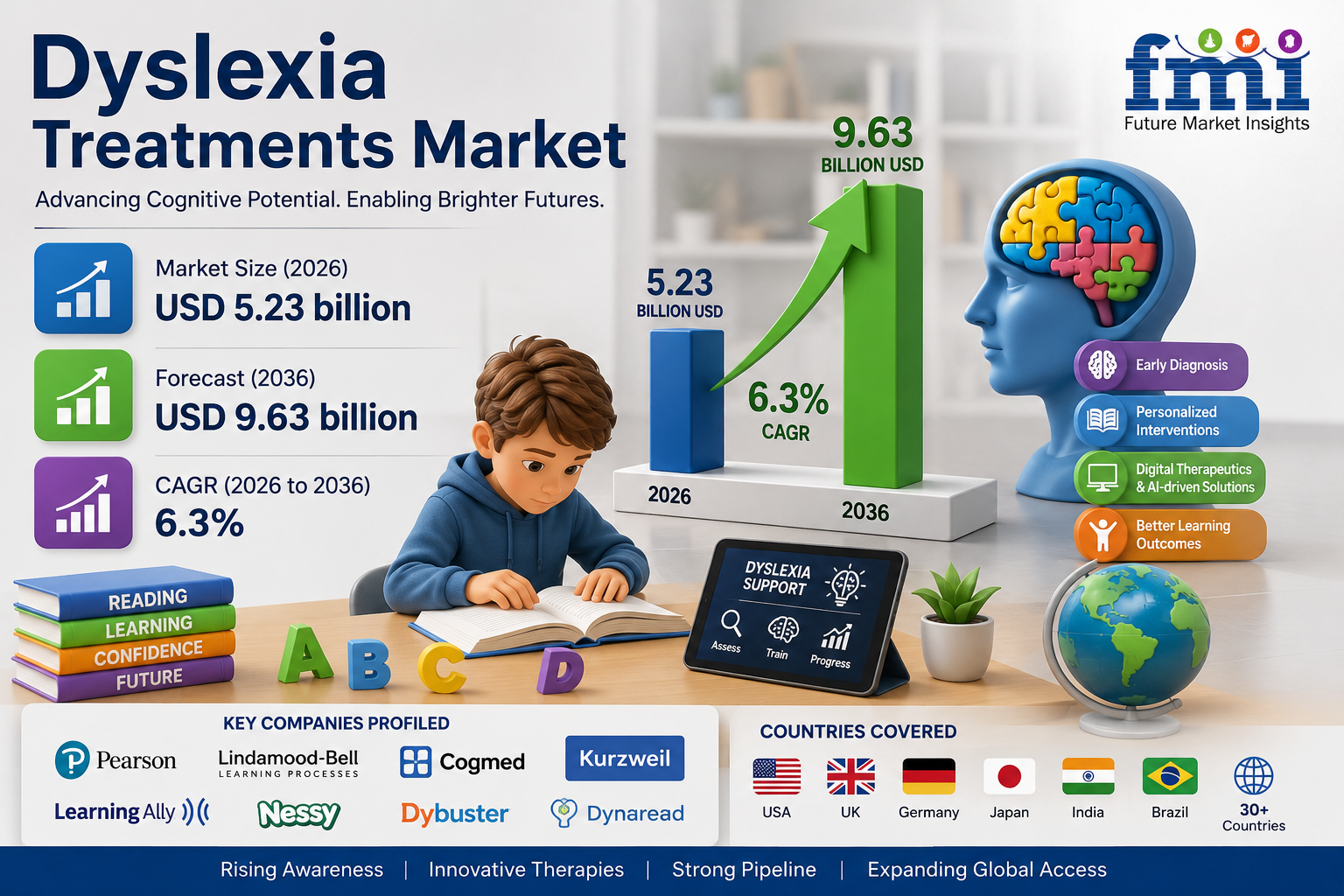
The global dyslexia treatments market is entering a sustained growth phase as rising diagnosis rates, stronger awareness of learning disabilities, and increased investments in neurodevelopmental healthcare reshape treatment adoption worldwide. Valued at USD 5.23 billion in 2026, the market is projected to reach USD 9.63 billion by 2036, expanding at a compound annual growth rate (CAGR) of 6.3% during the forecast period.
Growing recognition of dyslexia as a lifelong neurodevelopmental condition with direct implications for academic achievement, workforce readiness, and overall quality of life is driving demand for both traditional and technology-enabled treatment solutions. The industry is increasingly moving beyond conventional therapeutic models toward AI-driven assessment tools, digital therapeutics, cognitive training platforms, and personalized learning interventions.
Regulatory approval timelines are emerging as a critical competitive variable, influencing investment decisions, commercialization speed, and market entry strategies. The United States remains the preferred launch market due to regulatory clarity, strong reimbursement frameworks, and high healthcare spending. Meanwhile, Europe continues to offer broad market access despite reimbursement complexity, while Asia Pacific is rapidly gaining strategic importance due to healthcare modernization and regulatory reform.
As innovation accelerates, companies capable of navigating global regulatory pathways efficiently are expected to capture significant market share.
Market Overview
The dyslexia treatments market is undergoing structural transformation as healthcare systems increasingly prioritize early intervention and cognitive health. Dyslexia affects millions globally and remains one of the most prevalent learning disorders, creating long-term educational and economic challenges when left untreated.
Market expansion is being supported by improved diagnostic protocols, school-based screening programs, and broader inclusion of neurodevelopmental care within public healthcare strategies. Increased collaboration between clinicians, educators, and technology developers is also improving treatment accessibility.
From a commercial standpoint, the market is shifting from purely pharmaceutical and therapy-led approaches toward integrated ecosystems combining medication, cognitive rehabilitation, digital learning, and behavioral support. This diversification is expanding addressable market opportunities for pharmaceutical firms, healthcare technology developers, and digital health startups alike.
Key Growth Drivers
One of the strongest growth drivers is the sharp increase in dyslexia awareness among parents, schools, and healthcare providers. Earlier detection significantly improves intervention outcomes, leading to greater adoption of treatment programs.
Rising investments in neuroscience research are also accelerating innovation. Advances in understanding neural processing differences associated with dyslexia are helping researchers design more targeted interventions focused on reading fluency, language processing, and cognitive adaptation.
Government spending on cognitive healthcare and special education programs further supports market expansion. Public policy increasingly recognizes learning disabilities as an economic productivity issue, not merely an educational challenge.
The regulatory environment also influences growth. Faster approval pathways improve time-to-market for new therapies and digital solutions, making markets with efficient review systems especially attractive to investors.
Technology & Innovation Trends
Technology is becoming central to dyslexia treatment innovation. The market is seeing growing adoption of digital therapeutics, AI-powered screening tools, adaptive learning software, and gamified cognitive training platforms.
Artificial intelligence is improving diagnostic precision by identifying speech, reading, and behavioral patterns associated with dyslexia earlier than traditional assessments. These systems reduce diagnostic delays and enable personalized treatment planning.
Digital therapeutics are particularly disruptive because they offer scalable, software-driven interventions that can be delivered remotely. This improves access for underserved populations while reducing long-term treatment costs.
Real-world evidence, wearable cognitive monitoring, and machine learning are also beginning to influence clinical development and regulatory evaluations. These innovations may significantly shorten future approval timelines.
Market Challenges & Restraints
Despite favorable growth, the market faces several barriers.
Regulatory uncertainty remains a major challenge, especially for digital therapeutics and AI-enabled healthcare products. Many regulatory agencies are still adapting frameworks designed primarily for traditional pharmaceuticals.
Reimbursement complexity is another obstacle. In many regions, dyslexia treatments—particularly software-based interventions—lack standardized reimbursement pathways, limiting adoption.
Clinical validation requirements also present hurdles. Developers must demonstrate measurable cognitive improvement, long-term efficacy, and safety, often through costly studies.
Fragmented healthcare and education systems further complicate commercialization, especially across international markets with differing approval and reimbursement structures.
Segment Analysis
The market remains segmented by treatment type and distribution channels.
By Drug Type
Cyclizine-based treatments dominate the market, accounting for 36.0% market share in 2026, making them the leading drug segment. Their established clinical usage and familiarity among healthcare providers support continued demand.
Other therapeutic categories include cognitive enhancers, behavioral interventions, and adjunctive neurodevelopmental therapies. However, digital-first solutions are increasingly competing with conventional pharmaceutical approaches.
By Distribution Channel
Hospital pharmacies lead distribution, capturing 45.0% of total market share in 2026. Their dominance reflects the clinical nature of diagnosis and treatment initiation, which often occurs in specialized healthcare settings.
Retail pharmacies, online pharmacies, and direct digital subscription platforms are expected to grow steadily as treatment models become more decentralized.
The rise of app-based therapy delivery may gradually shift distribution economics away from conventional channels.
Regional Analysis
United States
The US remains the most attractive market for dyslexia treatment developers due to strong healthcare infrastructure, high spending, and favorable regulatory pathways.
The country frequently serves as the launch market for new neurodevelopmental therapies. Regulatory predictability improves investor confidence and accelerates commercialization.
Approval in the US often enhances global credibility, improving partnership and expansion opportunities.
Europe
Europe remains strategically important due to access to multiple healthcare markets and large patient populations.
However, developers must navigate complex reimbursement systems and country-specific policies. While regulatory harmonization offers advantages, commercialization remains more fragmented than in the US.
Despite these challenges, Europe remains essential for global market expansion.
Asia Pacific
Asia Pacific is rapidly emerging as a major growth engine.
Countries such as China, Japan, South Korea, Singapore, and Australia are modernizing healthcare systems and accelerating regulatory reforms.
India is the fastest-growing country in the market, projected to expand at a CAGR of 5.9% through 2036. Rising healthcare access, increased diagnosis rates, and digital health adoption are key growth drivers.
China’s regulatory reforms are attracting multinational interest, while Japan’s emphasis on regulatory efficiency supports faster access to novel therapies.
Smaller markets like Singapore and Australia are increasingly viewed as attractive early launch destinations due to transparent review systems.
Competitive Landscape
Competition in the dyslexia treatments market is intensifying as pharmaceutical companies, edtech firms, and digital health startups converge.
The market is transitioning from traditional therapy-centric competition toward integrated treatment ecosystems combining medication, diagnostics, AI, and software.
Competitive advantage increasingly depends on:
- Regulatory execution
- Clinical validation
- Digital scalability
- Reimbursement strategy
- Geographic launch sequencing
Companies capable of balancing these factors are expected to lead the next phase of market expansion.
Leading Companies Analysis
Market leaders are investing heavily in R&D focused on personalized neurodevelopmental interventions.
Pharmaceutical players continue refining cognitive therapeutics, while healthtech firms emphasize AI-based diagnosis and adaptive digital treatment platforms.
Emerging startups are particularly active in software-based interventions, leveraging machine learning to improve engagement and treatment outcomes.
Strategic partnerships between hospitals, educational institutions, and technology providers are becoming increasingly common.
Investment & Strategic Developments
Investor interest in neurodevelopmental disorders is rising due to strong long-term demand fundamentals.
Venture capital firms increasingly evaluate regulatory timelines before committing capital, since faster approvals improve return profiles.
Regions perceived as innovation-friendly attract greater research funding, creating reinforcing innovation ecosystems.
Developers are also adopting multi-market launch strategies to diversify regulatory risk while maximizing commercial reach.
Future Outlook
The future of the dyslexia treatments market will likely be shaped by regulatory modernization, AI integration, and broader adoption of digital therapeutics.
Real-world evidence, machine learning, and international regulatory collaboration may significantly reduce approval timelines in coming years.
Software-based interventions are expected to capture growing market share as treatment models shift toward personalized and remote delivery.
Companies that successfully integrate neuroscience, digital health, and regulatory agility will define the next generation of market leadership.
Conclusion
The dyslexia treatments market is evolving into a high-potential segment within neurodevelopmental healthcare. With the market projected to grow from USD 5.23 billion in 2026 to USD 9.63 billion by 2036, long-term growth remains supported by stronger diagnosis rates, digital innovation, and expanding healthcare investments.
While regulatory complexity and reimbursement challenges remain, markets offering speed, transparency, and flexibility will attract the greatest innovation. As digital therapeutics reshape treatment delivery, the industry is entering a new era where technology, regulation, and clinical science will collectively determine competitive success.
Explore More Related Studies Published by FMI Research
- The liver fibrosis treatment market is expected to be worth USD 65.19 billion by 2036 and is projected to create an incremental opportunity of USD 42.64 billion between 2026 and 2036.
- The monkeypox treatment market is projected to grow from USD 125.5 million in 2026 to USD 325.4 million by 2036, at a CAGR of 10.0%.
- The Acute Migraine Treatment Market is projected to grow from USD 2.95 Billion in 2025 to USD 4.58 Billion by 2036, at a CAGR of 4.5%.
FMI Custom Research: Strategic Intelligence for Confident Decision-Making
In today’s rapidly evolving business environment, leadership teams need more than market data—they need clear, actionable intelligence tailored to their strategic objectives. FMI’s Custom Research solutions are designed around the specific business questions organizations need answered, enabling executives to evaluate growth opportunities, validate investments, assess competitive dynamics, and reduce uncertainty before making critical decisions. By combining deep industry expertise, primary research, and proprietary market intelligence, FMI delivers insights that help organizations move from assumptions to evidence-based strategies with greater speed and confidence.
Key Executive Benefits
- Decision-Ready Insights: Research tailored to your specific business challenges, growth plans, and investment priorities.
- Reduced Strategic Risk: Validate market opportunities, customer demand, and competitive positioning before committing resources.
- Market Entry Confidence: Assess opportunity size, regulatory barriers, channel dynamics, and competitive landscapes with precision.
- Competitive Advantage: Gain proprietary intelligence unavailable through syndicated reports or internal datasets.
- Faster Growth Decisions: Accelerate expansion, product development, portfolio optimization, and investment planning.
- Primary Market Validation: Access real-world customer, buyer, and stakeholder insights that support high-confidence decision-making.
- Global Industry Expertise: Powered by 100+ analysts, 20,000+ published reports, and 1.6 million+ hours of research experience.
- Proven Track Record: Over 7,000 market-entry engagements completed across six regions and 14 industry sectors with strong client retention.
Business Impact
FMI helps organizations transform market complexity into strategic clarity, enabling leadership teams to identify growth opportunities faster, optimize resource allocation, strengthen competitive positioning, and make high-stakes business decisions with confidence.
To explore how FMI Custom Research can support your strategic priorities, please connect with our team at – sales@futuremarketinsights.com
Contact Us
Future Market Insights Inc.
Christiana Corporate, 200 Continental Drive,
Suite 401, Newark, Delaware – 19713, USA
T: +1-347-918-3531
Why FMI: Future Market Insights – Why FMI
Website: Future Market Insights