

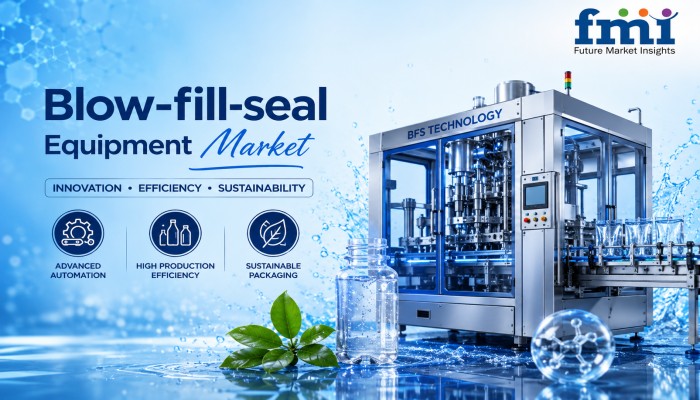
The pharmaceutical manufacturing landscape is evolving rapidly, with sterility, efficiency, and regulatory compliance becoming critical priorities. Among the technologies reshaping sterile production, Blow Fill Seal (BFS) equipment has emerged as a powerful solution that integrates container formation, filling, and sealing into a single enclosed process. By minimizing human intervention and reducing contamination risks, BFS technology is helping both established manufacturers and emerging players strengthen their competitive position in the sterile packaging market.
Why Blow Fill Seal Technology Matters
Traditional aseptic manufacturing often involves multiple handling and transfer stages, creating opportunities for contamination. BFS technology addresses this challenge by performing container molding, sterile filling, and sealing within one automated system.
Key advantages include:
- Reduced operator intervention and contamination risks
- Improved process consistency and product quality
- Faster production cycles and higher throughput
- Enhanced compliance with stringent regulatory requirements
- Lower dependence on complex container handling operations
As regulatory agencies increasingly focus on contamination control strategies rather than solely relying on final product testing, closed and automated manufacturing systems like BFS are gaining significant attention.
Strong Demand from Unit-Dose Sterile Applications
BFS technology has established itself as a preferred solution for several sterile liquid applications where convenience, safety, and efficiency are essential.
Major application areas include:
- Ophthalmic unit-dose products
- Respiratory and inhalation therapies
- Nebulizer solutions
- Small-volume sterile liquids
- Select vaccine packaging formats
The technology is particularly attractive in scenarios where lightweight polymer containers, rapid production, and integrated packaging processes deliver operational advantages.
Growth Outlook for 2026–2036
The outlook for BFS equipment remains positive over the next decade. However, growth is expected to be selective rather than universal.
Several factors are driving market expansion:
Rising Sterility Standards
Pharmaceutical manufacturers continue to invest in advanced contamination-control technologies to meet evolving global regulations.
Automation and Smart Manufacturing
Modern BFS systems increasingly incorporate:
- Artificial intelligence-driven monitoring
- Real-time quality inspection systems
- Predictive maintenance capabilities
- Digital process validation tools
These innovations are helping manufacturers maximize uptime, reduce waste, and improve operational efficiency.
Emerging Vaccine and Global Health Opportunities
Public health organizations and vaccine developers are exploring compact, cost-effective packaging formats that can simplify distribution and reduce logistics costs. BFS technology may play an increasingly important role in supporting these initiatives.
Challenges and Competitive Alternatives
Despite its advantages, BFS technology faces strong competition from alternative sterile packaging solutions.
Key competing technologies include:
- Prefilled syringes
- Autoinjectors
- Ready-to-use vial systems
- Isolator-based conventional filling lines
- Restricted Access Barrier Systems (RABS)
These alternatives continue to attract investment, particularly in high-value biologics and self-administration therapies where long-term stability and patient convenience are critical.
Additionally, material compatibility remains an important consideration. Some sensitive biologics and complex formulations may require packaging formats with superior barrier properties or extended shelf-life performance.
Opportunities for Manufacturers and Technology Innovators
For established BFS equipment manufacturers, the next growth phase will depend on expanding into new therapeutic categories and enhancing automation capabilities.
Meanwhile, emerging manufacturers have opportunities to differentiate through:
- Advanced polymer technologies
- Smart inspection solutions
- Energy-efficient machine designs
- Integrated digital manufacturing platforms
- Customized BFS systems for niche pharmaceutical applications
As sterile manufacturing continues its shift toward highly automated, contamination-resistant processes, BFS technology remains a strategically important solution. While competition from syringes, vials, and advanced fill-finish systems will persist, continued innovation in materials, process controls, and equipment design is expected to strengthen BFS adoption across global pharmaceutical and healthcare markets through 2036.
Explore More Related Studies Published by FMI Research:
- Blown Stretch Packaging Films Market: https://www.futuremarketinsights.com/reports/blown-stretch-packaging-films-market
- Blow Fill Seal Technology Market: https://www.futuremarketinsights.com/reports/blow-fill-seal-technology-market
- Blow Molded Plastic Market: https://www.futuremarketinsights.com/reports/blow-molded-plastic-bottles-market
About Future Market Insights (FMI)
Future Market Insights, Inc. (FMI) is an ESOMAR-certified, ISO 9001:2015 market research and consulting organization, trusted by Fortune 500 clients and global enterprises. With operations in the U.S., UK, India, and Dubai, FMI provides data-backed insights and strategic intelligence across 30+ industries and 1200 markets worldwide.
Contact Us:
Future Market Insights Inc.
Christiana Corporate, 200 Continental Drive,
Suite 401, Newark, Delaware – 19713, USA
T: +1-347-918-3531
For Sales Enquiries: sales@futuremarketinsights.com
Website: https://www.futuremarketinsights.com
LinkedIn| Twitter| Blogs | YouTube