

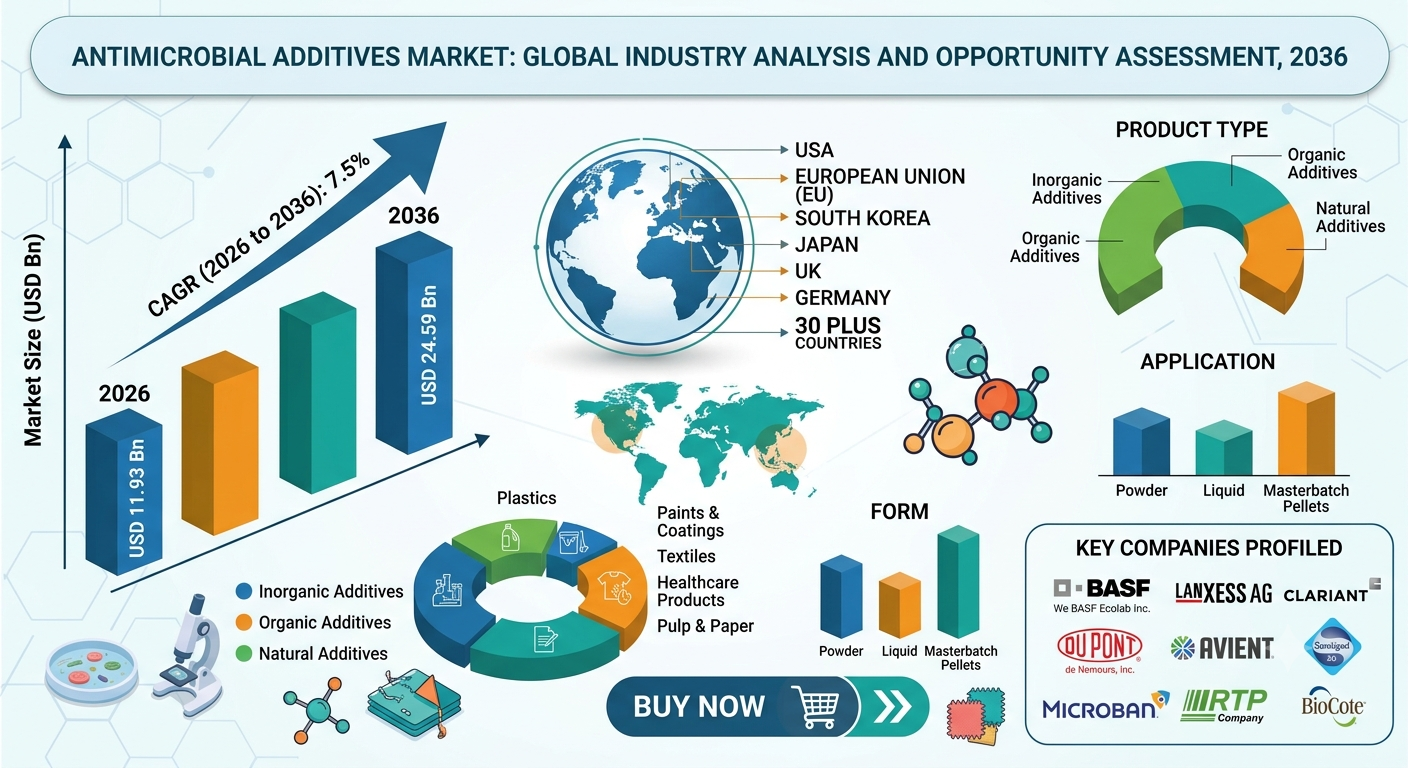
NEWARK, Del., July 27, 2026 — The Antimicrobial Additives Market is expected to experience robust growth as industries increasingly prioritize hygiene, product safety, and regulatory compliance across packaging, healthcare, construction, and consumer goods applications. According to Future Market Insights (FMI), the market is projected to grow from USD 11.93 billion in 2026 to USD 24.59 billion by 2036, registering a 7.5% CAGR during the forecast period. Rising demand for antimicrobial packaging, expanding healthcare infrastructure, growing adoption of hygienic building materials, and stricter global safety regulations are expected to support long-term market expansion.
The market is anticipated to generate an incremental opportunity of USD 12.66 billion between 2026 and 2036. Increasing use of antimicrobial technologies in plastics, coatings, textiles, food packaging, and healthcare products continues to strengthen demand across global industrial markets.
👉 Get Detailed Market Forecasts, Competitive Benchmarking, and Pricing Trends
Key Antimicrobial Additives Market Highlights at a Glance
- Market Size (2026): USD 11.93 Billion
- Forecast Market Size (2036): USD 24.59 Billion
- Forecast Period: 2026–2036
- CAGR (2026–2036): 7.5%
- Incremental Opportunity (2026–2036): USD 12.66 Billion
- Leading Product Type: Inorganic Additives (61.2% Market Share)
- Leading Application: Plastics (32.0% Market Share)
- Key Segments Covered: Product Type, Application, End Use, Form, Sales Channel, Region
- Report Pages: 339
- Last Updated: July 04, 2026
- Reviewed by: Nikhil Kaitwade
Why Is the Antimicrobial Additives Market Growing?
The market continues to expand as manufacturers across food packaging, healthcare, construction, textiles, and consumer products increasingly integrate antimicrobial technologies to improve hygiene, extend product life, and comply with evolving regulatory standards.
Growing consumer awareness regarding health and sanitation, rising demand for active food packaging solutions, and increasing investment in infection-control materials are accelerating adoption worldwide.
Key Growth Drivers
- Rising demand for antimicrobial food packaging.
- Growing focus on infection prevention across healthcare facilities.
- Increasing adoption of hygienic plastics and coatings.
- Expansion of food and beverage processing industries.
- Growing use of antimicrobial additives in consumer goods.
- Rising regulatory emphasis on product safety and hygiene.
- Increasing investment in sustainable and high-performance materials.
- Expansion of industrial manufacturing worldwide.
As industries prioritize product protection and contamination control, antimicrobial additives are becoming an essential component of advanced material development.
According to Nikhil Kaitwade, Principal Consultant at Future Market Insights, “Companies that improve cost competitiveness while delivering consistent antimicrobial performance across industrial applications will strengthen their market position. Procurement is increasingly shifting toward suppliers offering reliable production, regulatory compliance, and documented traceability, particularly as global performance standards continue to rise.”
Why Do Inorganic Additives Lead the Market?
Inorganic antimicrobial additives are expected to account for 61.2% of the global market owing to their long-lasting antimicrobial performance, thermal stability, and broad compatibility with plastics, coatings, healthcare products, and industrial materials.
Manufacturers continue to favor inorganic technologies for applications requiring durable protection against microbial contamination.
Product Type Highlights
- Inorganic additives dominate global demand.
- Long-lasting antimicrobial performance.
- Excellent thermal and chemical stability.
- Broad industrial application across multiple sectors.
Why Do Plastics Dominate Application Demand?
Plastics represent the leading application segment with a 32.0% market share, supported by widespread adoption across food packaging, medical devices, consumer products, construction materials, and automotive components.
Growing demand for antimicrobial plastic products continues to improve product durability, hygiene, and consumer safety.
Application Highlights
- Plastics remain the largest application segment.
- Food packaging drives significant demand.
- Healthcare products require enhanced microbial protection.
- Consumer goods increasingly incorporate antimicrobial technologies.
How Is Active Packaging Driving Market Expansion?
Active packaging technologies incorporating antimicrobial additives are becoming increasingly important for preserving food quality, extending shelf life, and reducing microbial contamination throughout global food supply chains.
Growing demand for packaged foods, ready-to-eat meals, and international food trade is encouraging manufacturers to invest in advanced packaging materials that improve food safety while reducing waste.
Market Trends
- Expansion of antimicrobial food packaging.
- Increasing use of natural antimicrobial additives.
- Growing adoption of advanced polymer technologies.
- Rising demand for hygienic consumer products.
- Expansion of antimicrobial coatings.
- Greater investment in sustainable packaging solutions.
Market Dynamics
Market Drivers
Growing demand for hygienic packaging, rising healthcare-associated infection prevention initiatives, increasing food safety regulations, expanding healthcare infrastructure, growing consumer awareness regarding sanitation, and wider adoption of antimicrobial materials continue driving market growth.
Market Restraints
Stringent regulatory approval requirements, fluctuating raw material prices, higher production costs, concerns regarding antimicrobial resistance, and complex product validation processes continue presenting challenges for manufacturers.
Market Trends
Innovation continues reshaping the antimicrobial additives industry.
Major trends include:
- Development of bio-based antimicrobial additives.
- Increasing use of silver- and zinc-based technologies.
- Expansion of antimicrobial masterbatch production.
- Rising investment in healthcare surface protection.
- Growing adoption of smart packaging technologies.
- Strategic collaborations between material manufacturers and packaging companies.
Regional and Country Outlook
The European Union remains one of the most significant regional markets, supported by stringent regulatory standards, strong industrial manufacturing, and growing demand for antimicrobial materials across healthcare and food packaging industries.
Western Europe is expected to maintain steady growth owing to regulation-driven material specifications and widespread adoption of advanced antimicrobial technologies.
South Korea continues to emerge as a key growth market through increasing investment in antimicrobial consumer goods, healthcare products, and advanced industrial materials.
North America and Asia Pacific are also expected to witness strong demand, driven by food safety regulations, healthcare investments, and expanding industrial manufacturing.
Competitive Landscape
Competition in the antimicrobial additives market is increasingly focused on manufacturing scale, product performance, regulatory compliance, innovation, and global distribution capabilities.
Leading manufacturers continue investing in advanced antimicrobial technologies, sustainable product development, and strategic partnerships to strengthen their market position across diverse industrial applications.
Frequently Asked Questions
- What is the projected size of the Antimicrobial Additives Market by 2036?
The global Antimicrobial Additives Market is projected to reach USD 24.59 billion by 2036, growing from USD 11.93 billion in 2026.
- What is the expected CAGR of the Antimicrobial Additives Market?
The market is forecast to expand at a 7.5% CAGR between 2026 and 2036.
- Which product type dominates the market?
Inorganic antimicrobial additives lead the market with a 61.2% share.
- Which application holds the largest market share?
Plastics dominate the market with a 32.0% share due to extensive use in packaging, healthcare, and industrial applications.
- What factors are driving market growth?
Growing demand for antimicrobial food packaging, increasing infection-control requirements, expanding healthcare infrastructure, stricter food safety regulations, rising consumer awareness of hygiene, and broader adoption of antimicrobial materials across industrial applications are driving global market growth.
Related Reports
- https://sites.google.com/view/healthcarewellnessinsights/life-sciences-next-generation-customer-engagement-platforms-marke
- https://sites.google.com/view/healthcarewellnessinsights/surface-disinfectant-market
- https://sites.google.com/view/healthcarewellnessinsights/biosimilar-contract-manufacturing-market
About Future Market Insights (FMI)
Economics
Future Market Insights, Inc. (ESOMAR certified, recipient of the Stevie® Award, and a member of the Greater New York Chamber of Commerce) provides deep insights into governing factors elevating demand in global markets.
FMI delivers market intelligence, consulting services, and syndicated research reports across chemicals, materials, food ingredients, pharmaceuticals, industrial manufacturing, sustainability, advanced materials, and infrastructure sectors.
With global expertise and industry-focused research capabilities, FMI provides actionable insights that help organizations understand market dynamics and identify emerging opportunities.
Contact
Future Market Insights Inc.
Christiana Corporate, 200 Continental Drive, Suite 401, Newark, Delaware 19713, USA
Rahul Singh
AVP – Marketing and Growth Strategy
Future Market Insights, Inc.
Phone: +91 8600020075
For Media: Rahul.Singh@futuremarketinsights.com
Email: sales@futuremarketinsights.com
Website: www.futuremarketinsights.com