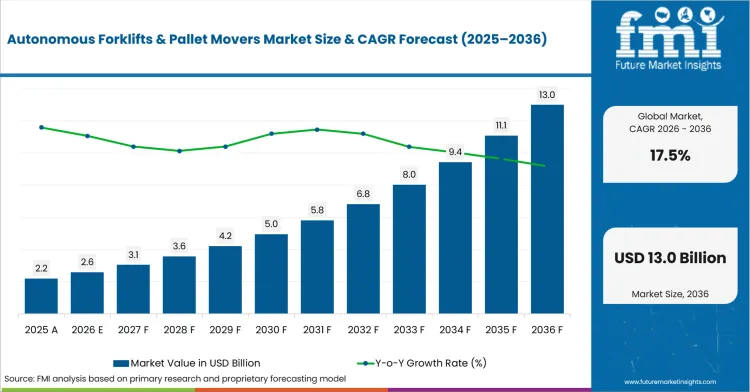
The global Autonomous Forklifts & Pallet Movers Market is projected to grow from USD 2.6 billion in 2026 to USD 13.0 billion by 2036, registering a compound annual growth rate (CAGR) of 17.5% during the forecast period, according to Future Market Insights (FMI).
The expansion reflects growing demand for automated material-handling solutions that improve pallet movement, reduce repetitive manual tasks, and support continuous warehouse operations. Advances in autonomous navigation, machine vision, sensor technologies, and pallet-localization systems are making it possible for forklifts and pallet movers to perform increasingly precise transport activities across industrial and distribution facilities.
As warehouse operators prioritize productivity, workplace safety, and operational consistency, autonomous forklifts and pallet movers are becoming important components of broader warehouse automation strategies.
Get Detailed Market Forecasts, Competitive Benchmarking & Industry Insights — Request a Sample Report: https://www.futuremarketinsights.com/reports/sample/rep-gb-34077
Autonomous Forklifts & Pallet Movers Market: Key Metrics
- Market Value (2026): USD 2.6 billion
- Forecast Value (2036): USD 13.0 billion
- Global CAGR (2026–2036):5%
- Leading Vehicle Type: Pallet jacks and movers, accounting for 30.0% of the market in 2025
- Key Demand Drivers: Warehouse automation, labor availability, pallet-handling accuracy, operational efficiency, and advances in autonomous navigation
What Is Driving Demand for Autonomous Forklifts & Pallet Movers?
Autonomous forklifts and pallet movers are gaining importance as warehouses and manufacturing facilities seek to automate repetitive transportation activities. Moving pallets between receiving docks, storage locations, production lines, and dispatch areas requires consistent coordination and can involve substantial labor resources.
Improvements in perception technology are helping autonomous vehicles identify pallets, assess their positions, and align their forks for pickup. Research published in March 2025 by Mueller and co-authors demonstrated a synthetic-data pallet-localization model achieving a detection score of 0.995 at a 50% intersection-over-union threshold, with average position error below 4.2 centimeters within five meters.
These developments highlight why accurate perception is essential for autonomous pallet handling. Vehicle speed alone does not determine operational performance; reliable pallet detection, approach positioning, load stability, and recovery from unexpected obstacles are equally important.
Five Key Trends Shaping the Autonomous Forklifts & Pallet Movers Market
- Pallet Jacks and Movers Strengthen Their Market Position
Pallet jacks and movers accounted for 30.0% of the market in 2025. Their suitability for horizontal pallet transportation makes them relevant to warehouses, distribution centers, and manufacturing facilities. Autonomous versions can support repetitive movement between designated operational zones.
- Precision Pallet Detection Becomes a Critical Technology
Autonomous forklifts depend on accurate pallet localization to approach loads, position forks, and complete pickup operations. Machine vision, depth sensors, LiDAR, and artificial intelligence are improving the ability of vehicles to identify pallets under varying lighting, positioning, and floor conditions.
- Warehouse Automation Expands Beyond Transportation
Automated material handling is increasingly focused on coordinating transportation with storage, picking, replenishment, and dispatch activities. Autonomous forklifts and pallet movers can complement conveyors, automated storage systems, and autonomous mobile robots to create more connected warehouse workflows.
- Safety and Navigation Reliability Influence Purchasing Decisions
Industrial operators evaluate obstacle detection, pedestrian recognition, emergency stopping, load stability, and navigation performance before deploying autonomous vehicles. Reliable operation around workers and conventional forklifts is essential for maintaining productivity while reducing workplace risks.
- Integration with Warehouse Management Systems Gains Importance
Connectivity with warehouse management systems and fleet-control platforms can improve task allocation, vehicle utilization, and traffic coordination. Integrated systems can help operators monitor vehicle status, identify operational bottlenecks, and manage material movement across multiple warehouse zones.
Key Application Areas Creating Growth Opportunities
Autonomous forklifts and pallet movers can support material transportation across several industrial and logistics environments:
- Warehousing and Distribution: Automating pallet movement between receiving, storage, picking, and dispatch areas.
- E-commerce Fulfillment: Supporting high-frequency material transfers within fulfillment centers.
- Manufacturing Facilities: Moving raw materials, work-in-progress inventory, and finished goods between production areas.
- Retail and Wholesale Distribution: Supporting pallet transportation and replenishment across distribution facilities.
- Cold Storage Logistics: Automating repetitive pallet movement in temperature-controlled environments where operational efficiency is particularly important.
- Third-Party Logistics (3PL): Improving material-handling consistency across facilities managing goods for multiple customers.
Competitive Landscape: Key Companies
The Autonomous Forklifts & Pallet Movers Market includes industrial truck manufacturers, warehouse automation specialists, and autonomous navigation technology providers.
Notable companies operating in the broader industry include:
- Toyota Industries Corporation
- KION Group AG
- Jungheinrich AG
- Mitsubishi Logisnext Co., Ltd.
- Crown Equipment Corporation
- Hyster-Yale Materials Handling, Inc.
- Seegrid Corporation
- Balyo
- Hyundai Construction Equipment
- Raymond Corporation
Competition is increasingly shaped by navigation accuracy, payload capacity, vehicle reliability, safety features, battery performance, and compatibility with existing warehouse infrastructure. Manufacturers that combine dependable material-handling equipment with advanced autonomous control systems may be better positioned to capture demand.
What This Means for Industry Participants
The projected market expansion creates opportunities for autonomous vehicle manufacturers, sensor suppliers, robotics developers, warehouse management software providers, system integrators, and industrial equipment distributors.
For manufacturers, product development priorities include improving pallet detection, fork alignment, obstacle avoidance, load stability, and battery efficiency. Technology providers can strengthen their position through advanced perception software, fleet management platforms, and warehouse connectivity solutions.
For warehouse operators, deployment decisions should be based on practical operating performance. Pilot programs can help assess pallet pickup accuracy, completed transport cycles, vehicle availability, safety performance, and compatibility with existing workflows before expanding deployments across facilities.
Future Market Outlook
The Autonomous Forklifts & Pallet Movers Market is moving toward more intelligent and connected material-handling operations. Improvements in navigation, computer vision, artificial intelligence, and sensor technologies are expanding the potential for autonomous vehicles to manage increasingly complex pallet transportation tasks.
However, commercial success will depend on consistent performance in real warehouse conditions. Accurate pallet localization, safe interaction with workers, reliable load handling, and seamless integration with existing systems will remain essential adoption factors.
As distribution centers and manufacturing facilities continue investing in warehouse automation, autonomous forklifts and pallet movers are expected to play a growing role in improving material flow and operational efficiency.
About the Autonomous Forklifts & Pallet Movers Market Report
Future Market Insights’ report provides an in-depth assessment of the global Autonomous Forklifts & Pallet Movers Market, covering historical developments, current market dynamics, competitive trends, and growth opportunities from 2026 to 2036.
The study examines key market dimensions, including:
- Vehicle Type: Pallet jacks and movers, autonomous forklifts, and other applicable vehicle categories.
- Application: Pallet transportation, warehouse operations, manufacturing logistics, and distribution activities.
- Technology: Autonomous navigation, machine vision, sensor-based positioning, and fleet management systems.
- End-use Industries: Warehousing, logistics, manufacturing, retail, e-commerce, and cold-chain operations.
- Regional Coverage: North America, Latin America, Europe, East Asia, South Asia, Oceania, and the Middle East and Africa.
Explore the Full Report: https://www.futuremarketinsights.com/reports/autonomous-forklifts-and-pallet-movers-market
Frequently Asked Questions
- How big is the Autonomous Forklifts & Pallet Movers Market in 2026?
The global market is estimated at USD 2.6 billion in 2026.
- What is the projected market value by 2036?
The market is forecast to reach USD 13.0 billion by 2036.
- What is the expected CAGR of the Autonomous Forklifts & Pallet Movers Market?
The market is projected to expand at a CAGR of 17.5% between 2026 and 2036.
- Which vehicle type leads the market?
Pallet jacks and movers accounted for 30.0% of the market in 2025.
- Which companies operate in the autonomous forklift industry?
Notable companies in the broader industry include Toyota Industries, KION Group, Jungheinrich, Mitsubishi Logisnext, Crown Equipment, Hyster-Yale, Seegrid, Balyo, Hyundai Construction Equipment, and Raymond Corporation.
Related Reports:
Asia Pacific Industrial Pumps Market- https://www.futuremarketinsights.com/reports/asia-Pacific-industrial-pumps-market
Sliding Bearing Market- https://www.futuremarketinsights.com/reports/sliding-bearing-market
Compact Construction Equipment Market Share Analysis- https://www.futuremarketinsights.com/reports/compact-construction-equipment-market-share-analysis
About Future Market Insights (FMI)
Future Market Insights (FMI) is a market research and consulting firm providing actionable insights, syndicated research, and strategic analysis to businesses across industries. FMI helps organizations understand evolving market dynamics, identify growth opportunities, and make informed business decisions through data-driven research.
Media Contact
Rahul Singh
AVP – Marketing and Growth Strategy
Future Market Insights, Inc.
Phone: +91 8600020075
Email: sales@futuremarketinsights.com
Rahul.singh@futuremarketinsights.com
Website: www.futuremarketinsights.com