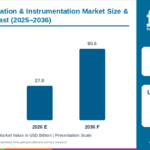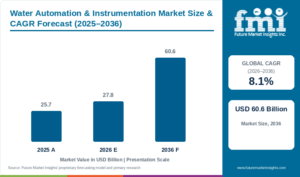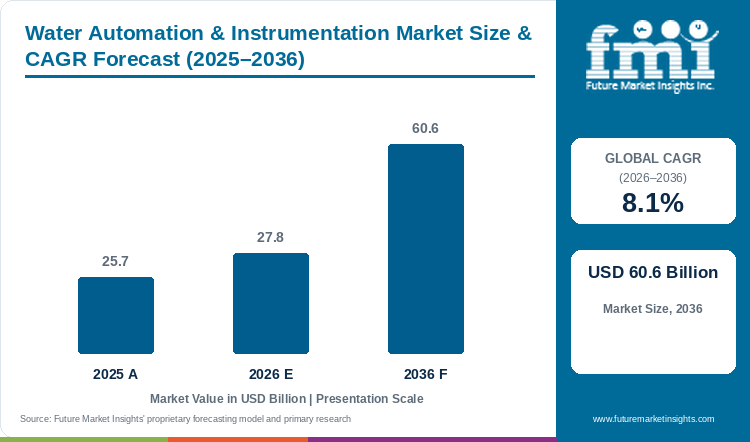
The global water automation and instrumentation market is projected to grow from USD 27.8 billion in 2026 to USD 60.6 billion by 2036, registering a compound annual growth rate (CAGR) of 8.1% during the forecast period. Market expansion is supported by rising investments in water infrastructure modernization, increasing pressure to reduce treated water losses, and the adoption of digital monitoring and process-control technologies across municipal water and wastewater networks.
The market increased from USD 25.7 billion in 2025 to USD 27.8 billion in 2026, creating an expected incremental opportunity of USD 32.8 billion through 2036. SCADA and distributed control systems account for 34.8% of automation system demand in 2026, while distribution network management represents 41.2% of process-stage demand. Municipal water and wastewater utilities dominate end-user demand with a 58.4% share.
Get Detailed Market Forecasts, Competitive Benchmarking & Industry Insights — Request a Sample Report: https://www.futuremarketinsights.com/reports/sample/rep-gb-17774
Water Automation & Instrumentation Market Size and Growth Forecast
The global water automation and instrumentation market is entering a strong growth phase as utilities modernize aging infrastructure and adopt digital technologies to improve water management. Automation systems, sensors, control equipment, and monitoring platforms are helping operators manage complex water and wastewater processes with greater visibility and operational efficiency.
Key market indicators include:
- 2025 Market Value: USD 25.7 billion
- 2026 Market Value: USD 27.8 billion
- 2036 Forecast Value: USD 60.6 billion
- Forecast CAGR (2026–2036):1%
- Incremental Opportunity: USD 32.8 billion
- Leading Automation System: SCADA and distributed control systems, accounting for 34.8%
- Leading Process Stage: Distribution network management, representing 41.2%
- Leading End User: Municipal water and wastewater utilities, accounting for 58.4%
Five Key Trends Shaping the Water Automation & Instrumentation Market
- SCADA and Distributed Control Systems Strengthen Centralized Water Management
Water utilities are increasingly adopting SCADA and distributed control systems to monitor operations across treatment plants, pumping stations, and distribution networks. These systems provide centralized visibility into equipment performance and process conditions, helping operators identify disruptions and improve coordination across geographically distributed infrastructure.
- Distribution Network Management Becomes a Major Investment Priority
Distribution network management accounts for 41.2% of process-stage demand in 2026. Utilities are focusing on monitoring water flow, pressure conditions, and network performance to identify inefficiencies and reduce treated water losses. Automation and instrumentation technologies can support faster detection of operational problems and more informed network management decisions.
- Municipal Utilities Drive Adoption of Automation Technologies
Municipal water and wastewater utilities represent 58.4% of end-user demand in 2026. These organizations manage extensive infrastructure and face growing requirements to maintain reliable water services, improve treatment operations, and monitor distribution systems. Their modernization programs are creating opportunities for integrated automation and instrumentation solutions.
- Digital Monitoring Improves Operational Visibility
Connected sensors, monitoring equipment, and automated control platforms are helping water operators gain better insight into system performance. Continuous data collection can support more effective process supervision, equipment monitoring, and maintenance planning. These capabilities are becoming increasingly relevant as utilities seek to improve operational efficiency and infrastructure reliability.
- Water Infrastructure Modernization Accelerates Technology Adoption
Aging water infrastructure and increasing pressure on municipal systems are encouraging utilities to invest in modern control and instrumentation technologies. Automation can help operators manage complex treatment and distribution processes while improving visibility into equipment and network conditions. This modernization trend is supporting demand for integrated digital water management solutions.
Regional Opportunities in the Water Automation & Instrumentation Market
North America
North America offers opportunities through water infrastructure modernization, municipal utility investments, and the adoption of digital monitoring systems. Utilities are focusing on improving network visibility, operational reliability, and the management of water and wastewater treatment facilities.
Europe
Europe’s market is supported by investments in water infrastructure efficiency, wastewater management, and digital utility operations. Demand for advanced instrumentation and automation systems is creating opportunities for technology providers serving municipal and industrial water networks.
Asia Pacific
Asia Pacific presents significant opportunities through urbanization, expanding municipal infrastructure, and rising demand for reliable water services. Investments in treatment facilities and distribution networks are supporting the adoption of automated monitoring and control technologies.
Middle East and Africa
The Middle East and Africa offer opportunities as water-scarce regions prioritize efficient water management, infrastructure development, and wastewater treatment. Automation and instrumentation solutions can support improved monitoring of distribution networks and treatment operations.
Latin America
Latin America is creating opportunities through municipal water infrastructure upgrades and efforts to improve distribution efficiency. Utilities are increasingly looking toward monitoring and control technologies to strengthen operational performance and manage water resources more effectively.
Competitive Landscape of the Water Automation & Instrumentation Market
Competition in the water automation and instrumentation market is shaped by system integration capabilities, monitoring accuracy, operational reliability, connectivity, and the ability to support complex water infrastructure. Suppliers are focusing on automation platforms, instrumentation equipment, control systems, and digital monitoring solutions for municipal and wastewater utilities.
The growing adoption of SCADA and distributed control systems is increasing the importance of integrated solutions that connect treatment facilities, pumping stations, and distribution networks. Companies that can provide scalable technologies, reliable equipment, and effective system integration are positioned to address the evolving requirements of water utilities.
Key Players:
- ABB Ltd.
- Siemens AG
- Schneider Electric SE
- Rockwell Automation Inc.
- Process Analytical and Flow Instrumentation Specialists
- Endress+Hauser Group Services AG
- Smart Water Metering and Utility Telemetry Platforms
- Xylem Inc.
Business Outlook
The water automation and instrumentation market is expected to expand steadily through 2036 as utilities accelerate the modernization of water and wastewater infrastructure. Distribution network management remains a major process-stage opportunity, while municipal water and wastewater utilities continue to represent the largest end-user category.
The increasing adoption of SCADA and distributed control systems highlights the industry’s shift toward centralized supervision and data-driven water operations. As utilities focus on reducing treated water losses, improving infrastructure visibility, and strengthening service reliability, demand for integrated automation and instrumentation solutions is expected to increase.
Browse Full Report: https://www.futuremarketinsights.com/reports/water-automation-and-instrumentation-market
About the Water Automation & Instrumentation Market Report
Future Market Insights’ Water Automation & Instrumentation Market Report provides an assessment of global market demand, automation technologies, process-stage developments, end-user trends, and growth opportunities through 2036.
- Report Author: Nikhil Kaitwade
- Report Length: 250 pages
- Historical Market Reference: 2025
- Forecast Period: 2026 to 2036
- Market Size (2026): USD 27.8 billion
- Market Forecast (2036): USD 60.6 billion
- Market Growth:1% CAGR
- Incremental Opportunity: USD 32.8 billion
Frequently Asked Questions
- How big is the water automation and instrumentation market in 2026?
The global water automation and instrumentation market is estimated to reach USD 27.8 billion in 2026, increasing from USD 25.7 billion in 2025.
- What is the projected market size by 2036?
The market is forecast to reach USD 60.6 billion by 2036, creating an incremental opportunity of USD 32.8 billion over the forecast period.
- What is the expected CAGR of the water automation and instrumentation market?
The global market is projected to expand at a CAGR of 8.1% between 2026 and 2036.
- Which automation system leads the market?
SCADA and distributed control systems lead the automation system category, accounting for 34.8% of demand in 2026.
- Which process stage holds the largest market share?
Distribution network management leads the process-stage category, representing 41.2% of demand in 2026.
Related Reports
Stair Lift Motors Market- https://www.futuremarketinsights.com/reports/stair-lift-motors-market
Plate Heat Exchanger Market- https://www.futuremarketinsights.com/reports/plate-heat-exchanger-market
Solar Inverter Market- https://www.futuremarketinsights.com/reports/solar-inverter-market
About Future Market Insights (FMI)
Future Market Insights (FMI) is a market research and consulting firm providing business intelligence, industry analysis, and strategic insights to organizations across global markets. FMI helps businesses understand market trends, assess growth opportunities, evaluate competitive landscapes, and make informed decisions through data-driven research.
Media Contact
Rahul Singh
AVP – Marketing and Growth Strategy
Future Market Insights (FMI)
Phone: +91 8600020075
Email: sales@futuremarketinsights.com
Email: Rahul.singh@futuremarketinsights.com
Website: https://www.futuremarketinsights.com/