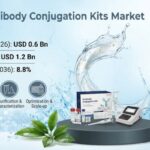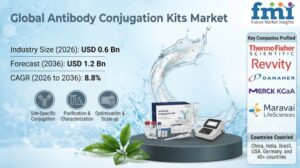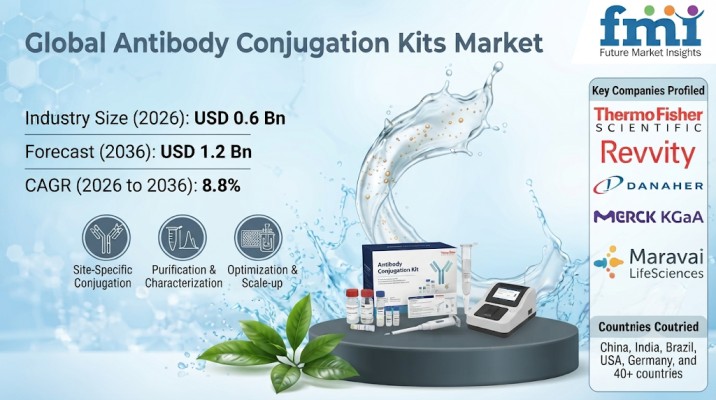
The global antibody conjugation kits market is projected to increase from USD 550.4 million in 2026 to USD 1.28 billion by 2036, registering a compound annual growth rate (CAGR) of 8.8% during the forecast period, according to Future Market Insights (FMI). Demand is being supported by the growing use of antibody labeling in biopharmaceutical research, flow cytometry, immunoassays, and preclinical antibody-drug conjugate (ADC) development.
Antibody conjugation kits enable researchers to attach fluorescent dyes, enzymes, biotin, nanoparticles, and other labels to antibodies for analytical and research applications. As biologics development becomes more sophisticated, laboratories are placing greater emphasis on controlled conjugation, reproducibility, and reliable labeling outcomes. These requirements are creating opportunities for suppliers offering site-specific and click chemistry-based solutions.
Request a report sample: https://www.futuremarketinsights.com/reports/sample/rep-gb-31780
The short version
- Market size: USD 550.4 million in 2026.
- Forecast value: USD 1.28 billion by 2036.
- Growth rate:8% CAGR from 2026 to 2036.
- Leading product type: NHS-ester dye labeling kits, with a 26.0% share in 2026.
- Leading application: Flow cytometry reagents, accounting for 28.5% of market revenue.
- Largest end-user segment: Biopharma R&D, representing 34.5% of the market.
- Fast-growing product formats: Click chemistry labeling kits and site-specific conjugation kits.
The projected expansion reflects the growing importance of antibody labeling in research workflows and the shift toward more precise conjugation techniques.
Why demand for antibody conjugation kits is increasing
Antibody conjugation is an established laboratory process used to prepare labeled antibodies for imaging, cell analysis, immunoassays, and other research applications. Biopharmaceutical companies and academic research facilities increasingly rely on these products to customize antibodies for specific experimental requirements.
The expansion of antibody-drug conjugate research is another important growth driver. ADC development requires careful control over conjugation chemistry and drug-to-antibody ratios. This is encouraging researchers to explore site-specific and click chemistry approaches that can deliver more controlled molecular attachment than conventional random labeling methods.
The increasing use of high-throughput laboratory systems is also supporting demand. Research organizations are seeking conjugation kits that can integrate into automated workflows, reduce experimental variability, and support repeatable results across multiple studies.
Product and application segments shaping the market
NHS-ester dye labeling kits lead the product category with a 26.0% market share in 2026. Their established use in fluorescent antibody labeling, flow cytometry, and imaging workflows supports their continued adoption among research laboratories.
However, the market is also moving toward advanced conjugation formats. Click chemistry labeling kits are projected to grow at a 12.6% CAGR, while site-specific conjugation kits are expected to expand at a 12.4% CAGR through 2036. These approaches are gaining attention as biopharma teams seek greater control over antibody modification and more consistent conjugate characteristics.
By application, flow cytometry reagents account for 28.5% of market revenue. Antibody labeling allows researchers to customize fluorescent reagents for multi-parameter cell analysis and specialized experimental requirements. Other applications include immunofluorescence and imaging, ELISA and plate-based immunoassays, lateral flow and rapid tests, and preclinical ADC research.
On the end-user side, biopharma R&D represents the largest segment, with a 34.5% share. Academic and core facilities, diagnostic developers, contract research organizations, assay developers, and OEM reagent manufacturers also contribute to demand.
Where growth is strongest
FMI identifies several countries as important markets for antibody conjugation kits. The United States represents the largest national market, accounting for 41.5% of global revenue in 2026. Germany and Japan follow with shares of 7.2% and 6.8%, respectively.
The report also identifies Brazil and South Korea among the fastest-growing country markets, with projected CAGRs of 12.1% and 10.6%, respectively. The United States is projected to grow at 9.1% during the forecast period.
Growth across these markets reflects differences in biopharmaceutical research capacity, laboratory infrastructure, and adoption of advanced analytical technologies. Expanding biologics research and precision medicine programs are creating opportunities for suppliers of specialized conjugation products.
Who is moving in the competitive landscape
The antibody conjugation kits market includes established life science suppliers and companies with broad portfolios in research reagents, analytical technologies, and biologics development.
Key companies profiled by FMI include:
- Thermo Fisher Scientific Inc.
- Revvity, Inc.
- Danaher Corporation
- Merck KGaA
- Maravai LifeSciences Holdings, Inc.
- Bio-Rad Laboratories, Inc.
- PerkinElmer, Inc.
- Cell Signaling Technology, Inc.
- BioVision, Inc.
- Promega Corporation
Competitive differentiation increasingly depends on product reliability, labeling precision, workflow compatibility, and the ability to support specialized research applications. Suppliers with portfolios spanning conventional fluorescent labeling and newer precision conjugation technologies are positioned to address a wider range of laboratory requirements.
Analyst perspective
“Conjugation kit suppliers will grow revenue faster than unit volume, because biopharma teams pay a premium for site-specific and click chemistry kits that feed antibody-drug conjugate programs. The main commercial risk is academic demand in the United States, where the NIH’s 2025 grant terminations showed how fast core-facility reagent budgets can freeze.”
— Anurag Sharma, Principal Consultant, Future Market Insights (FMI)
Access the Full Report: https://www.futuremarketinsights.com/reports/antibody-conjugation-kits-market
Where to act and where to be careful
The strongest opportunities are emerging in advanced conjugation formats, particularly click chemistry and site-specific kits. Their projected growth rates exceed the overall market CAGR, reflecting demand for greater control over antibody modification in complex research programs.
E-procurement platforms also represent an evolving sales opportunity. Although direct sales and supplier web stores account for 46.0% of market revenue, e-procurement platforms are projected to grow at an 11.7% CAGR through 2036.
Suppliers must nevertheless account for price sensitivity in standard reagent categories. NHS-ester and biotin-based kits are established catalog products, limiting the scope for price increases. In addition, research funding constraints can affect purchasing cycles at academic institutions and core facilities. Product performance, reproducibility, and workflow value will remain important factors in purchasing decisions.
Market outlook and research coverage
FMI expects the antibody conjugation kits market to benefit from the expansion of biologics research, ADC development, and increasingly sophisticated analytical workflows. While conventional labeling kits will continue to support routine laboratory requirements, precision-oriented chemistries are expected to gain importance as researchers seek more controlled and reproducible conjugation outcomes.
The report examines the market by product type, application, end user, and region. It includes analysis of NHS-ester dye labeling kits, click chemistry labeling kits, site-specific conjugation kits, biotinylation and streptavidin kits, enzyme conjugation kits, and nanoparticle conjugation kits.
Related Reports:
- Menopause Treatment Market – https://www.futuremarketinsights.com/reports/menopause-treatment-market
- Clinical Diagnostics Market – https://www.futuremarketinsights.com/reports/clinical-diagnostics-market
- Aromatherapy Market – https://www.futuremarketinsights.com/reports/aromatherapy-market
About Future Market Insights (FMI)
Future Market Insights (FMI) is a global market intelligence and consulting firm providing comprehensive market research, competitive intelligence, and strategic business insights across industries. The firm delivers detailed forecasts, technology analysis, and data-driven recommendations that support informed decision-making for manufacturers, investors, distributors, and policymakers worldwide.
For Press & Corporate Inquiries
Rahul Singh
AVP – Marketing and Growth Strategy
Future Market Insights, Inc.
+91 8600020075
For Sales – sales@futuremarketinsights.com