

NEWARK, Del., November 17, 2026 — The global dehydrated garlic market is witnessing steady growth as food manufacturers, seasoning producers, and foodservice operators increasingly incorporate shelf-stable garlic ingredients into processed foods, sauces, soups, savory snacks, ready meals, and meat products. Rising demand for convenient food ingredients, standardized flavor profiles, extended shelf life, and reliable agricultural supply chains is strengthening the commercial adoption of dehydrated garlic across global food processing industries.
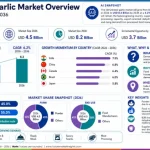
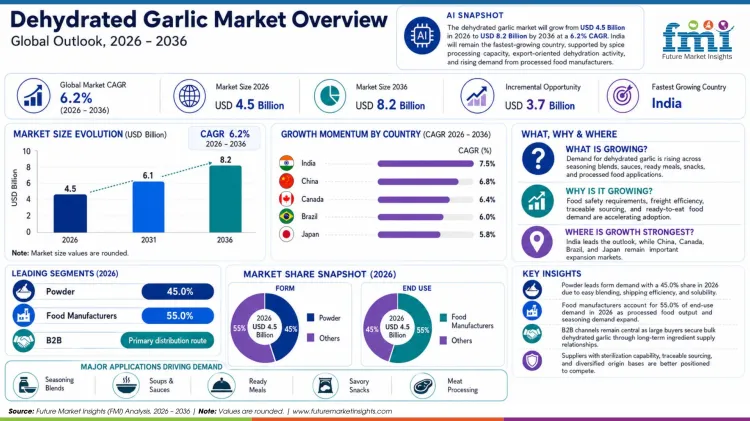
According to the latest market intelligence report published by Future Market Insights (FMI), the global dehydrated garlic market is estimated to reach USD 4.5 billion in 2026, up from USD 4.2 billion in 2025. The market is projected to expand to USD 8.2 billion by 2036, registering a compound annual growth rate (CAGR) of 6.20% during the 2026–2036 forecast period. The market is expected to generate an incremental revenue opportunity of approximately USD 3.7 billion over the assessment period.
Get Detailed Market Forecasts, Competitive Benchmarking & Industry Insights: Request a Sample Report: https://www.futuremarketinsights.com/reports/sample/rep-gb-8596
The expansion reflects increasing demand for shelf-stable garlic ingredients that provide consistent flavor, convenient storage, reduced transportation weight, and formulation flexibility. Dehydrated garlic is increasingly used by food manufacturers, seasoning companies, restaurants, and ingredient distributors seeking reliable alternatives to fresh garlic for large-scale food production.
Market Size & Growth Forecasts
The dehydrated garlic market is entering a sustained growth phase supported by expanding processed food production, rising demand for ready-to-eat meals, and increasing adoption of standardized seasoning ingredients. Manufacturers are focusing on advanced dehydration technologies, improved sterilization processes, traceable agricultural sourcing, and export-oriented processing capabilities to address evolving food industry requirements.
Powder is projected to account for 45.0% of the form segment in 2026, supported by its widespread use in seasoning blends, soup bases, sauces, marinades, and processed food formulations. Its high bulk density and convenient handling characteristics also make it attractive for industrial procurement.
From an end-use perspective, food manufacturers are anticipated to account for 55.0% of market demand in 2026. Increasing incorporation of garlic powder, granules, and flakes into packaged foods, savory snacks, ready meals, and processed meat products is strengthening demand from industrial ingredient buyers.
B2B distribution is expected to account for 60.0% of market demand in 2026, reflecting the importance of bulk procurement, long-term supply agreements, and direct sourcing relationships between dehydration processors and industrial food manufacturers.
The industry is also witnessing increasing investment in food safety technologies, pathogen control, organic pasteurization, and supply chain traceability. These developments are encouraging manufacturers to strengthen quality assurance and improve the reliability of international dehydrated garlic supplies.
Key Market Takeaways
- Market Valuation: The global dehydrated garlic market is projected to increase from USD 4.5 billion in 2026 to USD 8.2 billion by 2036.
- Growth Rate: The market is expected to register a 6.20% CAGR between 2026 and 2036.
- Incremental Opportunity: The market is forecast to generate approximately USD 3.7 billion in additional revenue during the assessment period.
- Leading Form Segment: Powder is anticipated to capture 45.0% of the form segment in 2026.
- Leading End Use: Food manufacturers are expected to account for 55.0% of market demand.
- Leading Distribution Channel: B2B distribution is projected to represent 60.0% of market demand in 2026.
- Fastest-Growing Country: India is projected to lead evaluated national markets with a 7.5% CAGR through 2036.
- Regional Growth Opportunities: China is forecast to expand at 6.8%, Canada at 6.4%, Brazil at 6.0%, Japan at 5.8%, and the United States at 5.2%.
- Key Growth Driver: Increasing demand for shelf-stable ingredients, processed foods, and standardized seasoning formulations is supporting market expansion.
- Emerging Industry Opportunity: Advanced dehydration, organic pasteurization, and traceable agricultural sourcing are creating additional opportunities for manufacturers.
Processed Food Innovation Strengthens Dehydrated Garlic Demand
The growing demand for convenient and shelf-stable food ingredients is emerging as a major growth catalyst for the global dehydrated garlic market. Food manufacturers are increasingly incorporating dehydrated garlic into processed food formulations to maintain consistent flavor, simplify ingredient handling, and improve supply chain efficiency.
Dehydrated garlic offers several functional advantages over fresh garlic. Its reduced moisture content supports longer storage periods, while powder, granules, and flakes provide flexibility across different industrial food applications.
The expansion of ready-to-eat meals is creating additional opportunities for dehydrated garlic suppliers. Manufacturers are incorporating garlic ingredients into instant soups, seasoning mixes, frozen meals, sauces, marinades, and convenience food products.
Savory snack manufacturers are also contributing to market development. Increasing demand for flavored chips, extruded snacks, crackers, and ready-to-eat savory products is strengthening the use of garlic powder in seasoning formulations.
Food safety requirements are further influencing procurement decisions. Large food manufacturers increasingly prioritize suppliers with reliable pathogen-control systems, traceable sourcing networks, and consistent product specifications.
The development of advanced dehydration and pasteurization technologies is supporting this transition. Improved processing methods help manufacturers maintain product quality while addressing microbiological safety requirements.
Powder and Food Manufacturing Applications Shape Product Demand
Powder is expected to maintain its leading position, accounting for 45.0% of the form segment in 2026. Its versatility, convenient handling, and suitability for industrial seasoning applications make it attractive for large-scale food manufacturers.
Garlic powder is widely incorporated into spice blends, soups, sauces, instant noodles, savory snacks, processed meat products, and ready meals. Its fine particle size and ease of blending support consistent flavor distribution across commercial food formulations.
Granules are gaining importance in applications requiring visible garlic particles and controlled flavor release. They are commonly used in seasoning blends, marinades, sauces, and foodservice preparations.
Dehydrated garlic flakes provide opportunities in specialty food applications, seasoning products, and premium ingredient formulations. Dehydrated cloves are also used by food processors and commercial kitchens requiring convenient garlic ingredients.
From an end-use perspective, food manufacturers are projected to account for 55.0% of market demand in 2026. Their large-scale procurement requirements and increasing use of standardized ingredients make them the primary demand contributors.
Foodservice operators represent another important customer category. Restaurants, catering companies, institutional kitchens, and commercial foodservice providers use dehydrated garlic to simplify food preparation and maintain consistent seasoning quality.
Retail applications are also creating opportunities through packaged garlic powder, flakes, and granules sold to household consumers.
B2B distribution is expected to account for 60.0% of market demand in 2026, reflecting the importance of bulk ingredient procurement and long-term sourcing relationships.
Food Safety, Traceability and Advanced Processing Create New Opportunities
Food safety and supply chain transparency are becoming increasingly important considerations for dehydrated garlic manufacturers. Food processors are demanding ingredients that meet stringent microbiological specifications, pesticide residue requirements, and international quality standards.
One important opportunity lies in advanced pasteurization technologies. Manufacturers are exploring processing solutions that reduce microbial contamination while preserving the natural flavor characteristics of dehydrated garlic.
In August 2024, Olam Food Ingredients (ofi) and Agri-Neo announced a partnership involving Neo-Pure organic pasteurization technology for dried onion and garlic ingredients. Such developments highlight the growing importance of food safety innovation across the dehydrated ingredients industry.
Traceable agricultural sourcing is another emerging opportunity. Food manufacturers increasingly require visibility into cultivation practices, supplier relationships, origin documentation, and sustainability performance.
Digital supply chain platforms are helping ingredient suppliers strengthen procurement transparency and demonstrate compliance with customer requirements.
The expansion of agricultural processing infrastructure in India, China, and Brazil is also creating opportunities for value-added dehydration facilities. Investments in improved drying technologies, storage infrastructure, and export capabilities can strengthen supply reliability.
Regional Growth Outlook: India, China and Canada Lead Expansion
The global dehydrated garlic market is experiencing varied growth patterns across major national markets, driven by agricultural production, food processing investments, international spice trade, and increasing demand for shelf-stable ingredients.
India is projected to register the fastest growth among evaluated countries, with a 7.5% CAGR through 2036. Its established garlic cultivation base, expanding spice processing infrastructure, and export-oriented dehydration industry are expected to support market development.
India’s position as an important global supplier of spices and dehydrated ingredients is creating opportunities for manufacturers investing in modern processing facilities. Increasing demand from international food manufacturers is also encouraging suppliers to strengthen quality control and export capabilities.
China is forecast to expand at a 6.8% CAGR during the assessment period. Its established garlic cultivation and dehydration infrastructure, large food processing industry, and growing domestic demand for processed food ingredients are supporting market development.
Canada is anticipated to register a 6.4% CAGR through 2036. Increasing agricultural diversification, investments in local garlic cultivation, and demand for value-added food ingredients are creating opportunities for dehydrated garlic producers.
Brazil is projected to grow at a 6.0% CAGR, supported by agricultural expansion, import substitution initiatives, and investments in domestic garlic production. The development of processing infrastructure is expected to strengthen the country’s position as an alternative sourcing destination.
Japan is expected to expand at a 5.8% CAGR through 2036. Demand from convenience food manufacturers, seasoning producers, and ready-meal processors is supporting the adoption of dehydrated garlic.
The United States dehydrated garlic market is forecast to grow at a 5.2% CAGR. Strong demand from processed food manufacturers, seasoning companies, and foodservice operators is creating opportunities for international suppliers.
Germany is projected to register a 4.8% CAGR, supported by demand from industrial food processing, seasoning manufacturers, and packaged food producers. Increasing emphasis on ingredient traceability and food safety is influencing supplier selection.
Download the Market Research Summary – Explore Exclusive Industry Insights: https://www.futuremarketinsights.com/reports/brochure/rep-gb-8596
Key Companies in the Dehydrated Garlic Market
The competitive landscape includes international agricultural ingredient processors, seasoning manufacturers, dehydrated vegetable suppliers, and specialized garlic processing companies.
Key companies covered in the Future Market Insights report and competitive analysis include:
- Olam Food Ingredients (ofi)
- Sensient Technologies
- McCormick & Company
- Garlic Industries
- Henan Sunny Foodstuff
Market participants are focusing on advanced dehydration technologies, agricultural sourcing partnerships, pathogen-control systems, product quality consistency, and stronger distribution relationships with industrial food manufacturers.
Olam Food Ingredients (ofi) operates across agricultural sourcing and food ingredient processing, supplying dehydrated vegetable and seasoning ingredients to international food manufacturers.
Sensient Technologies provides colors, flavors, and ingredient solutions for food and beverage manufacturers. Its flavor and seasoning capabilities are relevant to industrial applications involving dehydrated garlic.
McCormick & Company is a major participant in the global flavor and seasoning industry, with a broad portfolio of herbs, spices, seasonings, and flavor solutions serving retail and industrial customers.
Garlic Industries specializes in garlic-related products and processing, while Henan Sunny Foodstuff participates in the international supply of agricultural and processed food ingredients.
Supplier capabilities in agricultural sourcing, dehydration capacity, microbial safety, particle-size consistency, export documentation, and reliable bulk distribution are expected to remain important competitive factors.
Growth Opportunities and Industry Challenges
The expansion of processed food production and increasing demand for convenient seasoning ingredients are creating new opportunities for dehydrated garlic manufacturers.
One important opportunity lies in the growing use of garlic powder and granules in ready-to-eat meals, savory snacks, soups, sauces, and processed meat products. Manufacturers offering consistent flavor intensity, customized particle sizes, and reliable supply arrangements are positioned to address industrial procurement requirements.
Advanced dehydration technologies present another opportunity. Investments in air drying, improved moisture control, and processing automation can help manufacturers improve product quality and operational efficiency.
Organic pasteurization and advanced pathogen-control systems are also creating opportunities in premium food ingredient categories. Suppliers capable of providing microbiologically controlled ingredients with traceable sourcing are likely to strengthen their competitive positioning.
Emerging cultivation and processing locations in Latin America are providing additional sourcing opportunities. Brazil, Argentina, and other agricultural markets can help international buyers diversify procurement away from traditional Asian supply origins.
However, the industry faces challenges related to agricultural volatility, seasonal production, climate-related crop disruptions, and raw material price fluctuations.
Garlic cultivation is sensitive to weather conditions, soil characteristics, and agricultural input costs. Unpredictable weather can influence bulb size, yield, and raw material quality, affecting dehydration efficiency.
Supply shortages in major producing countries may increase procurement costs and create challenges for manufacturers operating under fixed-price contracts.
Food safety compliance also remains important. Differences in microbiological standards, pesticide residue requirements, and international import regulations can increase operating costs.
Manufacturers are therefore emphasizing diversified sourcing networks, long-term grower partnerships, improved storage infrastructure, advanced dehydration technologies, and flexible procurement strategies to manage supply chain risks.
Future Market Outlook
The global dehydrated garlic market is expected to benefit from the continued expansion of processed food manufacturing, increasing demand for convenient ingredients, and growing international trade in dehydrated vegetables and spices.
Rising adoption of garlic powder, granules, and flakes across savory snacks, soups, sauces, ready meals, and foodservice applications will support long-term market opportunities.
For agricultural processors, seasoning manufacturers, ingredient distributors, food manufacturers, and procurement teams, consistent raw material quality, traceable sourcing, advanced processing capabilities, and reliable supply arrangements will remain important factors in strengthening market positioning.
Future Market Insights expects the market to maintain a positive growth trajectory through 2036 as dehydrated garlic continues to serve as a versatile, shelf-stable ingredient across global food manufacturing and foodservice supply chains.
Explore the market outlook, forecast analysis and competitive landscape in the Full Report: https://www.futuremarketinsights.com/reports/dehydrated-garlic-market
About the Dehydrated Garlic Market Report
Future Market Insights’ Dehydrated Garlic Market Report provides comprehensive insights into market size, growth forecasts, segment performance, regional opportunities, competitive benchmarking, and industry developments for the 2026–2036 assessment period.
The report evaluates the market across product forms, including powder, granules, flakes, and cloves, alongside end-use applications such as food manufacturers, foodservice, retail, and cosmetics.
It also examines distribution channels, including B2B, B2C, and other channels, alongside major food applications such as savory snacks, soups and sauces, ready meals, and meat processing.
The assessment covers key regional markets across North America, Latin America, Europe, East Asia, South Asia, Oceania, and the Middle East and Africa.
The report provides strategic insights into agricultural sourcing, dehydration technologies, food safety requirements, competitive positioning, international trade, and emerging growth opportunities across the global dehydrated garlic industry.
Related Food & Beverage Industry Reports
Semillon Market https://www.futuremarketinsights.com/reports/semillon-market
Rolle Market https://www.futuremarketinsights.com/reports/rolle-market
Blend Market https://www.futuremarketinsights.com/reports/blend-market
Zeaxanthin Market https://www.futuremarketinsights.com/reports/zeaxanthin-market
About Future Market Insights (FMI)
Future Market Insights (FMI) is a market intelligence and consulting firm providing data-driven research, strategic insights, and industry analysis to support business decision-making. FMI delivers market forecasts, competitive intelligence, demand assessments, and growth opportunity analysis across global industries, helping businesses identify emerging trends and develop informed growth strategies.
Media Contact
For Press & Corporate Inquiries
Rahul Singh
AVP – Marketing and Growth Strategy
Phone: +91 8600020075
For Sales: sales@futuremarketinsights.com
For Media: Rahul.singh@futuremarketinsights.com
Website: https://www.futuremarketinsights.com