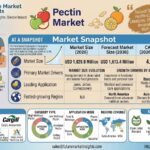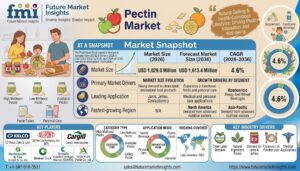


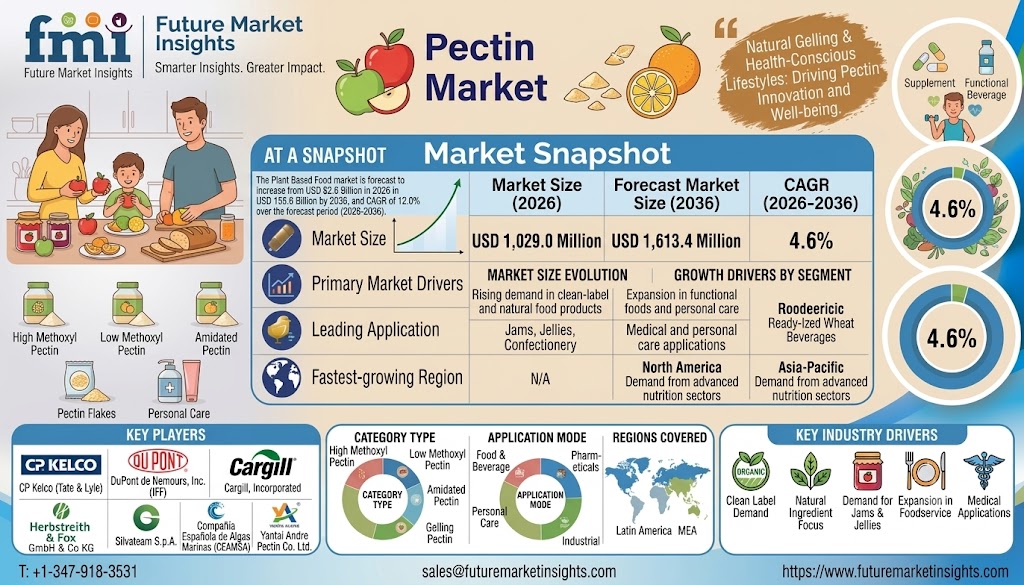
NEWARK, Del., September 25, 2026 — According to Future Market Insights (FMI), the Pectin Market is projected to grow from sales estimated at USD 1,029.0 million in 2026 to USD 1,613.4 million by 2036, expanding at a 4.6% CAGR. The market was valued at USD 983.7 million in 2025.
Pectin is widely used by food manufacturers to control gel strength, thickness, suspension, and texture stability across jams, dairy foods, beverages, confectionery, bakery fillings, and other food applications. Its performance depends on recipe conditions such as sugar, acidity, calcium, heat, and storage.
The market is increasingly influenced by recipe reformulation. Lower-sugar products can require specialized pectin grades because changes in sugar concentration affect gel formation and texture stability. Food manufacturers therefore evaluate pectin performance not only in laboratory trials but also during plant-scale production.
Demand remains concentrated in food and beverage applications, where pectin supports a broad range of everyday food formats. Fruit products, dairy foods, beverages, confectionery, and bakery fillings provide recurring applications for different pectin grades.
Suppliers must manage differences in fruit source, extraction processes, pectin chemistry, and gel behavior while providing consistent performance across production batches. Buyers also require detailed ingredient records and approval testing when formulations or pectin grades are changed.
Key Takeaways
- The market is estimated at USD 1,029.0 million in 2026 and is forecast to reach USD 1,613.4 million by 2036 at a 4.6% CAGR. The 2025 market base was USD 983.7 million.
- High Methoxyl (HM) Pectin accounts for 68.0% of Product Type demand in 2026, supported by its fit with acidic, high-solids recipes containing higher levels of sugar or dissolved solids.
- Food & Beverages account for 71.0% of Application demand in 2026, supported by widespread use across fruit products, dairy foods, beverages, confectionery, and bakery fillings.
- Lower-sugar foods are creating demand for specialized pectin grades, as reduced sugar levels can change gel formation and texture stability.
- Pectin performance can vary according to fruit source, extraction process, and chemical properties, requiring manufacturers to conduct additional testing when grades or production conditions change.
- Functional gummies represent another emerging application area as manufacturers develop formulations requiring controlled texture and stability.
- Key companies include CP Kelco (Tate & Lyle), DuPont de Nemours, Inc. (IFF), Cargill, Incorporated, Herbstreith & Fox GmbH & Co KG, Naturex (Givaudan), Silvateam S.p.A., Compañía Española de Algas Marinas (CEAMSA), and Yantai Andre Pectin Co. Ltd.
Analyst Perspective
Lower-sugar foods are opening a clear pectin opportunity because less sugar changes how a stable gel forms. Producers need plant-scale texture and heat-stability data so buyers can approve one grade across bakery, dairy, or fortified gummy lines.
— Nandini Roy Choudhury, Principal Consultant, Future Market Insights
Market Growth Outlook
The Pectin Market is positioned at the intersection of food texture management, clean-label formulation, and ingredient functionality. Growth through 2036 is supported by continued demand for pectin in fruit preparations, dairy products, beverages, confectionery, bakery fillings, and other food applications.
Pectin provides manufacturers with a versatile way to control gel strength, thickness, particle suspension, and texture stability. Its performance can be adjusted according to recipe conditions, including sugar concentration, acidity, calcium levels, processing temperature, and storage requirements.
The market is also being influenced by reformulation toward lower-sugar products. As sugar levels change, food manufacturers may need pectin grades designed to deliver stable texture under different formulation conditions.
High methoxyl pectin remains the leading product type because of its suitability for acidic, high-solids recipes. At the same time, specialized grades are gaining relevance as manufacturers develop new food formats and reformulate established products.
The broad food and beverage application base provides recurring demand. Fruit products, dairy foods, drinks, confectionery, bakery fillings, and functional gummies each create different technical requirements for pectin suppliers.
Key Market Drivers
- Rising demand for texture-control ingredients in food production
- Widespread use of pectin in jams and fruit preparations
- Increasing application in dairy foods and beverages
- Growing demand for lower-sugar food products
- Increasing development of specialized pectin grades
- Expansion of functional gummy applications
- Demand for stable texture during processing and storage
- Growing use in bakery fillings and confectionery
- Increasing focus on ingredient consistency and batch-to-batch performance
- Expansion of food production across international markets
Segment Insights
Which Product Type Leads the Pectin Market?
High Methoxyl (HM) Pectin leads the Product Type segment with a 68.0% share in 2026.
HM pectin is widely suited to acidic, high-solids recipes where sugar or dissolved solids play an important role in gel formation.
Food manufacturers use it across applications where controlled gel strength and stable texture are required. Recipe conditions still need to be evaluated carefully because changes in sugar, acid, heat, or storage can influence final product performance.
Which Application Leads the Market?
Food & Beverages account for 71.0% of Application demand in 2026.
The category benefits from pectin’s broad functionality across fruit products, dairy foods, beverages, confectionery, bakery fillings, and other processed food formats.
The recurring use of pectin in everyday food manufacturing supports consistent demand across different product categories.
Why Are Specialized Pectin Grades Gaining Attention?
Lower-sugar formulations are creating additional requirements for pectin performance.
Reducing sugar changes the conditions under which a stable gel forms. Manufacturers therefore need specialized grades that can deliver appropriate texture and stability under revised recipe conditions.
Plant-scale testing is particularly important because a pectin grade that performs effectively during laboratory trials may require further validation under commercial processing conditions.
Regional Outlook
Market development varies across major food-producing regions according to food regulations, manufacturing structures, export requirements, formulation practices, and ingredient approval processes.
United States represents an important market because of its large food-production base and extensive range of pectin applications. In March 2026, the U.S. Census Bureau reported USD 88.4 billion in U.S. food-product shipments for January 2026, highlighting the scale of the domestic food manufacturing environment.
US food manufacturers also need to evaluate pectin grades against federal definitions and product-specific formulation requirements before making changes to established recipes.
United Kingdom food manufacturers use E 440 pectin across applicable food formulations, while Germany has processors operating multiple recipes on shared production lines. These manufacturing environments increase the importance of ingredient consistency and controlled formulation changes.
Japan and South Korea place additional emphasis on detailed ingredient records as exporters ensure finished foods meet destination-market requirements. This can affect how manufacturers approve and document pectin grades for different applications.
Market Dynamics
Market Opportunities
The market presents opportunities for pectin manufacturers through specialized grades designed for lower-sugar formulations, functional foods, dairy products, beverages, bakery fillings, and confectionery.
Suppliers can also differentiate through technical support, plant-scale testing, and formulation guidance. Providing data on gel strength, heat stability, texture, and storage performance can help buyers qualify pectin grades more efficiently.
Functional gummies represent another opportunity as manufacturers seek ingredients capable of delivering controlled texture in fortified and functional confectionery formats.
The continued development of lower-sugar foods also creates opportunities for pectin suppliers that can address changing gel requirements without compromising product texture.
Market Challenges
Pectin manufacturers must manage variability in fruit sources, extraction processes, and pectin chemistry. These factors can affect gel behavior and create additional approval requirements for food manufacturers.
Changes in sugar, acidity, calcium, processing temperature, and storage conditions can also alter pectin performance. As a result, buyers may need to conduct additional testing before replacing an approved grade.
Export markets add further complexity because ingredient documentation and food regulations can differ across countries.
Emerging Market Trends
Major trends shaping the Pectin Market include:
- Growing demand for lower-sugar food formulations
- Increasing use of specialized pectin grades
- Continued dominance of high methoxyl pectin
- Expansion of pectin use in functional gummies
- Rising demand for clean-label and plant-derived ingredients
- Increasing application in dairy foods and beverages
- Greater use in bakery fillings and confectionery
- Growing emphasis on plant-scale texture validation
- Increasing focus on heat and storage stability
- Greater importance of batch-to-batch ingredient consistency
Competitive Landscape
Competition in the Pectin Market is influenced by product consistency, technical performance, grade specialization, sourcing capabilities, formulation support, and global distribution.
Key companies include CP Kelco (Tate & Lyle), DuPont de Nemours, Inc. (IFF), Cargill, Incorporated, Herbstreith & Fox GmbH & Co KG, Naturex (Givaudan), Silvateam S.p.A., Compañía Española de Algas Marinas (CEAMSA), and Yantai Andre Pectin Co. Ltd.
Companies are focusing on specialized pectin grades, formulation support, and improved product consistency to address changing requirements across food and beverage applications.
Suppliers are also responding to demand for lower-sugar formulations by developing solutions that maintain appropriate gel strength and texture under altered recipe conditions.
Frequently Asked Questions
What is the projected size of the Pectin Market by 2036?
The global Pectin Market is forecast to reach USD 1,613.4 million by 2036, increasing from USD 1,029.0 million in 2026.
What is the expected CAGR of the Pectin Market?
The market is projected to expand at a 4.6% CAGR between 2026 and 2036.
What was the market size in 2025?
The Pectin Market was valued at approximately USD 983.7 million in 2025.
What is the market size in 2026?
The market is estimated at USD 1,029.0 million in 2026.
Which product type dominates the market?
High Methoxyl (HM) Pectin leads the Product Type segment, accounting for 68.0% of demand in 2026.
Which application holds the largest share?
Food & Beverages account for 71.0% of Application demand in 2026.
Why is demand for specialized pectin grades increasing?
Lower-sugar formulations can change the conditions required for stable gel formation. Food manufacturers therefore require pectin grades capable of maintaining suitable texture and stability under different recipe conditions.
Which food applications use pectin?
Pectin is used across fruit products, dairy foods, beverages, confectionery, bakery fillings, jams, and functional gummies, among other food formats.
Who are the key companies in the market?
Key companies include CP Kelco (Tate & Lyle), DuPont de Nemours, Inc. (IFF), Cargill, Incorporated, Herbstreith & Fox GmbH & Co KG, Naturex (Givaudan), Silvateam S.p.A., CEAMSA, and Yantai Andre Pectin Co. Ltd.
Explore More Research Reports by FMI
Food Additives Market — Future Market Insights
Clean-label Pectin Market — Future Market Insights
Gummy Market — Future Market Insights
About Future Market Insights (FMI)
Future Market Insights, Inc. (ESOMAR certified and a recipient of the Stevie® Award) provides actionable market intelligence and consulting services across food & beverage, pharmaceuticals, chemicals, advanced materials, industrial manufacturing, sustainability, and consumer goods industries.
FMI delivers comprehensive market research, competitive intelligence, and strategic insights that help organizations identify emerging opportunities, evaluate market dynamics, and make informed business decisions across global markets.
For Press & Corporate Inquiries
Rahul Singh
AVP – Marketing and Growth Strategy
Future Market Insights, Inc.
+91 8600020075
For Sales: sales@futuremarketinsights.com
For Media: Rahul.singh@futuremarketinsights.com
For Web: https://www.futuremarketinsights.com/