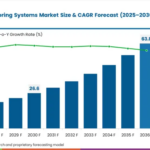


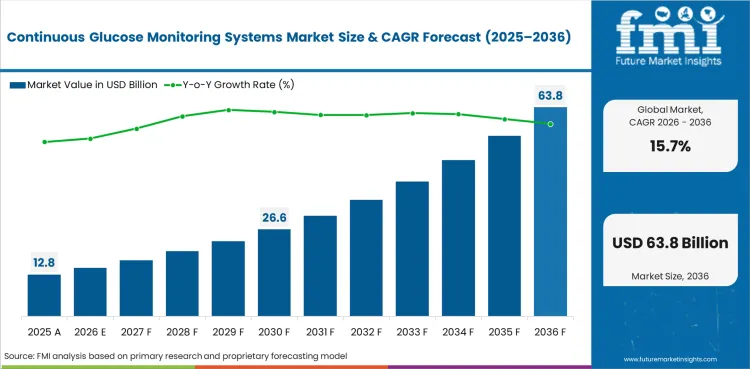
NEWARK, Del. — According to Future Market Insights (FMI), the global continuous glucose monitoring systems market is expected to reach USD 14.84 billion in 2026 and is projected to reach USD 63.81 billion by 2036, expanding at a 15.7% CAGR during the 2026–2036 forecast period. The market is being supported by rising diabetes prevalence, expanding reimbursement coverage, sensor technology improvements, and greater integration of CGM systems with automated insulin delivery and digital health platforms. FMI estimates that global diabetes prevalence will exceed 700 million people by 2045, expanding the addressable population for continuous glucose monitoring.
CGM adoption is also expanding beyond established use among type 1 diabetes patients. The report identifies type 2 diabetes as a major growth opportunity as clinical evidence, payer coverage, smaller sensors, longer wear periods, and factory calibration reduce barriers associated with conventional glucose monitoring. Current-generation sensors can provide readings every one to five minutes over wear periods of 10 to 15 days.
Get Detailed Market Forecasts, Competitive Benchmarking, and Pricing Trends
Global Segment Leaders
- Sensors and Insulin Pump — 73.0% share: This category leads the components segment in 2026, supported by recurring sensor replacement cycles of 7 to 15 days and increasing integration with automated insulin delivery systems.
- Home Care Diagnostics — 61.3% share: Home care diagnostics leads the end-use sector as CGM increasingly supports patient self-management and remote glucose monitoring outside conventional clinical settings.
- Diabetes Management: Diabetes management remains the dominant application, supported by clinical evidence around glycemic control and reduction of hypoglycemic events.
FMI segments the market across components, end-use sector, application, and technology. Technology categories include sensor technology, connectivity technology, data analytics technology, and integration technology, with subcategories such as electrochemical sensing, optical sensing, Bluetooth-enabled systems, cloud-connected systems, predictive analytics, real-time alerts, closed-loop insulin delivery, and digital health platform integration.
Country-Level Performance
| Country | CAGR | Key Growth Driver |
| China | 17.8% | A large diabetic population, expanding healthcare coverage, and domestic CGM manufacturing are supporting adoption. Medtrum Technologies is cited by FMI as an example of domestic CGM manufacturing capability. |
| India | 17.2% | High diabetes prevalence, growing physician and patient awareness, and increasing availability of lower-cost CGM platforms are expanding adoption. |
| USA | 11.9% | Medicare and commercial insurance coverage expansion, type 2 diabetes adoption, and integration with automated insulin delivery systems are supporting growth. |
| Germany | 9.3% | Established reimbursement frameworks, strong diabetes-care infrastructure, and integration of CGM into national diabetes management pathways support adoption. |
| Japan | 8.1% | An aging population, increasing diabetes prevalence, and reimbursement support for CGM among insulin-treated patients are supporting market development. |
China and India are the two fastest-growing profiled markets, while the USA maintains a double-digit CAGR. Germany and Japan show comparatively slower growth within the five-country forecast as established reimbursement and clinical adoption provide a more mature market base.
Regional Context
East Asia represents an important growth center, led by China at a 17.8% CAGR and supported by diabetes prevalence, healthcare coverage expansion, and domestic CGM manufacturing. Japan is projected to grow at 8.1%, with aging demographics, diabetes prevalence, and reimbursement for insulin-treated patients shaping demand.
South Asia and Pacific, represented by India in the detailed country analysis, is projected to expand rapidly at 17.2%. FMI links India’s growth to its large diabetic population, greater awareness of continuous monitoring, adoption in urban tertiary-care settings, and availability of lower-cost platforms.
North America, represented by the USA, is projected to grow at 11.9%. Medicare and commercial coverage expansion, type 2 diabetes adoption, and integration with automated insulin delivery are identified as key factors supporting demand.
Europe, represented by Germany in the detailed country forecast, is projected to expand at 9.3%. Established reimbursement and clinical diabetes-care infrastructure provide a foundation for continued CGM use.
FMI’s full assessment covers North America, Latin America, Europe, East Asia, South Asia and Pacific, and the Middle East and Africa, with country analysis covering China, India, USA, Germany, Japan, and more than 30 countries overall.
Drivers, Restraints and Opportunities
Rising diabetes prevalence is a structural demand driver. The report identifies particularly strong growth in the addressable patient population across South Asia, East Asia, and the Middle East. Expansion of CGM recommendations to insulin-treated and selected non-insulin-treated type 2 diabetes patients further broadens the potential user base.
Sensor costs and reimbursement gaps remain adoption constraints. Recurring sensor expenses can limit access in price-sensitive markets, while coverage gaps remain for certain type 2 diabetes and pre-diabetic populations. In emerging markets, FMI notes that limited reimbursement can leave CGM concentrated among self-pay patients.
Closed-loop insulin delivery and digital health integration create additional opportunities. CGM data can feed automated insulin-delivery algorithms, smartphone applications, telehealth platforms, and clinical decision-support systems. These integrations expand the role of CGM beyond glucose measurement toward broader diabetes-management workflows.
Competitive Landscape
The competitive landscape includes Abbott Laboratories, Dexcom Inc., Medtronic plc, Senseonics Holdings Inc., GlySens Incorporated, Ascensia Diabetes Care, Biolinq Inc., and Medtrum Technologies Inc.
Abbott’s FreeStyle Libre platform has broad unit-volume penetration, with factory calibration and pricing supporting adoption among type 2 diabetes patients. Dexcom competes through real-time CGM platforms and integration with multiple insulin-pump systems. Medtronic combines Guardian CGM technology with its MiniMed insulin-pump ecosystem for automated insulin delivery.
Senseonics and Ascensia maintain positions through specialized capabilities and regional service networks, while GlySens, Biolinq, and Medtrum Technologies are developing focused product strategies. FMI identifies regulatory approval requirements, clinical evidence requirements, payer coverage agreements, and endocrinologist recommendations as important entry considerations.
Analyst Perspective
“Continuous glucose monitoring is expanding from specialist diabetes management into broader chronic-care and digital-health workflows. The next phase of adoption will depend on reducing recurring sensor costs while maintaining accuracy, extending wear duration, and integrating glucose data with automated therapy and remote monitoring platforms. Coverage expansion will remain important as manufacturers seek to reach the larger type 2 diabetes population.”
— Anurag Sharma, Principal Analyst, Future Market Insights
About Future Market Insights
Future Market Insights (FMI) is a leading provider of market research and consulting services, offering syndicated and customized research across industries including healthcare, medical devices, and digital health.
Related Reports:
- The global continuous glucose monitoring device market is estimated to be valued at USD 12,690.7 million in 2025 and is projected to reach USD 54,553.1 million by 2035, registering a CAGR of 15.7% over the forecast period.
- The glucose monitoring device market is expected to expand from USD 17.9 billion in 2026 to USD 49.3 billion by 2036. The market is anticipated to register a 10.6% CAGR during the forecast period.
- The Continuous Cardiac Monitoring Devices Market is projected to reach USD 19.2 billion by 2035, registering a compound annual growth rate (CAGR) of 8.1% over the forecast period.
About Future Market Insights (FMI)
Future Market Insights (FMI) is a global market intelligence and consulting firm providing comprehensive market research, competitive intelligence, and strategic business insights across industries. The firm delivers detailed forecasts, technology analysis, and data-driven recommendations that support informed decision-making for manufacturers, investors, distributors, and policymakers worldwide.
For Press & Corporate Inquiries
Rahul Singh
AVP – Marketing and Growth Strategy
Future Market Insights, Inc.
+91 8600020075
For Sales – sales@futuremarketinsights.com
For Media – Rahul.singh@futuremarketinsights.com
For Web – https://www.futuremarketinsights.com