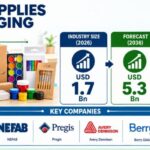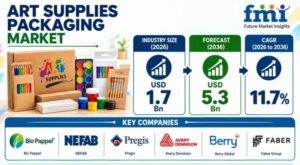


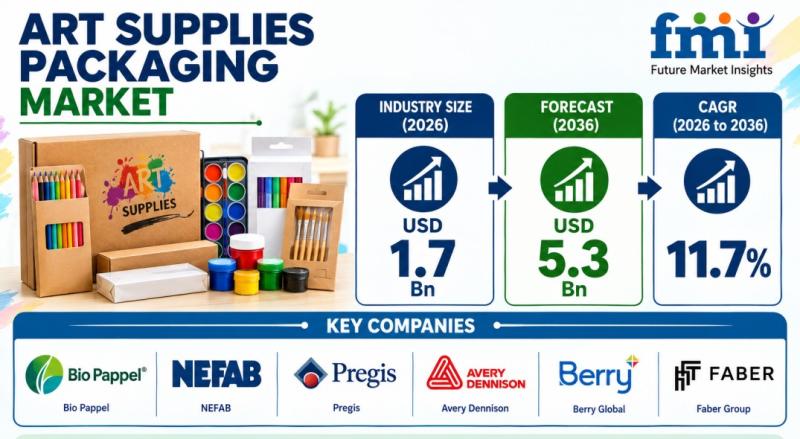
The global art supplies packaging market is projected to reach USD 5.3 billion by 2036, up from USD 1.7 billion in 2026, expanding at a 11.7% CAGR between 2026 and 2036, according to Future Market Insights (FMI).
The market is being influenced by growing consumer awareness of sustainable practices, increased demand for environmentally friendly art materials, and regulatory changes affecting packaging design. The EU Packaging and Packaging Waste Regulation (PPWR), adopted in December 2024, requires packaging to be economically recyclable by 2030, creating additional pressure for brands and packaging manufacturers to redesign existing formats.
California’s SB 54 is also increasing the focus on producer responsibility and recyclable packaging structures. These developments are encouraging manufacturers to reconsider mixed-material packaging and explore paperboard, molded fiber, cellulose-based clear films, and other material configurations.
👉 Get Detailed Market Forecasts, Competitive Benchmarking, and Pricing Trends: https://www.futuremarketinsights.com/reports/sample/rep-gb-31834
Paperboard Accounts for 44% of the Material Segment
Paperboard is projected to hold a 44% share of the art supplies packaging market. Its position reflects the industry’s effort to reduce plastic use in secondary packaging while maintaining retail presentation and product protection.
The transition is particularly relevant for products such as sketchpads, acrylic paper, canvas sets, and other creative materials where packaging needs to balance structural performance with sustainability objectives.
Window cartons remain an important pack type, projected to account for 34% of the market. However, traditional plastic windows face increasing pressure from retailers and recycling requirements.
Packaging suppliers are therefore exploring cellulose-based clear films, open-window structures, and die-cut windows that allow consumers to view products while reducing reliance on conventional plastic components.
Paints and Liquids Lead Product Demand
The paints and liquids category accounts for 38% of the market. These products require packaging capable of providing leak protection, chemical resistance, and product integrity during transportation and handling.
Flexible spouted pouches and high-barrier tubes are among the formats being considered for liquid art materials. Their lightweight construction can also support logistics efficiency compared with heavier rigid packaging formats.
For packaging manufacturers, this creates a need to balance material reduction with sealing performance, barrier protection, and usability.
Regulatory Compliance Is Becoming a Packaging Requirement
The market is increasingly shaped by regulatory compliance across major regions.
In China, enforcement of GB 4806.15-2024 is driving closer attention to adhesives used in children’s art kits. The regulation is encouraging manufacturers to move away from solvent-based adhesives toward compliant alternatives.
In Europe, PPWR is accelerating the focus on recyclability. In North America, California’s SB 54 is increasing producer responsibility requirements.
These developments are making material selection, adhesive systems, recyclability, and packaging construction increasingly important during product development and procurement.
China and Mexico Show Strong Growth
China is projected to register a 13.6% CAGR between 2026 and 2036. Its growth is supported by industrial production capacity, changing safety requirements, and increasing demand for compliant packaging.
Mexico is projected to grow at a 12.2% CAGR, supported by nearshoring activity and circular-economy requirements.
The USA is expected to register a 10.8% CAGR, while Germany is projected to grow at 10.4%. Japan is estimated to expand at 9.0%, with premium presentation and plastic reduction influencing packaging development.
Competition Moves Toward Fiber, Compliance and Premium Presentation
Competition is increasingly centered on material innovation, regulatory readiness, and packaging presentation.
Companies such as Bio Pappel, NEFAB, Pregis, Avery Dennison, Berry Global, Faber Group, Smurfit Westrock, Mondi Group, Sonoco Products Company, Huhtamaki, DS Smith, and Graphic Packaging International are among the companies profiled in the market.
Fiber-based packaging is gaining attention for applications where manufacturers need to reduce plastic while maintaining protection. At the premium end of the market, packaging design is also being used to combine sustainable materials with the presentation expected from professional artist products.
Recent developments across the art supplies industry further demonstrate this direction. Winsor & Newton introduced a premium watercolor product featuring sustainably sourced pigments and eco-friendly packaging in February 2025. Crayola partnered with Scholastic in March 2025 to provide standardized art kits and educational content for K-12 schools. In June 2025, Crayola launched its “Creative Acts of Color” campaign around its 64-count crayon box.
Market Outlook
The art supplies packaging market is moving toward packaging structures that combine product protection, retail visibility, regulatory compliance, and material efficiency.
As packaging regulations become more demanding, suppliers and art brands are increasingly required to evaluate recyclability and material composition alongside cost, functionality, and presentation.
>> Access detailed market insights: https://www.futuremarketinsights.com/reports/brochure/rep-gb-31834
Art Supplies Packaging Market — Key Metrics
- Market Size (2026): USD 1.7 billion
- Forecast Value (2036): USD 5.3 billion
- CAGR (2026–2036): 11.7%
- Leading Material: Paperboard — 44%
- Leading Product Category: Paints & Liquids — 38%
- Leading Pack Type: Window Cartons — 34%
Report Scope
The FMI report covers product categories including paints and liquids, dry media, tools and accessories, and canvases and surfaces. Pack types include window cartons, blister cards and clamshells, flexible pouches and sachets, tubes, and rigid boxes and tins. Materials covered include paperboard and corrugated, PET and rigid plastics, flexible plastics, metal, and molded fiber.
The study covers North America, Europe, Asia Pacific, Latin America, and the Middle East & Africa, including the United States, Germany, China, Japan, Mexico, and more than 35 additional countries.