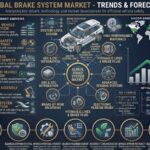


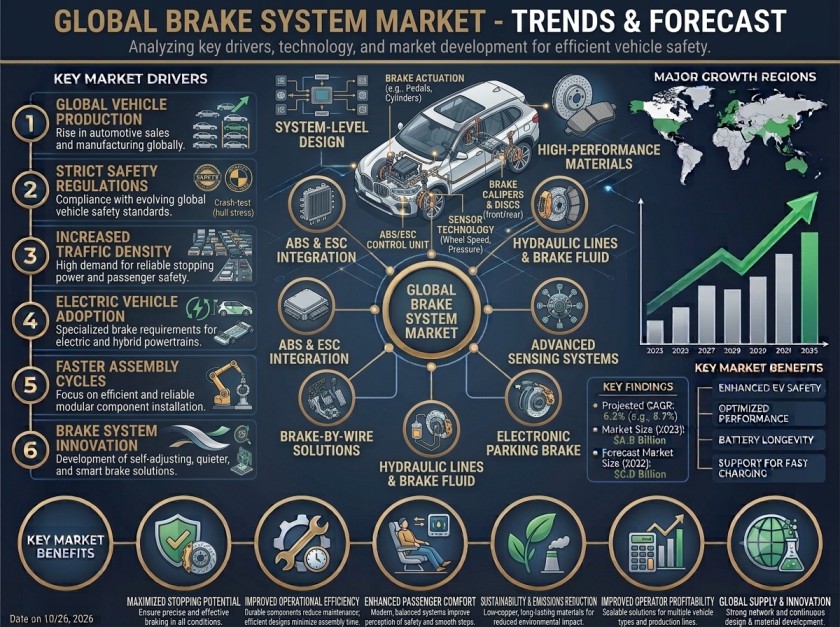
The global brake system market was valued at USD 26.2 billion in 2025 (with base market valuation reaching USD 27.54 billion) and is set to reach USD 27.5 billion by the end of 2026. Expanding at a Compound Annual Growth Rate (CAGR) of 5.1% between 2026 and 2036, total market valuation is projected to achieve USD 45.3 billion (USD 45.28 billion) by 2036. According to comprehensive market intelligence from Future Market Insights (FMI), the sector will generate an absolute incremental opportunity of USD 22.71 billion over the ten-year forecast period. As regulatory compliance requirements tighten, vehicle safety standards elevate, and industrial transport networks modernize globally, brake system procurement is evolving from a commodity supply category into a highly structured, performance-certified procurement framework.
Get detailed market forecasts, competitive benchmarking, and pricing trends:
https://www.futuremarketinsights.com/reports/sample/rep-gb-18941
Key Market Highlights at a Glance
• 2025 Baseline Market Size: USD 26.2 billion (USD 27.54 billion valuation)
• 2026 Estimated Market Size: USD 27.5 billion
• 2036 Forecasted Market Size: USD 45.3 billion (USD 45.28 billion)
• Ten-Year Compound Annual Growth Rate (CAGR 2026-2036): 5.1%
• Absolute Incremental Opportunity: USD 22.71 billion
• Leading Product Type Segment (2026): Disc Brakes, holding a 71.4% market share
• Leading End-Use Segment (2026): Automotive, commanding a 61.3% market share
• Leading Distribution Channel Segment (2026): Original Equipment Manufacturers (OEMs), accounting for 67.5% market share
• Fastest-Growing Country Market: South Korea, leading with a 7.0% CAGR
• Second Fastest-Growing Country Market: Japan, expanding at a 6.9% CAGR
• Report Scope & Coverage: 300+ pages of detailed quantitative analysis across product types, end-use applications, distribution channels, and 30+ regional markets.
Why Is the Brake System Market Growing?
Demand across the global brake system market is accelerating due to three primary growth drivers shaping industrial and commercial vehicle procurement:
• Tightening Quality Standards and Regulatory Compliance: Regulated industries are enforcing stricter stopping-distance mandates and safety certifications, driving vehicle manufacturers toward standardized, tested braking assemblies.
• Industrial and Infrastructure Development in Emerging Markets: Expanding regional infrastructure and industrial logistics hubs are increasing demand for heavy-duty commercial fleets, construction machinery, and specialized transport equipment.
• Shift Toward Established Suppliers and Cost Optimization: Fleet operators and vehicle producers are consolidating vendor contracts toward established manufacturers capable of delivering consistent performance, long service life, and competitive pricing.
“The brake system market is evolving as demand patterns shift across established and emerging application categories,” stated Nikhil Kaitwade, Principal Consultant at Future Market Insights. “Companies that can deliver consistent quality at competitive pricing while expanding geographic reach are likely to gain traction during the forecast period. Growth in South Korea reflects expanding industrial and commercial demand.”
Brake System Market Segmentation Analysis
Which Product Type Segment Leads Market Share?
Disc Brakes represent the dominant product type, projected to account for a 71.4% market share in 2026. Disc brake architectures lead global demand due to superior heat dissipation, consistent stopping power under high thermal loads, and direct compatibility with advanced vehicle safety systems. Secondary product types-including Drum Brakes, Hydrostatic Brakes, Hydraulic Wet Brakes, as well as Regenerative and Dynamic Braking systems-fulfill specialized niche roles across heavy industrial machinery, off-highway vehicles, and electrified transport platforms.
• Disc Brakes: Projected to account for 71.4% of the product type market share in 2026, driven by core automotive and commercial vehicle adoption.
• Drum, Hydrostatic, Hydraulic Wet, & Regenerative Brakes: Comprise the remaining 28.6% combined share, catering to specialized off-highway equipment, agricultural machinery, and industrial trucks.
Which End-Use Sector Commands Highest Demand?
The Automotive sector represents the primary end-use segment, capturing a 61.3% market share in 2026. High vehicle assembly volumes, coupled with expanding consumer and commercial transport fleets, ensure sustained procurement of high-performance brake assemblies. Other end-use sectors-including Construction Equipment, Agricultural Equipment, Industrial Trucks, and Mining Equipment-account for the remaining market share, supported by global infrastructure construction and raw material extraction activities.
• Automotive End-Use: Projected to hold a 61.3% market share in 2026, supported by high-volume light vehicle and commercial truck production.
• Construction, Agriculture, Mining, & Industrial Trucks: Account for the remaining 38.7% share, driven by heavy machinery fleet upgrades and industrial automation.
Which Distribution Channel Holds the Largest Market Share?
Original Equipment Manufacturers (OEMs) dominate distribution, expected to capture 67.5% of the market share in 2026. Factory-installed brake systems ensure compliance with structural vehicle specifications and warranty mandates. The Aftermarket channel represents the remaining market share, driven by routine component replacement, fleet maintenance contracts, and vehicle repair spending.
• Original Equipment Manufacturers (OEMs): Projected to account for 67.5% of total market distribution in 2026.
• Aftermarket Channel: Represents the remaining 32.5% market share, supported by wear-and-tear replacement parts and maintenance servicing.
Speak to Analyst: Customize insights for your business strategy:
https://www.futuremarketinsights.com/customization-available/rep-gb-18941
Market Dynamics: Drivers, Restraints, and Trends
Key Market Drivers
Primary growth drivers include the global expansion of automotive assembly plants, mandatory integration of anti-lock braking and electronic stability control systems, and rising infrastructure investments across emerging economies. Stricter vehicle safety testing and fleet compliance standards further sustain steady procurement.
Key Market Restraints
Raw material price volatility in specialized steel, friction compounds, and aluminum alloys creates margin pressure for tier-1 suppliers. Additionally, complex qualification timelines required by automotive OEMs can delay new product introduction cycles.
Key Market Trends
Automotive decision-makers are increasingly favoring integrated braking solutions that reduce weight, enhance acoustic damping, and support long service intervals. Furthermore, manufacturers are establishing localized production capacity near major assembly hubs to fortify supply chain resilience.
Regional Outlook: Asian Markets Lead Global Expansion
• South Korea: Projected CAGR of 7.0% (2026-2036)
• Japan: Projected CAGR of 6.9% (2026-2036)
• United Kingdom: Projected CAGR of 6.6% (2026-2036)
• China: Projected CAGR of 5.9% (2026-2036)
• United States: Projected CAGR of 5.7% (2026-2036)
South Korea Market Growth
South Korea leads global expansion with a 7.0% CAGR. Growth is driven by aggressive manufacturing modernization, heavy capital investments in industrial vehicle production, and expanding commercial vehicle export capabilities.
Japan Market Growth
Japan expands at a 6.9% CAGR, supported by strict vehicle safety compliance mandates, continuous technological refinement in friction materials, and infrastructure renewal projects.
United Kingdom, China, and United States Market Growth
The United Kingdom grows at a 6.6% CAGR, driven by specialized commercial fleet upgrades and vehicle safety compliance. China records a 5.9% CAGR, underpinned by its massive industrial vehicle manufacturing base and expanding domestic transport infrastructure. The United States expands at a 5.7% CAGR, sustained by strong commercial freight activity and aftermarket maintenance spending.
Latest Automotive Industry Analysis Reports:
https://www.futuremarketinsights.com/industry-analysis/automotive
Competitive Landscape
The global brake system market is characterized by a mix of established tier-1 automotive suppliers and specialized industrial component manufacturers. Companies with global manufacturing footprints, extensive distribution reach, and robust safety certifications maintain strong competitive positions. Key market participants include:
• Robert Bosch GmbH: Global market leader offering integrated braking systems, electronic safety controls, and extensive OEM supply networks.
• KNORR-BREMSE AG: Premier specialist in heavy commercial vehicle braking systems and rail safety hardware.
• Continental AG: Major tier-1 developer of advanced braking components, vehicle sensors, and digital chassis systems.
• Brembo S.p.A.: Leading designer of high-performance disc braking systems and premium aluminum calipers.
• ZF Friedrichshafen AG: Global automotive technology provider specializing in integrated chassis and safety braking hardware.
• Aisin Corporation: Renowned manufacturer of original equipment powertrain and braking assemblies.
• Nissin Kogyo Co., Ltd.: Specialized producer of lightweight hydraulic braking components and motorcycle brake systems.
Market dynamics center on strategic supplier partnerships, localized component production, and continuous cost optimization to secure long-term OEM manufacturing contracts.