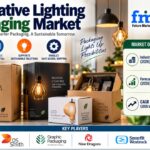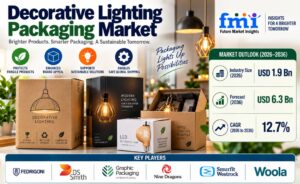


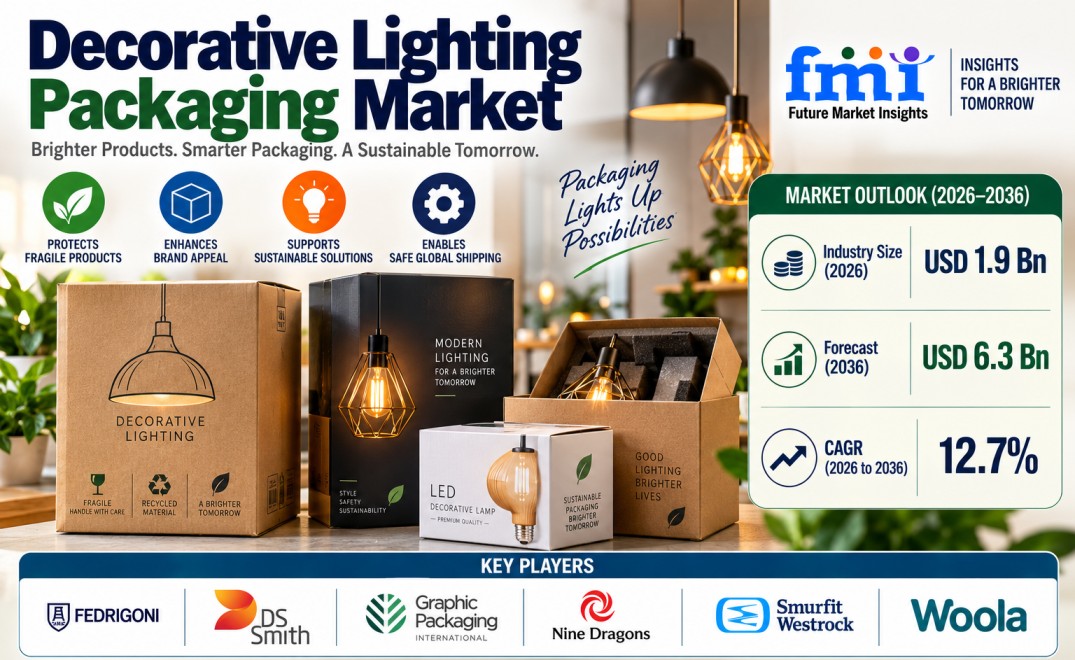
The global decorative lighting packaging market is entering a period of strong expansion as lighting manufacturers, retailers, and e-commerce companies increasingly prioritize product protection, packaging efficiency, and sustainable materials. According to Future Market Insights (FMI), the decorative lighting packaging market is valued at USD 1.9 billion in 2026 and is projected to reach USD 6.3 billion by 2036, expanding at a CAGR of 12.7% during the forecast period.
The rapid expansion of e-commerce for fragile lighting products is creating substantial demand for engineered packaging capable of protecting chandeliers, pendant lights, table lamps, wall sconces, and other decorative fixtures during transportation. At the same time, lighting manufacturers are facing growing pressure to reduce plastic content, eliminate unnecessary packaging space, and improve recyclability.
Packaging suppliers are responding by developing customized corrugated boxes, rigid cartons, molded pulp inserts, paper honeycomb structures, and emerging bio-based cushioning materials. The market is therefore shifting from conventional protective packaging toward engineered systems that combine structural performance, presentation, sustainability, and efficient logistics.
👉 Get Detailed Market Forecasts, Competitive Benchmarking, and Pricing Trends: https://www.futuremarketinsights.com/reports/sample/rep-gb-31885
Featured Snippet: Key Market Answer
Q: What is driving the growth of the decorative lighting packaging market?
A: Market growth is being driven by expanding e-commerce sales of fragile lighting products, increasing demand for protective packaging, growth in residential renovation and home décor, stricter packaging sustainability requirements, rising adoption of recycled fiber and molded pulp, and growing demand for premium packaging for high-value lighting products.
Quick Stats for Decorative Lighting Packaging Market
Industry Size (2026): USD 1.9 Billion
Forecast Value (2036): USD 6.3 Billion
CAGR (2026–2036): 12.7%
Leading Lighting Category: Indoor Décor – 44%
Leading Presentation Style: Premium Rigid Boxes – 38%
Leading Substrate: Specialty Board – 42%
Key Growth Markets: China, USA, Italy, Japa
Fastest Emerging Trend: Bio-based cushioning and right-sized packaging
Major Growth Driver: E-commerce-driven demand for fragile product protection
Market Overview: Protective Packaging Becomes Critical for Decorative Lighting
Decorative lighting products require specialized packaging because many fixtures contain fragile glass, ceramic, metal, electrical, and intricate structural components.
Unlike conventional consumer goods, chandeliers, pendants, table lamps, and decorative fixtures can feature irregular shapes and delicate protruding components. This makes standard packaging formats less effective and increases the need for customized internal cushioning and engineered structural protection.
The growth of online lighting sales is further increasing packaging requirements. Products transported through multiple logistics stages face greater exposure to vibration, compression, drops, and handling damage.
Packaging manufacturers are consequently developing solutions that combine rigid outer structures with molded fiber, paper inserts, corrugated dividers, honeycomb systems, and other cushioning technologies.
Sustainability is simultaneously reshaping packaging specifications. Lighting brands are increasingly looking for alternatives to expanded polystyrene and other plastic-based protective materials.
Key Growth Drivers
Expansion of E-commerce for Fragile Lighting Products
The rapid expansion of e-commerce has become one of the most important drivers of decorative lighting packaging demand.
Online lighting purchases require packaging capable of protecting products throughout fulfillment, warehousing, last-mile delivery, and returns.
Chandeliers, pendant lights, table lamps, and other fragile fixtures often require customized inserts that prevent movement within the shipping container.
This is encouraging lighting manufacturers to invest in stronger corrugated master cartons, molded pulp components, and engineered paper cushioning.
Growing Demand for Home Décor and Decorative Lighting
Decorative lighting is increasingly being used as a design element rather than simply a functional source of illumination.
Consumers and interior designers are investing in pendant lights, chandeliers, wall sconces, table lamps, and other decorative fixtures to enhance residential and commercial interiors.
Higher product turnover creates recurring demand for retail-ready and transport packaging.
Increasing Focus on Product Protection
Breakage and damage during transportation can significantly increase costs for lighting manufacturers and retailers.
Packaging suppliers are therefore developing customized systems that secure products while minimizing movement and impact exposure.
Protective inserts, die-cut corrugated structures, molded pulp components, and engineered cushioning are becoming increasingly important.
Sustainability and Plastic Reduction
Environmental concerns are accelerating the shift away from plastic-based cushioning.
Brands are exploring recycled paperboard, corrugated kraft, molded pulp, mycelium, wool, and other bio-based materials.
The transition allows manufacturers to address sustainability targets while maintaining the protective performance required for fragile products.
Segment Insights
Segment Leadership: Indoor Décor (44%)
Indoor Décor is expected to account for 44% of the lighting category segment.
The segment includes table lamps, pendant lights, chandeliers, sconces, and other fixtures designed primarily for residential and interior applications.
Frequent renovation cycles and changing interior design preferences support consistent demand for decorative lighting products.
The packaging used for these products must combine protection with strong visual presentation, particularly for premium retail products.
Presentation Style Analysis
Premium Rigid Boxes Account for 38%
Premium rigid boxes are projected to hold a 38% share of the presentation style segment.
High-end lighting brands increasingly view packaging as part of the overall product experience.
Rigid boxes offer:
High structural strength
Premium appearance
Better product presentation
Enhanced printing capabilities
Embossing and finishing opportunities
Improved protection for high-value product
The format is particularly suitable for premium chandeliers, designer lamps, boutique lighting, and luxury decorative fixtures.
Substrate Analysis
Specialty Board Leads with 42%
Specialty board is expected to account for 42% of the substrate segment.
Its combination of rigidity, printability, surface quality, and structural performance makes it suitable for premium decorative lighting packaging.
Specialty board also allows manufacturers to create high-quality packaging without depending entirely on plastic-based materials.
Recycled board and other fiber-based alternatives are increasingly being incorporated into packaging designs to support sustainability objectives.
Why Is Packaging Consolidation Fueling Sustainability?
The growing complexity of sustainable packaging development is encouraging consolidation among major packaging companies.
Large packaging groups can invest more heavily in material research, production capacity, automation, and global distribution networks.
Recent consolidation across the packaging sector is also creating larger platforms capable of supporting international lighting brands with standardized packaging solutions.
This is particularly important for decorative lighting manufacturers selling products across multiple countries, where packaging specifications increasingly need to satisfy different sustainability and transportation requirements.
>> Access detailed market insights: https://www.futuremarketinsights.com/reports/brochure/rep-gb-31885
Competitive Landscape
Competition in the decorative lighting packaging market is increasingly centered on protection, sustainability, customization, design quality, and manufacturing scale.
Large corrugated packaging companies compete through global manufacturing networks and high-volume production, while specialist material companies are introducing innovative bio-based alternatives.
The competitive landscape is therefore developing across two broad areas: large-scale fiber packaging and emerging sustainable protective materials.
Key Players
Fedrigoni
DS Smith
Graphic Packaging International
Nine Dragons Paper
Smurfit WestRock
Toppan
Mondi
Ranpak
Woola
Magical Mushroom Company
S.Lab
Notpla
Competitive Differentiation Factors
Leading companies compete through:
Customized packaging engineering
Sustainable material development
High-strength corrugated solutions
Molded pulp technology
Premium printing and finishing
Right-sized packaging
E-commerce packaging expertise
Global manufacturing capabilities
Product protection performance
Material innovation
Future Outlook
The decorative lighting packaging market is expected to maintain strong growth through 2036 as e-commerce, home improvement, premium lighting, and sustainable packaging requirements continue to expand.
The market’s future will increasingly depend on the ability of packaging suppliers to combine product protection with reduced material usage.
Right-sized packaging, molded fiber, engineered corrugated structures, paper honeycomb, mycelium, and wool-based cushioning are expected to remain important areas of innovation.
China is expected to remain a major manufacturing-driven market, while the United States and Europe will continue to influence packaging innovation through e-commerce requirements and sustainability initiatives.
Premium lighting brands are also expected to increase investment in packaging presentation as the unboxing experience becomes an increasingly important part of product differentiation.
Conclusion
The global decorative lighting packaging market is transitioning from conventional protective cartons toward engineered, sustainable, and presentation-focused packaging systems.
Valued at USD 1.9 billion in 2026, the market is projected to reach USD 6.3 billion by 2036, expanding at a 12.7% CAGR.
Indoor Décor leads the lighting category with a 44% share, while Premium Rigid Boxes account for 38% of the presentation style segment and Specialty Board holds a 42% share among substrates.
As e-commerce continues to increase the need for reliable protection of fragile lighting products, packaging manufacturers will increasingly focus on right-sizing, structural engineering, recycled fiber, molded pulp, and bio-based cushioning.
The combination of fragile-product protection, premium presentation, sustainability, and logistics efficiency will shape the next phase of growth in the decorative lighting packaging industry.