

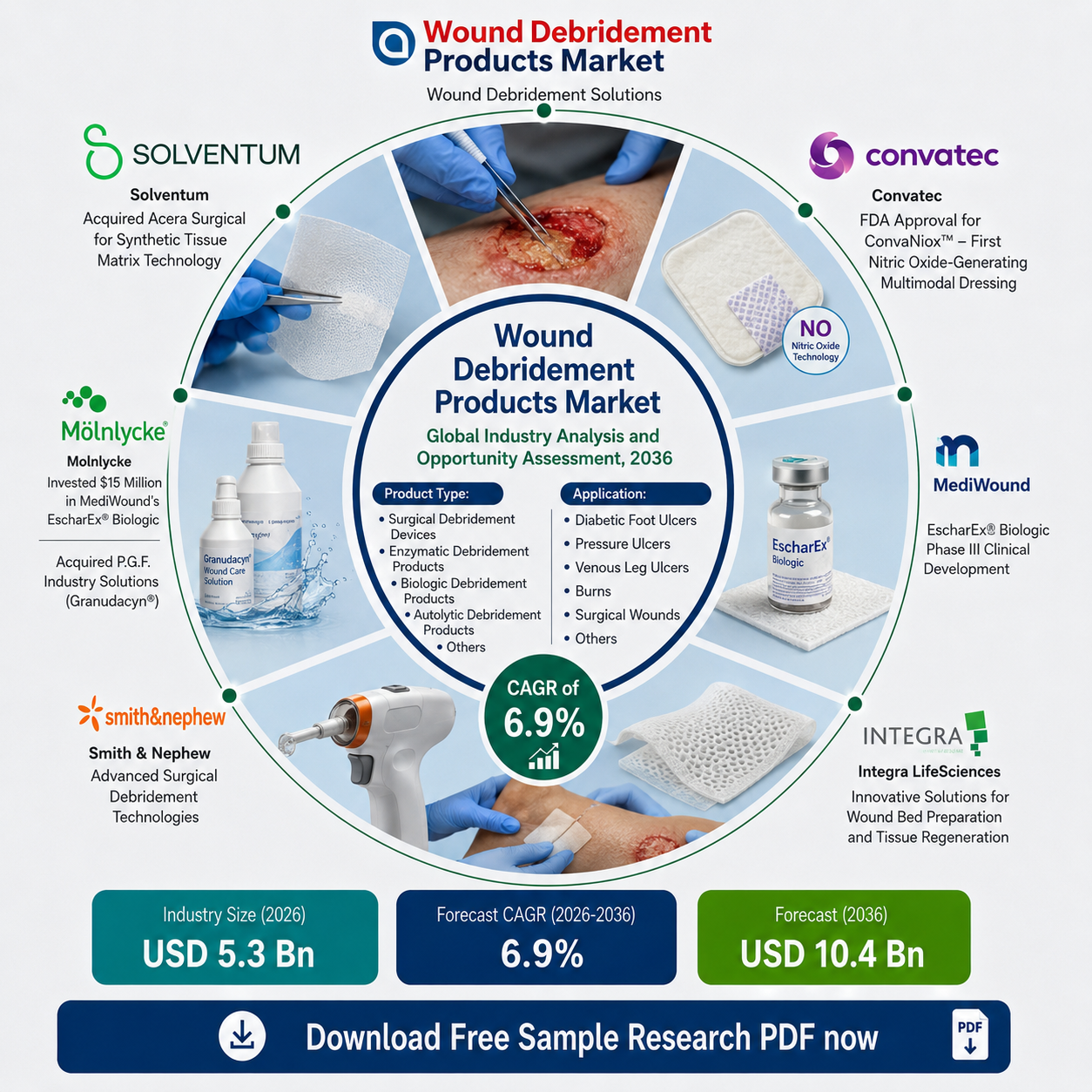
NEWARK, Del., Aug. 12, 2026 — The global Wound Debridement Products Market is expanding as healthcare providers increasingly adopt advanced technologies to remove necrotic tissue, reduce microbial burden, prepare wound beds, and support healing across chronic, surgical, traumatic, and burn wounds. According to Future Market Insights (FMI), the market is projected to grow from USD 5.3 billion in 2026 to USD 10.4 billion by 2036, registering a 6.9% CAGR during the forecast period.
Market development is being supported by the rising prevalence of chronic wounds, increasing demand for efficient wound-bed preparation, technological advances in surgical and hydrosurgical debridement, and growing interest in biologic, enzymatic, antimicrobial, and precision-based approaches. The industry is gradually moving beyond conventional mechanical tissue removal toward technologies designed to improve selectivity, patient comfort, and clinical outcomes.
The market is expected to create an absolute dollar opportunity of approximately USD 5.1 billion between 2026 and 2036. Adoption will increasingly depend on clinical effectiveness, procedural efficiency, tissue selectivity, ease of use, patient comfort, cost considerations, and the ability of manufacturers to demonstrate advantages over established debridement techniques.
👉 Get Detailed Market Forecasts, Competitive Benchmarking, and Pricing Trends
Key Wound Debridement Products Market Highlights at a Glance
- Market Size (2026): USD 5.3 Billion
- Forecast Market Size (2036): USD 10.4 Billion
- Forecast Period: 2026–2036
- CAGR (2026–2036): 6.9%
- Absolute Dollar Opportunity: Approximately USD 5.1 Billion
- Key Product Segments: Hydrosurgical Debridement Devices, Low-Frequency Ultrasound Devices, Surgical Wound Debridement Devices, Mechanical Debridement Pads, Traditional Wound Debridement Devices, Larval Therapy
- Key Applications: Chronic Ulcers, Surgical Wounds, Traumatic Wounds, Burn Cases
- Key End Users: Hospitals, Ambulatory Surgical Centres, Specialized Clinics, Nursing Facilities, Others
- Key Growth Areas: North America, Europe, and Asia Pacific
- Key Companies Profiled: Solventum, Molnlycke, Convatec, MediWound, Smith and Nephew, Integra LifeSciences
Analyst Viewpoint
“Wound debridement is increasingly evolving from conventional mechanical tissue removal toward more selective, technology-enabled and biologically targeted approaches. Laser debridement illustrates the industry’s broader focus on precision and reduced tissue trauma, while hydrosurgical, ultrasound, enzymatic and antimicrobial modalities are expanding the available treatment toolkit. Competitive differentiation will increasingly depend on clinical evidence, wound-bed preparation quality, patient comfort, and the ability to integrate debridement with comprehensive wound-healing pathways.”
Why Is the Wound Debridement Products Market Growing?
The increasing prevalence of chronic wounds and the need for effective wound-bed preparation are creating new opportunities for advanced debridement products across healthcare settings.
Debridement remains a cornerstone of wound management because removal of necrotic tissue can reduce bacterial burden, facilitate drainage, relieve pressure, and support the development of healthy granulation tissue.
Traditional sharp debridement remains widely used because of its convenience and efficiency. However, procedural pain, operator dependence, and the possibility of damaging healthy tissue are encouraging interest in alternative technologies.
Laser debridement offers a notable precision-based approach by enabling controlled ablation of superficial necrotic tissue. Pulsed laser systems and Er:YAG technology have also been investigated for reducing thermal injury while improving tissue removal accuracy.
Key Growth Drivers
- Rising prevalence of chronic wounds and ulcers.
- Increasing demand for advanced wound-bed preparation.
- Growing adoption of hydrosurgical and ultrasound technologies.
- Rising healthcare expenditure on wound management.
- Increasing focus on patient comfort and procedural precision.
- Technological advances in laser and energy-based debridement.
- Growing interest in enzymatic and biologic debridement.
- Expansion of antimicrobial wound-care technologies.
Advanced debridement technologies can help clinicians address complex wounds while improving procedural control and supporting subsequent healing interventions.
How Is Laser Debridement Changing Wound Management?
Laser debridement is attracting attention as a potentially safer and less painful alternative to conventional sharp debridement for selected chronic wounds. Controlled vaporization allows targeted removal of superficial necrotic tissue while limiting unnecessary mechanical trauma.
The depth of tissue ablation depends on the laser type and treatment parameters. Pulsed systems can deliver high-energy bursts over shorter periods, while Er:YAG lasers offer limited tissue penetration because water absorbs their energy efficiently.
Preliminary clinical observations in diabetic wounds, chronic venous leg ulcers, and neuropathic wounds have indicated potential improvements in patient tolerance and wound-bed preparation. However, broader comparative studies are required to establish definitive clinical superiority.
What Are the Latest Technology and Innovation Trends?
Innovation is reshaping the wound debridement industry.
Major trends include:
- Development of precision laser debridement.
- Growth of hydrosurgical debridement systems.
- Increasing use of low-frequency ultrasound.
- Expansion of enzymatic and biologic debridement.
- Development of nitric oxide-generating antimicrobial modalities.
- Greater emphasis on selective tissue removal.
- Integration of debridement with advanced wound dressings.
- Increasing focus on patient comfort and reduced procedural trauma.
The competitive landscape is also shifting toward biologic and biochemical approaches. MediWound’s EscharEx development, Convatec’s ConvaNiox platform, and Molnlycke’s investment and acquisition strategy illustrate the industry’s movement toward targeted tissue removal and antimicrobial wound management.
What Are the Key Market Challenges and Restraints?
Thermal damage associated with laser systems, procedural complexity, equipment costs, limited clinical evidence for emerging technologies, operator training requirements, and the need for comparative studies can restrict adoption.
For laser debridement specifically, thermal diffusion remains an important concern because excessive heat can affect surrounding healthy tissue. Manufacturers are addressing this through pulsed-energy systems, improved wavelength selection, and greater control over ablation parameters.
Which Applications Drive Market Demand?
Chronic ulcers represent an important area of demand because diabetic, venous, and neuropathic wounds often require repeated wound-bed preparation.
Surgical wounds, traumatic wounds, and burn cases also contribute to demand as healthcare providers seek technologies capable of removing devitalized tissue efficiently while preserving viable tissue.
What Is the Regional Outlook?
North America remains a major market due to advanced healthcare infrastructure, high wound-care expenditure, established pharmaceutical and medical-device industries, and early adoption of advanced technologies.
Europe supports market development through established wound-care networks, increasing demand for innovative treatment modalities, and investment in advanced medical technologies.
Asia Pacific is emerging as an important growth region as healthcare infrastructure expands, chronic disease prevalence increases, and access to advanced wound-management technologies improves.
What Is the Competitive Landscape?
Competition is increasingly centered on clinical effectiveness, tissue selectivity, procedural efficiency, antimicrobial performance, technology differentiation, and integration with broader wound-care pathways.
Leading companies are strengthening their positions through acquisitions, strategic investments, regulatory approvals, biologic technologies, advanced devices, and partnerships.
Key Companies
- Solventum
- Molnlycke
- Convatec
- MediWound
- Smith and Nephew
- Integra LifeSciences
These companies are competing through advanced debridement devices, biologic products, antimicrobial technologies, surgical solutions, wound-care platforms, and expanded clinical capabilities.
Frequently Asked Questions
- What is the projected size of the Wound Debridement Products Market by 2036?
The global market is projected to reach USD 10.4 billion by 2036, increasing from USD 5.3 billion in 2026. - What is the expected CAGR of the Wound Debridement Products Market?
The market is forecast to expand at a 6.9% CAGR between 2026 and 2036. - Which product categories are covered in the market?
Key categories include hydrosurgical debridement devices, low-frequency ultrasound devices, surgical wound debridement devices, mechanical debridement pads, traditional wound debridement devices, and larval therapy. - Which applications are covered?
The market covers chronic ulcers, surgical wounds, traumatic wounds, and burn cases. - Which end users drive market demand?
Hospitals, ambulatory surgical centres, specialized clinics, nursing facilities, and other healthcare providers represent key end-user groups. - Why is laser debridement gaining attention?
Laser debridement can provide controlled tissue ablation and potentially reduce procedural trauma and discomfort compared with conventional sharp debridement. - What factors are driving the market?
Rising chronic wound prevalence, demand for advanced wound-bed preparation, technology innovation, patient-comfort requirements, and growing adoption of biologic and antimicrobial approaches continue driving market development.
Related Reports
- https://sites.google.com/view/healthcarewellnessinsights/assistive-robots-for-disability-market
- https://sites.google.com/view/healthcarewellnessinsights/tele-robotic-ultrasound-remote-diagnostics-market
- https://sites.google.com/view/healthcarewellnessinsights/dental-implant-robotics-market
- https://sites.google.com/view/healthcarewellnessinsights/elderly-care-companion-robots-market
- https://sites.google.com/view/healthcarewellnessinsights/patient-transfer-nursing-assist-robots-market
About Future Market Insights (FMI)
Future Market Insights (FMI) is a global market intelligence and consulting firm providing comprehensive market research, competitive intelligence, and strategic business insights across industries. The firm delivers detailed forecasts, technology analysis, and data-driven recommendations that support informed decision-making for manufacturers, investors, distributors, and policymakers worldwide.
For Press & Corporate Inquiries
Rahul Singh
AVP – Marketing and Growth Strategy
Future Market Insights, Inc.
+91 8600020075
For Sales – sales@futuremarketinsights.com
For Media – Rahul.singh@futuremarketinsights.com
For Web – https://www.futuremarketinsights.com