

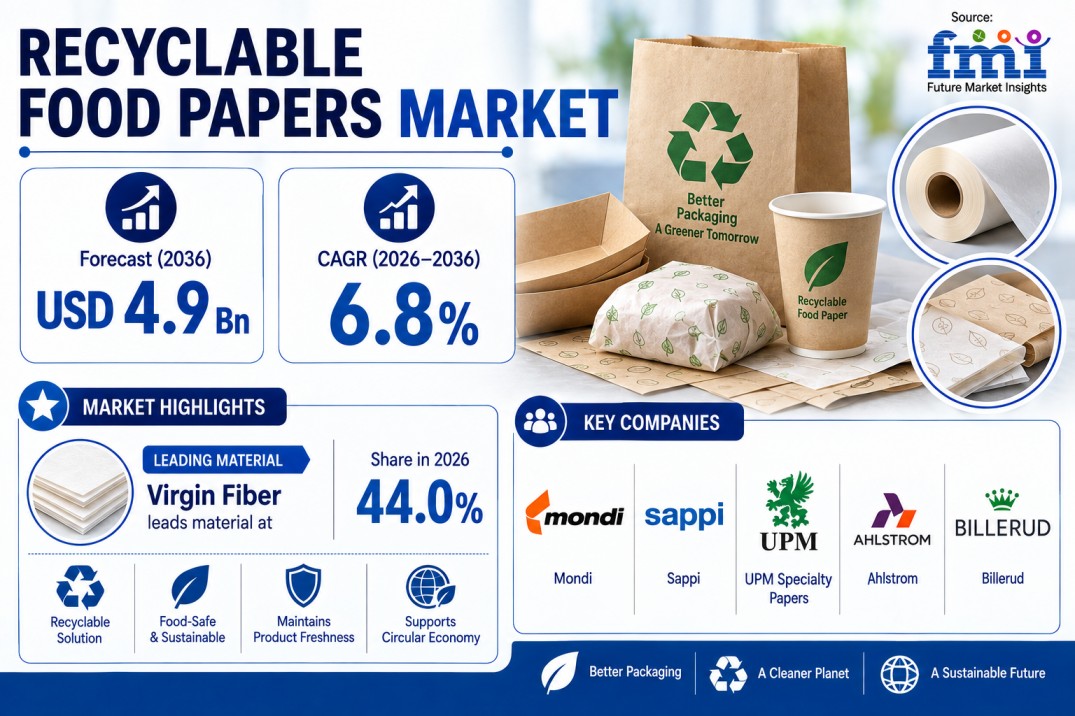
The Recyclable Food Papers Market is projected to reach USD 2.5 billion in 2026 and expand to USD 4.9 billion by 2036, advancing at a 6.8% CAGR during the forecast period. Demand is being driven by food brands seeking paper-based packaging that combines food protection, barrier performance, and compatibility with established fiber-recycling routes. Barrier-coated recyclable papers are expected to account for 30.0% share of the product type segment in 2026, while virgin fiber is projected to lead the material category with 44.0% share. Among the countries analyzed, Brazil is expected to record the fastest growth at 7.2% CAGR, followed by the United Kingdom at 6.7% and Germany at 6.6%.
Recyclable Food Papers Market Size and Forecast
The market is expected to grow from USD 2.5 billion in 2026 to USD 4.9 billion by 2036, creating significant opportunities for manufacturers developing recyclable paper structures for food packaging. The market is forecast to expand at a 6.8% CAGR from 2026 to 2036, supported by rising demand for barrier-coated, grease-resistant, and heat-sealable paper formats.
What is Driving the Recyclable Food Papers Market?
The market is gaining momentum as food manufacturers reconsider packaging specifications around both product protection and end-of-life recovery. Recyclable paper structures are increasingly being evaluated as alternatives to conventional packaging formats where brands need grease, moisture, oxygen, or heat-sealing functionality without compromising access to established fiber-recycling systems.
Regulatory developments are also increasing the importance of documented recyclability. Food brands and packaging converters are placing greater emphasis on the performance of the complete printed and sealed structure, rather than assessing the paper substrate alone. This is encouraging suppliers to develop papers with optimized coatings and barrier systems that can satisfy recycling, food-contact, and production-line requirements simultaneously.
Barrier-Coated Recyclable Papers Lead the Product Type Segment
Barrier-coated recyclable papers are projected to hold 30.0% share in 2026, making them the leading product type. These papers allow manufacturers to introduce grease, moisture, oxygen, or aroma protection while maintaining a fiber-based substrate.
Their commercial value depends on the ability to preserve barrier performance during printing, folding, forming, and sealing. Converters therefore increasingly match coating weight and formulation with the specific food product and equipment conditions to maintain consistent performance during large-scale production.
Virgin Fiber Leads the Material Category
Virgin fiber is estimated to account for 44.0% share in 2026. Its controlled furnish and consistent mechanical properties make it attractive for food-packaging applications requiring predictable coating behavior, surface quality, and migration performance.
Recycled fiber remains relevant for suitable indirect-contact applications, but its adoption depends heavily on contamination control and consistency between production batches. As a result, material selection continues to depend on the specific food application, regulatory requirements, and required barrier performance.
Grease & Oil Barrier Remains a Key Functional Requirement
Grease and oil barrier functionality is forecast to represent 30.0% share in 2026. Fatty foods, prepared meals, and other oil-containing products require packaging that prevents staining and maintains structural integrity throughout filling, storage, handling, and distribution.
The transition away from legacy fluorinated grease-proofing chemistries is encouraging suppliers to develop alternative barrier systems. The opportunity is particularly significant for paper structures that can provide grease resistance while maintaining compatibility with fiber recovery.
Direct Converter Supply Leads the Sales Channel
Direct converter supply is expected to hold 48.0% share in 2026. Direct relationships enable paper producers and converters to coordinate coating, printing, forming, and sealing requirements during qualification.
This approach is increasingly important because recyclable food papers must perform as part of a complete packaging system. Commercial trials can identify issues related to drying, folding, sealing, coating adhesion, and barrier stability before the material moves into recurring production.
Key Growth Drivers, Restraints and Opportunities
Driver: Recyclability requirements are encouraging food brands to document how complete paper packaging structures enter established recycling systems.
Restraint: Barrier chemistry must satisfy recycling, food-contact, and production-line requirements simultaneously, extending qualification timelines.
Opportunity: Low-coat-weight aqueous and mineral-based barriers can help recyclable papers enter flexible formats such as wraps, sachets, pouches, and flow packs that traditionally rely on more complex structures.
The market is therefore shifting toward application-specific recyclable papers, where barrier performance, sealing behavior, and recovery compatibility are evaluated together rather than independently.
Country Growth Outlook
Brazil is projected to be the fastest-growing market at 7.2% CAGR, supported by food-packaging demand and evolving domestic recovery networks.
The United Kingdom is expected to grow at 6.7% CAGR, with recyclability assessment and packaging fee mechanisms increasing the importance of documented material performance.
Germany, at 6.6% CAGR, benefits from established packaging infrastructure and stronger emphasis on design-for-recycling documentation.
The United States is projected to expand at 6.2% CAGR, driven by food-packaging demand and continued reformulation of grease-resistant paper structures.
Japan is forecast to grow at 5.4% CAGR, with adoption supported by stable production standards and detailed qualification practices.
Competitive Landscape
The competitive landscape includes integrated paper and packaging companies as well as specialty-paper manufacturers focused on barrier and converting performance.
Key companies include Mondi, Sappi, UPM Specialty Papers, Ahlstrom, Billerud, Koehler Paper, Delfort, and Oji Holdings.
Mondi and Oji Holdings benefit from broader paper and packaging operations, while Sappi, UPM Specialty Papers, and Ahlstrom maintain strong positions in functional and barrier paper solutions. Billerud, Koehler Paper, and Delfort focus on specialized barrier performance and converting compatibility across food applications.
Key Industry Developments
- In August 2025, Mondi ramped up production of FunctionalBarrier Paper Ultimate following a EUR 16 million investment at its Solec facility in Poland.
- In March 2025, UPM Specialty Papers reported that selected barrier and base papers had passed the Cepi recyclability test, providing additional evidence for recyclable food-paper applications.
- In March 2025, Ahlstrom launched LamiBak Flex, a base paper designed for further coating or metallization in pouches, sachets, and flow-pack applications.
Future Outlook
The Recyclable Food Papers Market is moving toward packaging structures that balance recyclability, food protection, and commercial processing reliability. Growth will depend on the ability of paper manufacturers and converters to demonstrate that coatings and functional layers do not undermine fiber recovery while still delivering the barrier and sealing performance required by food processors.
With the market projected to rise from USD 2.5 billion in 2026 to USD 4.9 billion by 2036, opportunities are emerging for suppliers developing low-coat-weight barriers, heat-sealable papers, grease-resistant structures, and recyclable papers designed for flexible food packaging. The strongest suppliers are likely to be those capable of supporting customers through the full qualification process—from material selection and recycling assessment to commercial line trials.
Related Research Reports:
Recyclable Flexible Packaging (Pouches) Market: USD 36.1 billion in 2026 and USD 66.5 billion by 2036 at a 6.3% CAGR.
Compostable Fresh Food Wraps Market: USD 404.1 million in 2026 and USD 1,029.2 million by 2036 at a 9.8% CAGR.
Bio-Based Fresh Food Wraps Market: USD 326.8 million in 2026 and USD 879.0 million by 2036 at a 10.4% CAGR.
About Future Market Insights (FMI)
Future Market Insights is a leading provider of market intelligence, consulting services, and syndicated research reports. FMI delivers actionable insights across packaging, logistics, industrial manufacturing, food and beverage, healthcare, chemicals, and emerging technologies, helping organizations identify growth opportunities and make informed strategic decisions in rapidly evolving markets.
Contact
Future Market Insights Inc.
Christiana Corporate
200 Continental Drive, Suite 401
Newark, Delaware 19713, USA