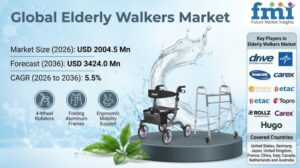


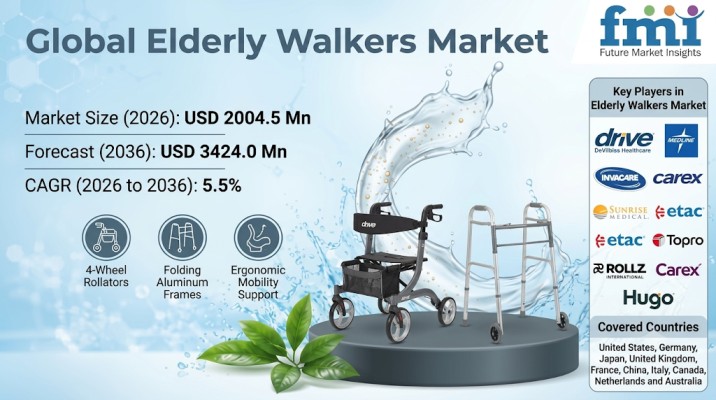
NEWARK, Del., November 18, 2026 — The global elderly walkers market is projected to increase from USD 2.00 billion in 2026 to USD 3.42 billion by 2036, registering a compound annual growth rate (CAGR) of 5.5%, according to Future Market Insights (FMI). The market, valued at USD 1.90 billion in 2025, is benefiting from an expanding older population, increasing mobility limitations, and growing demand for assistive devices that support independent movement and everyday activities.
Healthcare providers, rehabilitation centers, medical equipment distributors, and homecare organizations are strengthening their mobility assistance portfolios as more older adults seek products that improve stability and reduce dependence on caregivers. Elderly walkers are becoming essential equipment across residential care, outpatient rehabilitation, and home healthcare environments. However, market expansion will depend on affordability, reimbursement eligibility, product suitability, and manufacturers’ ability to maintain dependable distribution and after-sales service networks.
👉 Get Detailed Market Forecasts, Competitive Benchmarking, and Pricing Trends:
https://www.futuremarketinsights.com/reports/sample/rep-gb-36208
The short version: Four-wheeled rollators reshape the mobility equipment landscape
Elderly walkers provide physical support to individuals experiencing balance difficulties, reduced mobility, or age-related physical limitations. The product category includes four-wheeled rollators, two-wheeled walkers, standard walkers, and other specialized walking support equipment.
FMI identifies four-wheeled rollators as the leading product-type segment, with a projected 50.0% market share in 2026. By frame material, aluminium is expected to account for 64.0% of market revenue. Retail pharmacies and stores are forecast to represent 34.0% of distribution-channel demand.
These segment positions reflect the importance of lightweight equipment, accessible purchasing channels, and product configurations that support both indoor and outdoor mobility.
Online distribution is emerging as an important growth opportunity, particularly as consumers increasingly compare product specifications, frame materials, folding mechanisms, and pricing before purchasing mobility equipment.
Three numbers that matter
- USD 2,004.5 million: Estimated market size in 2026.
- USD 3,424.0 million: Projected market value by 2036.
- 5%: Forecast CAGR between 2026 and 2036.
The projected increase represents an opportunity for mobility equipment manufacturers, rollator suppliers, rehabilitation equipment distributors, medical retailers, and home healthcare providers.
Four-wheeled rollators lead product demand
Four-wheeled rollators are projected to account for 50.0% of the elderly walkers market by product in 2026. Their leading position reflects demand for walking equipment that combines stability, maneuverability, and convenience.
Unlike conventional walking frames, four-wheeled rollators commonly incorporate hand-operated brakes, seating arrangements, and storage accessories. These features make them relevant to older adults seeking mobility support during indoor and outdoor activities.
FMI projects four-wheeled rollator revenue to expand at a 6.7% CAGR between 2026 and 2036. Their growing contribution reflects demand for differentiated product designs, including outdoor models and lightweight premium configurations.
Two-wheeled walkers and standard walkers continue to serve consumers requiring simpler and more economical mobility assistance. Standard frames remain particularly relevant in clinical and institutional environments where product suitability, durability, and affordability influence procurement decisions.
Manufacturers are therefore focusing on product differentiation through adjustable frame heights, ergonomic handles, folding mechanisms, braking systems, and improved portability.
Aluminium dominates frame material demand
Aluminium is expected to account for 64.0% of the market by frame material in 2026. Its leading position reflects the material’s combination of relatively low weight, structural strength, manufacturing availability, and affordability.
FMI estimates aluminium-based elderly walker revenue at USD 1,282.9 million in 2026. Aluminium remains an important choice for manufacturers supplying standard walking frames and rollators across institutional and retail channels.
Carbon fibre and composite materials represent an emerging premium opportunity. Their lightweight characteristics can appeal to consumers who regularly transport walking equipment or require products that are easier to lift and fold.
Steel continues to serve institutional and cost-sensitive applications, where durability and purchase economics remain important considerations.
The increasing availability of different frame materials is encouraging manufacturers to develop product portfolios that address multiple consumer requirements rather than relying on a single standardized walking frame.
Online distribution creates a faster-growing sales opportunity
Retail pharmacies and stores are projected to account for 34.0% of the distribution segment in 2026. Their position reflects consumer access to physical product demonstrations, established medical equipment relationships, and assistance with selecting appropriate mobility devices.
However, online distribution is forecast to expand at an 8.9% CAGR between 2026 and 2036. Its market share is projected to increase from 26.0% in 2026 to 35.7% by 2036.
Online suppliers are benefiting from consumers’ ability to compare product dimensions, supported user weights, frame materials, portability, and pricing across multiple brands.
Medical supply stores remain important because they can provide specialized product information and after-sales assistance. Hospitals and clinics also contribute through mobility assessments, rehabilitation programs, and equipment recommendations.
For manufacturers, the opportunity lies in combining online accessibility with reliable product documentation, replacement-part availability, warranty support, and clear purchasing guidance.
Where growth is strongest: China leads country-level forecasts
FMI’s country-level analysis identifies China as the fastest-growing market, with a projected 8.3% CAGR from 2026 to 2036. Canada and Australia follow at 5.8% each.
Other country-level projections include:
- United States:3% CAGR
- United Kingdom:3% CAGR
- France:3% CAGR
- Netherlands:3% CAGR
- Germany:8% CAGR
- Japan:8% CAGR
- Italy:8% CAGR
China’s outlook is supported by its expanding older population and growing emphasis on technology-enabled elderly care and community-based support services.
Canada and Australia represent attractive opportunities as healthcare systems strengthen assistive technology access and home-based care arrangements.
In the United States, established durable medical equipment distribution networks and Medicare coverage for eligible prescribed walkers support market development. The United Kingdom benefits from established healthcare and mobility retail channels, while Germany and Japan represent mature markets where reimbursement arrangements, equipment selection, and replacement demand influence purchasing decisions.
Who is moving: Established mobility equipment manufacturers strengthen competition
The elderly walkers market includes specialized rollator manufacturers, rehabilitation equipment suppliers, and diversified medical device companies.
FMI identifies the following notable companies and brands:
- Drive Medical
- Medline Industries
- Invacare
- Sunrise Medical
- TOPRO
- Rollz International
- Carex
- Hugo Mobility
- Etac
Drive Medical offers multiple walking aid configurations, including rollators and specialized mobility products. Medline Industries maintains a broad portfolio of walking frames and mobility equipment for institutional and consumer markets.
Invacare provides rehabilitation and mobility products, while Sunrise Medical competes through its GEMINO rollator range, including lightweight and outdoor configurations.
TOPRO focuses on specialized rollators, with product families targeting different mobility and portability requirements. Rollz International also competes in premium mobility equipment and has strengthened its distribution responsibilities for TOPRO products in the Netherlands.
Competition increasingly depends on product weight, folding convenience, braking performance, ergonomic design, replacement-part availability, and distributor service capabilities.
As online sales expand, manufacturers must also communicate product specifications clearly and distinguish premium features from standard mobility equipment.
Analyst perspective
Anurag Sharma, Principal Consultant at Future Market Insights, commented:
“Walker suppliers need two commercial offers. Clinically supplied frames compete within local assessment and payment arrangements. Premium rollators compete for an additional payment through lower carrying weight, a suitable folding design and dependable service. Online growth will reward brands that explain those differences clearly before an order is placed. A larger catalogue alone does not resolve a poor fit or a replacement brake that cannot be obtained.”
Where to act and where to be careful
The market presents opportunities across lightweight rollators, carbon-fibre frames, specialized mobility equipment, online distribution, and after-sales services.
Manufacturers investing in premium lightweight designs may benefit from increasing interest in products that simplify transportation and everyday use. However, higher selling prices must be supported by demonstrable product advantages, including reduced frame weight, convenient folding, durability, and appropriate user support.
Online retailers can strengthen their position through accurate product specifications, comparison tools, transparent delivery policies, and accessible replacement parts.
Healthcare providers and medical equipment distributors should also evaluate local reimbursement and equipment assessment requirements. Coverage differs across countries and sometimes between individual product categories. A privately purchased rollator and a clinically supplied walking frame may follow different purchasing and payment arrangements.
Reliable after-sales service represents another important competitive factor. Brake replacement, spare-part availability, warranty support, and product maintenance can influence long-term customer satisfaction and distributor relationships.
Market outlook and research coverage
FMI’s market assessment covers product type, distribution channel, frame material, and regional demand across North America, Western Europe, East Asia, Oceania, and the rest of the world.
The research evaluates four-wheeled rollators, two-wheeled walkers, standard walkers, knee walkers and other products; retail pharmacies and stores, online distribution, medical supply stores, and hospitals and clinics; and aluminium, steel, and carbon fibre and composite frames.
The forecast covers the period from 2026 to 2036, examining changing mobility requirements, material innovation, purchasing channels, competitive developments, and country-level growth opportunities.
Related Reports:
- Lab Safety Clothing Market – https://www.futuremarketinsights.com/reports/lab-safety-clothing-market
- Non-Medical Grade Aesthetic Device Market – https://www.futuremarketinsights.com/reports/non-medical-grade-aesthetic-device-market
- Non-Medical Grade Ophthalmic Device Market – https://www.futuremarketinsights.com/reports/non-medical-grade-ophthalmic-device-market
About Future Market Insights (FMI)
Future Market Insights (FMI) is a global market intelligence and consulting firm providing comprehensive market research, competitive intelligence, and strategic business insights across industries. The firm delivers detailed forecasts, technology analysis, and data-driven recommendations that support informed decision-making for manufacturers, investors, distributors, and policymakers worldwide.
For Press & Corporate Inquiries
Rahul Singh
AVP – Marketing and Growth Strategy
Future Market Insights, Inc.
+91 8600020075
For Sales – sales@futuremarketinsights.com