

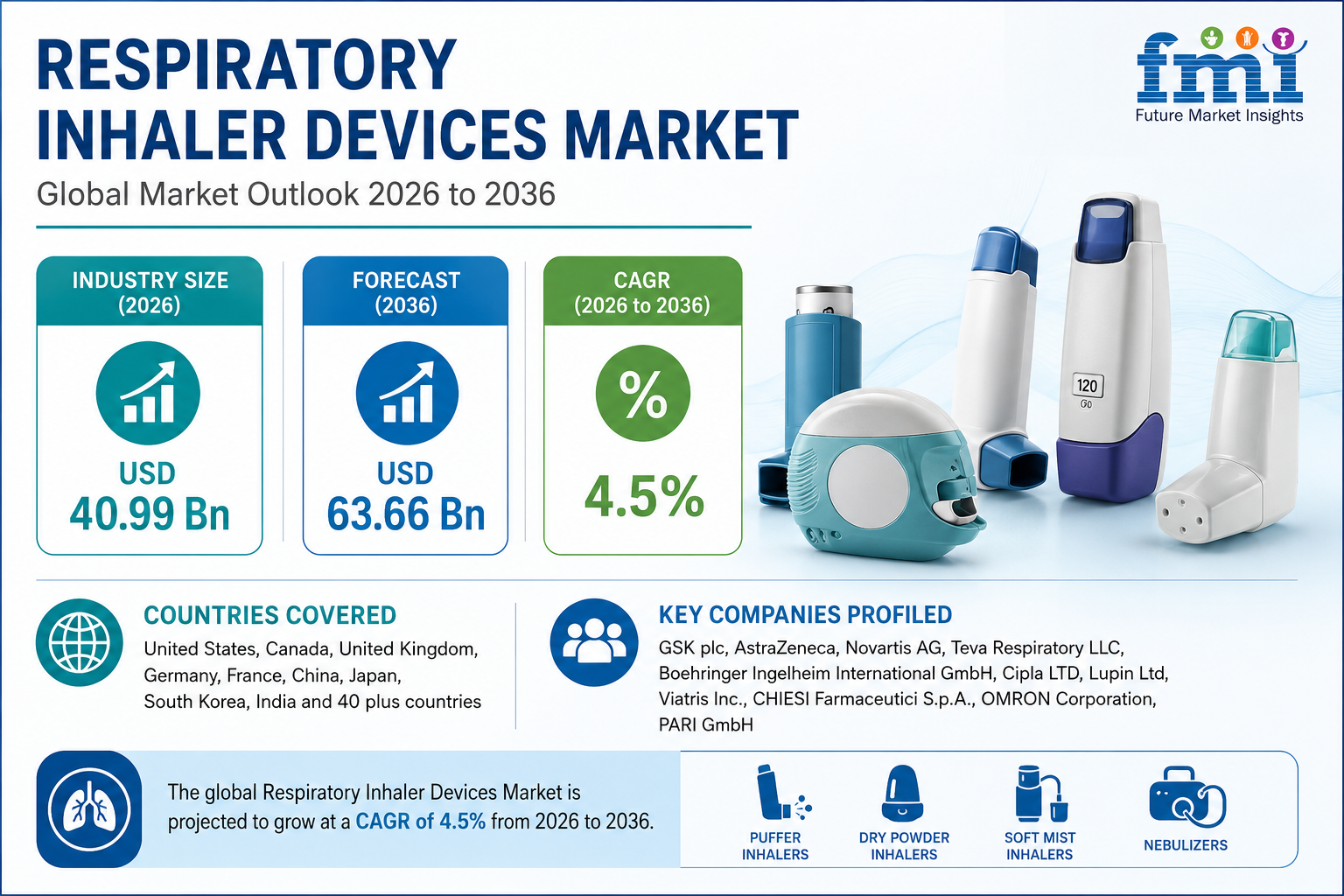
NEWARK, Del., July 28, 2026 – The global Respiratory Inhaler Devices Market is projected to reach USD 63.66 billion by 2036, expanding from USD 40.99 billion in 2026 at a 4.5% CAGR, according to Future Market Insights (FMI). The market continues to expand as respiratory diseases such as asthma and chronic obstructive pulmonary disease (COPD) increase worldwide, creating sustained demand for reliable inhalation therapies and next-generation respiratory drug delivery systems.
Growing urban pollution, smoking-related illnesses, and aging populations are increasing the number of patients requiring long-term respiratory care. Inhaler devices remain essential because they deliver medication directly into the lungs, offering faster symptom relief while reducing systemic drug exposure. Manufacturers continue to improve inhaler usability, dose accuracy, and patient adherence through better device engineering and digital monitoring capabilities.
The market is also witnessing increasing investment in digital respiratory technologies. Connected inhalers equipped with sensors and mobile applications are helping physicians monitor treatment compliance while enabling patients to better manage chronic respiratory conditions. Although manual inhalers continue to dominate global prescriptions, digital inhalers are gradually creating new opportunities for manufacturers as healthcare systems embrace connected care solutions.
Industry participants are focusing on product innovation while maintaining compatibility with existing prescribing habits. Metered-dose inhalers remain the leading product category because physicians and patients are highly familiar with their operation, while asthma continues to represent the largest disease indication due to lifelong therapy requirements and recurring prescription refills.
Growing Respiratory Disease Burden Supports Long-Term Market Expansion
The increasing prevalence of asthma and COPD remains the primary growth engine for the respiratory inhaler devices market. Chronic respiratory diseases require continuous maintenance therapy as well as emergency rescue treatment, ensuring recurring demand for inhaler devices across hospitals, specialty clinics, and retail pharmacies.
Improved healthcare access across emerging economies is expanding diagnosis rates and increasing prescription volumes. India and China continue to experience particularly strong growth as healthcare infrastructure develops and respiratory disease awareness improves.
Digital innovation is also reshaping respiratory disease management. Companies are integrating inhalers with smartphone applications to improve medication adherence, provide dose reminders, and generate real-time usage information that supports physicians in optimizing treatment outcomes.
Industry Evidence Reinforces Market Momentum
Independent public health organizations continue to report a significant global burden of chronic respiratory diseases.
- The World Health Organization (WHO) identifies chronic respiratory diseases, including asthma and COPD, among the leading causes of illness worldwide, highlighting growing healthcare demand.
- The Global Initiative for Chronic Obstructive Lung Disease (GOLD) continues to emphasize early diagnosis and maintenance inhaler therapy as the standard approach for COPD management.
- The Global Initiative for Asthma (GINA) regularly updates international treatment recommendations supporting inhaled medications as the cornerstone of asthma care.
These long-established clinical guidelines continue to reinforce demand for respiratory inhaler technologies across global healthcare systems.
Key Market Numbers
|
Metric |
Value |
|
Market Size (2025) |
USD 40.2 Billion |
|
Market Size (2026) |
USD 40.99 Billion |
|
Forecast (2036) |
USD 63.66 Billion |
| CAGR (2026–2036) |
4.5% |
|
Incremental Opportunity |
USD 18.3 Billion |
|
Leading Technology |
Manual Inhalers |
| Manual Inhaler Share (2026) |
91.0% |
Market Segment Analysis
By Product: Metered-dose inhalers continue to lead the market because of strong physician familiarity, widespread patient acceptance, and extensive use for both maintenance and rescue therapy.
By Disease Indication: Asthma remains the largest therapeutic segment owing to the long treatment duration required for both pediatric and adult patients.
By Technology: Manual inhalers account for 91.0% of technology demand in 2026 as connected inhalers still represent a relatively small portion of total prescriptions worldwide.
By Sales Channel: Hospitals and retail pharmacy channels continue to generate substantial revenue through ongoing prescription refills and supervised respiratory disease management.
Fastest-Growing Countries
| Country | Forecast CAGR |
|
India |
7.2% |
| China |
7.0% |
Competitive Landscape
The respiratory inhaler devices market remains highly competitive, with established pharmaceutical companies leveraging strong respiratory portfolios, physician relationships, and global distribution capabilities.
Leading companies include:
- GSK
- AstraZeneca
According to FMI, these companies maintain strong competitive positions through extensive respiratory product portfolios and long-standing prescriber acceptance across major healthcare markets.
Analyst Perspective
Anurag Sharma, Principal Consultant for Healthcare at Future Market Insights, states:
“In respiratory care, device selection depends on intuitive handling and consistent dose delivery. Familiar inhalers therefore remain widely used in asthma and COPD management. Future innovation must improve patient-familiar formats to support adherence and steadier market expansion.”
Frequently Asked Questions
How large is the Respiratory Inhaler Devices Market in 2026?
The market is valued at USD 40.99 billion in 2026.
What will be the market size by 2036?
The market is projected to reach USD 63.66 billion by 2036.
What is driving market growth?
Increasing asthma and COPD prevalence, growing respiratory disease diagnosis, and continued demand for effective inhalation therapies are supporting market expansion.
Which technology dominates the market?
Manual inhalers lead the market with a 91.0% technology share in 2026.
Which countries are expected to grow the fastest?
India is forecast to grow at 7.2% CAGR, followed by China at 7.0% CAGR.
Related Reports
- The demand for patient monitoring systems is estimated to grow to USD 69.2 million in 2026 and USD 169.9 million by 2036.
- The mri compatible patient monitoring systems market is projected to grow from USD 4.3 billion in 2025 to USD 6.4 billion by 2035, at a CAGR of 4.0%.
- The patient monitoring devices market is projected to grow from USD 62.6 million in 2025 to USD 169.9 million by 2035, at a CAGR of 10.5%.
About Future Market Insights (FMI)
Future Market Insights, Inc. (ESOMAR certified, recipient of the Stevie® Award, and a member of the Greater New York Chamber of Commerce) provides deep insights into governing factors elevating demand in global markets.
FMI delivers market intelligence, consulting services, and syndicated research reports across chemicals, materials, food ingredients, pharmaceuticals, industrial manufacturing, sustainability, advanced materials, and infrastructure sectors.
With global expertise and industry-focused research capabilities, FMI provides actionable insights that help organizations understand market dynamics and identify emerging opportunities.
Contact
Future Market Insights Inc.
Christiana Corporate, 200 Continental Drive, Suite 401, Newark, Delaware 19713, USA
Rahul Singh
AVP – Marketing and Growth Strategy
Future Market Insights, Inc.
Phone: +91 8600020075
For Media: Rahul.Singh@futuremarketinsights.com
Email: sales@futuremarketinsights.com
Website: www.futuremarketinsights.com