

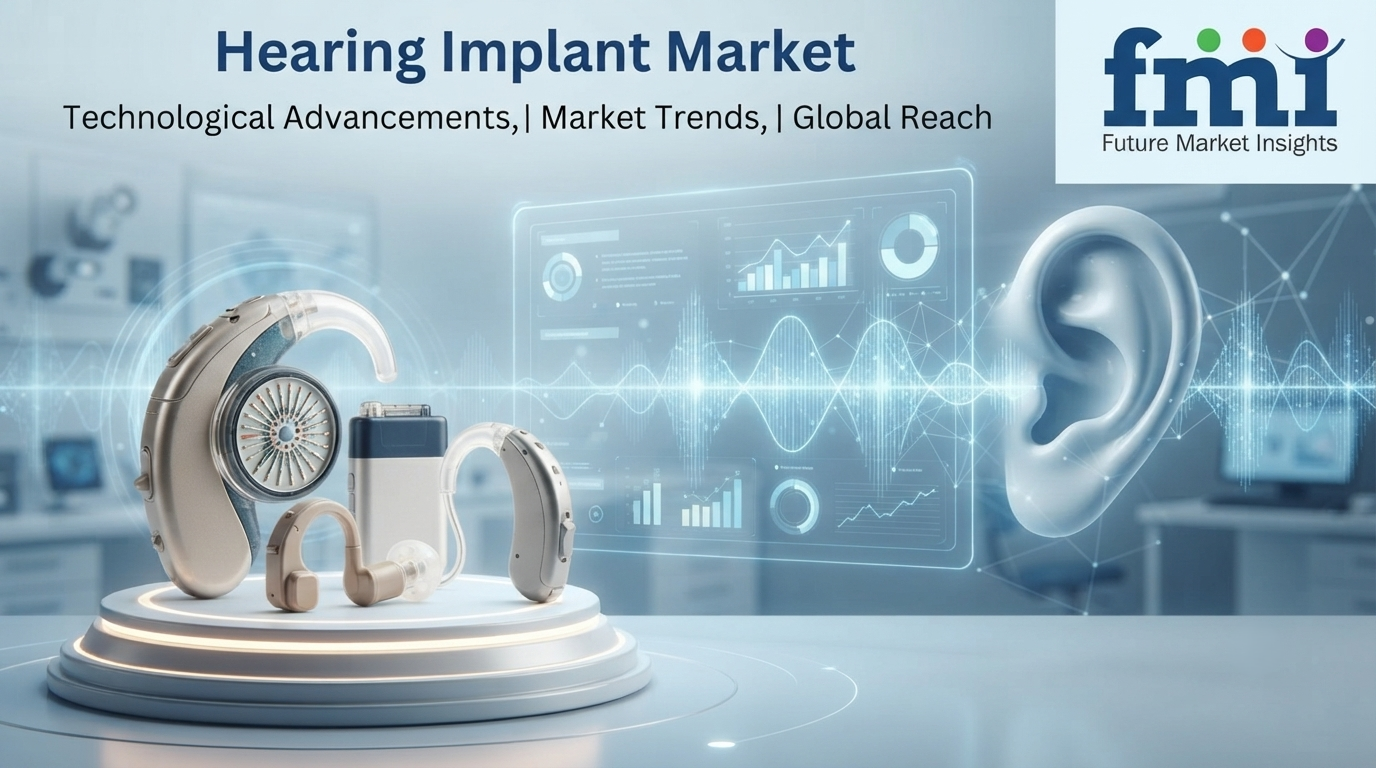
The global hearing implant market is undergoing a significant transformation as demographic shifts, technological innovation, and growing awareness of hearing health continue to reshape demand across developed and emerging healthcare markets. According to industry analysis, the market is projected to expand from US$ 1.7 million in 2026 to approximately US$ 3.5 billion by 2036, registering a compound annual growth rate (CAGR) of 7.3% during the forecast period.
Rising cases of age-related hearing impairment, increasing diagnosis of congenital and pediatric hearing disorders, and continuous improvements in implant technologies are strengthening long-term market fundamentals. Cochlear implants remain the leading product category due to their effectiveness in treating severe to profound hearing loss where conventional hearing aids often fail to deliver satisfactory outcomes.
Healthcare providers are increasingly adopting advanced implant systems featuring wireless connectivity, remote programming capabilities, and enhanced sound processing technologies that improve patient outcomes and post-operative care. At the same time, manufacturers continue investing in product innovation to improve accessibility, surgical efficiency, and long-term hearing performance.
Market Overview
The hearing implant market has become an increasingly important segment within the global medical device industry as hearing impairment continues to affect millions of individuals worldwide. Population aging remains one of the strongest demand catalysts, with age-related sensorineural hearing loss becoming more prevalent across developed and developing economies.
Beyond the elderly population, healthcare professionals are reporting higher diagnosis rates of hearing impairment among infants and children through improved newborn screening programs and early intervention initiatives. Earlier diagnosis allows patients to receive hearing implants during developmental stages, improving speech recognition, language acquisition, and overall quality of life.
These trends are creating long-term opportunities for manufacturers developing next-generation implantable hearing technologies that combine clinical effectiveness with patient convenience.
Industry analysts estimate that the market will nearly double in value over the forecast period, reaching US$ 1.7 billion by 2026 from US$ 3.5 million in 2036, supported by a 7.3% CAGR.
Key Growth Drivers
- Rising global geriatric population leading to higher prevalence of age-related hearing loss.
- Increasing diagnosis of pediatric hearing impairment through early screening programs.
- Growing adoption of cochlear implants for severe and profound hearing loss.
- Continuous advancements in sound processing and implant technologies.
- Integration of Bluetooth connectivity and wireless communication features.
- Development of remote programming and tele-audiology services for follow-up care.
- Increasing healthcare expenditure on hearing rehabilitation and specialized ENT treatments.
- Strong manufacturer investments in next-generation implant systems and patient-centered technologies.
Technology & Innovation Trends
Technology continues to redefine hearing restoration by making implant systems more intelligent, connected, and clinically effective.
Among recent innovations, cochlear implant manufacturers are integrating Bluetooth wireless connectivity directly into implant processors. These systems enable users to stream audio from compatible devices while improving listening experiences across diverse environments including educational settings, workplaces, and daily communication.
Remote programming has emerged as another transformative advancement. Traditionally, cochlear implant recipients required frequent hospital visits for device tuning and audiologist consultations. Modern remote adjustment platforms allow clinicians to modify implant settings digitally, reducing travel requirements while improving continuity of patient care.
Market Challenges & Restraints
Although hearing implants provide life-changing clinical benefits, affordability remains one of the industry’s most significant barriers.
Implant procedures involve substantial expenses beyond the device itself, including diagnostic evaluations, surgery, hospitalization, rehabilitation, medication, and long-term audiology support. These cumulative costs restrict accessibility for middle-income and lower-income populations.
The surgical nature of implantation also discourages certain patients. Unlike hearing aids, hearing implants require invasive procedures that may involve post-operative complications and extended recovery periods.
Segment Analysis
Cochlear implants continue to dominate the global hearing implant market owing to their ability to restore hearing perception among patients experiencing severe to profound sensorineural hearing loss.
Unlike conventional hearing aids that primarily amplify sound, cochlear implants bypass damaged sensory hair cells and directly stimulate the auditory nerve, allowing patients to perceive sound more effectively.
Healthcare professionals increasingly recommend cochlear implants for individuals whose hearing loss cannot be adequately treated using traditional amplification devices. Their superior clinical outcomes have strengthened physician confidence and accelerated patient acceptance worldwide.
Growing awareness regarding early intervention has further expanded demand among pediatric patients. Earlier implantation enables improved language development, educational outcomes, and social integration, making pediatric cochlear implantation an increasingly important application area.
Meanwhile, bilateral implantation is gaining attention for delivering improved spatial hearing and speech recognition. However, production capacity constraints continue limiting broader availability, presenting manufacturers with considerable expansion opportunities.
Regional Analysis
North America remains one of the largest hearing implant markets due to advanced healthcare infrastructure, favorable reimbursement systems, and widespread adoption of innovative medical technologies.
Europe continues demonstrating steady growth supported by strong public healthcare systems, increasing elderly populations, and growing investments in hearing rehabilitation services.
Asia-Pacific represents one of the fastest-evolving regional markets as expanding healthcare infrastructure, rising disposable income, increasing awareness, and improving access to specialized ENT services encourage greater adoption of hearing implants.
Emerging economies are expected to witness gradual acceleration as governments strengthen hearing screening initiatives and improve healthcare accessibility.
Competitive Landscape
The hearing implant industry remains relatively consolidated, with only a limited number of global manufacturers competing in advanced implant technologies.
This concentrated competitive environment creates both challenges and opportunities. Limited competition encourages continuous innovation while simultaneously allowing established manufacturers to strengthen technological leadership through research, intellectual property development, and specialized clinical expertise.
Companies increasingly compete through product differentiation, digital connectivity features, improved patient outcomes, and expanded post-operative support services.
Strategic investments in production expansion are becoming increasingly important as global demand continues exceeding current manufacturing capacity, particularly for bilateral implantation procedures.
Leading Companies Analysis
Industry participants are prioritizing research and development to introduce next-generation hearing implants capable of delivering superior hearing performance, simplified device programming, and enhanced patient comfort.
Manufacturers are investing heavily in wireless connectivity, miniaturization, intelligent sound processing, and digital healthcare integration to improve both clinical outcomes and user experiences.
Partnerships with audiologists, hospitals, rehabilitation centers, and healthcare providers remain central to long-term commercial success. Companies are also emphasizing comprehensive patient support programs that extend beyond device implantation through continuous monitoring and follow-up care.
Investment & Strategic Developments
Investment across the hearing implant sector increasingly focuses on expanding manufacturing capacity, improving device affordability, and accelerating innovation.
Companies are directing resources toward remote healthcare platforms, Bluetooth-enabled processors, digital hearing ecosystems, and personalized rehabilitation services.
Future Outlook
The outlook for the global hearing implant market remains highly positive as demographic trends continue favoring long-term industry expansion.
Increasing life expectancy, greater awareness of hearing health, earlier pediatric diagnosis, and continuous technological innovation are expected to sustain market growth throughout the coming decade.
Future product development will likely emphasize artificial intelligence-enabled hearing optimization, improved battery efficiency, cloud-connected programming, minimally invasive implantation techniques, and greater affordability.
As healthcare systems increasingly recognize hearing restoration as an essential component of overall well-being, hearing implants are expected to become more widely accessible across broader patient populations.
Related Report:
https://www.openpr.com/news/4382195/sweat-resistant-natural-pigment-systems-market-set-to-surge
FMI Custom Research: Strategic Intelligence for Confident Decision-Making
In today’s rapidly evolving business environment, leadership teams need more than market data—they need clear, actionable intelligence tailored to their strategic objectives. FMI’s Custom Research solutions are designed around the specific business questions organizations need answered, enabling executives to evaluate growth opportunities, validate investments, assess competitive dynamics, and reduce uncertainty before making critical decisions. By combining deep industry expertise, primary research, and proprietary market intelligence, FMI delivers insights that help organizations move from assumptions to evidence-based strategies with greater speed and confidence.
Key Executive Benefits
- Decision-Ready Insights: Research tailored to your specific business challenges, growth plans, and investment priorities.
- Reduced Strategic Risk: Validate market opportunities, customer demand, and competitive positioning before committing resources.
- Market Entry Confidence: Assess opportunity size, regulatory barriers, channel dynamics, and competitive landscapes with precision.
- Competitive Advantage: Gain proprietary intelligence unavailable through syndicated reports or internal datasets.
- Faster Growth Decisions: Accelerate expansion, product development, portfolio optimization, and investment planning.
- Primary Market Validation: Access real-world customer, buyer, and stakeholder insights that support high-confidence decision-making.
- Global Industry Expertise: Powered by 100+ analysts, 20,000+ published reports, and 1.6 million+ hours of research experience.
- Proven Track Record: Over 7,000 market-entry engagements completed across six regions and 14 industry sectors with strong client retention.
Business Impact
FMI helps organizations transform market complexity into strategic clarity, enabling leadership teams to identify growth opportunities faster, optimize resource allocation, strengthen competitive positioning, and make high-stakes business decisions with confidence.
About Future Market Insights (FMI)
Fture Market Insights, Inc. (FMI) is an ESOMAR-certified, ISO 9001:2015 market research and consulting organization, trusted by Fortune 500 clients and global enterprises. With operations in the U.S., UK, India, and Dubai, FMI provides data-backed insights and strategic intelligence across 30+ industries and 1200 markets worldwide.
Contact Us:
Future Market Insights Inc.
Christiana Corporate, 200 Continental Drive,
Suite 401, Newark, Delaware – 19713, USA
T: +1-347-918-3531
For Sales Enquiries: sales@futuremarketinsights.com
Website: https://www.futuremarketinsights.com