


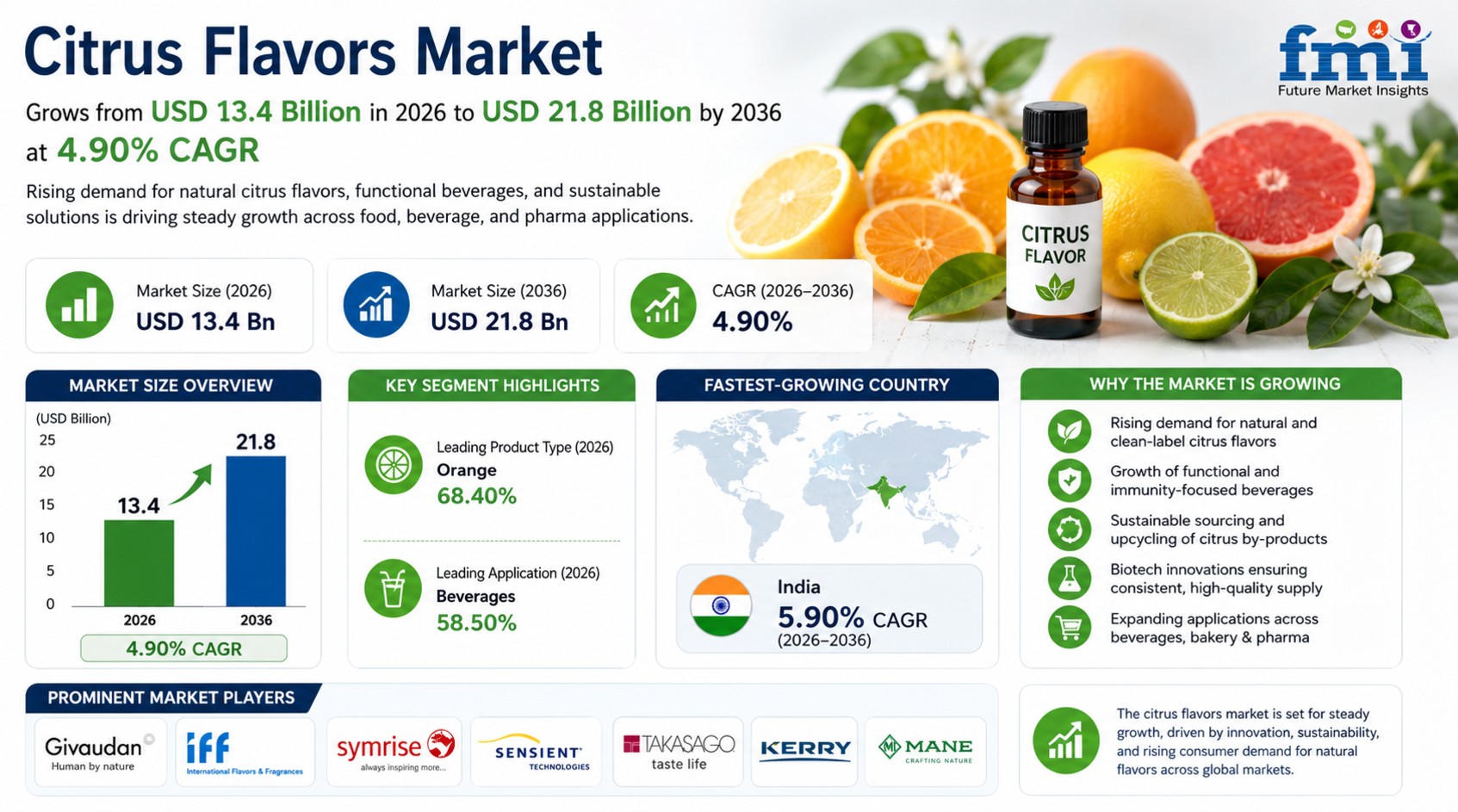
The global citrus Flavours market is evolving from a flavor-focused category into a multifunctional clean-label platform where natural sensory appeal and food functionality work together to replace synthetic ingredient systems. As food and beverage manufacturers reformulate products to meet growing consumer demand for recognizable ingredients, citrus-derived solutions are gaining commercial importance not only for their fresh taste and aroma but also for their ability to improve texture, stability, water retention, and gelling performance.
Today, citrus ingredients are being evaluated as formulation tools rather than simply flavor additives. Citrus flavors, citrus oils, citrus fiber, citrus pectin, and peel-derived functional ingredients allow manufacturers to simplify ingredient declarations while maintaining product quality, sensory performance, and processing efficiency. This combination of technical functionality and consumer familiarity is positioning citrus as one of the strongest clean-label ingredient platforms across beverages, dairy, bakery, confectionery, sauces, snacks, and plant-based foods.
Featured Snippet: Key Market Answer
Q: Why are citrus ingredients becoming important for clean-label food reformulation?
A: Citrus ingredients provide far more than natural flavor. Citrus flavors deliver fresh and recognizable taste profiles, citrus oils enhance aroma, citrus fiber improves texture and water binding, while citrus pectin offers natural gelling and stabilization. Together, these ingredients help manufacturers replace synthetic emulsifiers, stabilizers, and texture modifiers while maintaining product quality, processing performance, and clean-label credibility.
Quick Stats of the Citrus Ingredients Market
- Core Growth Theme: Clean-Label Reformulation Through Multifunctional Citrus Ingredients
- Leading Commercial Driver: Natural flavor combined with technical food functionality
- Key Ingredient Categories: Citrus Flavors, Citrus Fiber, Citrus Pectin, Citrus Oils
- Primary Applications: Beverages, bakery, dairy, confectionery, sauces, snacks, and plant-based foods
- Critical Technical Variable: Replacing synthetic systems without compromising product performance
Market Overview: Citrus Has Become a Complete Functional Ingredient Platform
The citrus ingredients market has expanded well beyond traditional flavor applications. Manufacturers increasingly view citrus-derived ingredients as multifunctional solutions capable of addressing both consumer expectations and technical formulation challenges.
Orange, lemon, lime, grapefruit, mandarin, yuzu, and other citrus varieties continue providing familiar taste profiles associated with freshness, naturalness, and refreshment. However, their commercial value increasingly extends into ingredient systems that enhance texture, stabilize formulations, improve moisture management, support gelling, and strengthen clean-label positioning.
This broader functionality allows food manufacturers to reduce dependence on synthetic additives while maintaining the sensory characteristics consumers expect.
Key Growth Drivers Across Citrus Ingredients
Consumer Demand for Recognizable Ingredients
Consumers increasingly prefer ingredient labels featuring familiar fruit-derived components instead of artificial stabilizers, emulsifiers, or flavor systems. Citrus ingredients naturally align with these expectations because they originate from widely recognized fruit sources while delivering multiple functional benefits.
Growth of Clean-Label Reformulation
Food manufacturers continue reformulating products to remove synthetic additives without sacrificing product quality. Citrus-derived ingredients provide practical alternatives that support natural positioning while maintaining processing performance and shelf-life stability.
Functional Food Innovation
Demand for healthier foods continues expanding opportunities for citrus ingredients across nutritional beverages, plant-based foods, dairy alternatives, bakery products, functional snacks, and wellness-focused formulations where natural functionality supports premium positioning.
Circular Economy and Ingredient Valorization
Citrus processing generates valuable peel, pulp, and other by-products that can be transformed into high-value functional ingredients including oils, fibers, and pectins. This improves resource utilization while creating additional commercial opportunities for ingredient manufacturers.
Technical & Ingredient Economics Behind Citrus Functionality
Modern citrus ingredient development balances sensory quality with formulation performance.
- Natural Flavor Systems: Citrus flavors deliver bright, fresh, and widely accepted taste profiles that perform effectively across beverages, confectionery, dairy, bakery, and nutritional products while supporting clean-label positioning.
- Fiber-Based Functional Performance: Citrus fiber provides water binding, moisture retention, viscosity improvement, texture enhancement, and stabilization. These characteristics enable manufacturers to reduce reliance on synthetic hydrocolloids and emulsifiers without compromising product quality.
- Natural Gelling Technology: Citrus pectin functions as an effective gelling, thickening, and stabilizing ingredient in jams, fruit preparations, confectionery, dairy products, and beverages. Its technical performance allows manufacturers to maintain familiar textures using naturally derived ingredients.
- Peel-Derived Aroma Enhancement: Citrus essential oils contribute concentrated aroma and flavor complexity while utilizing valuable by-products generated during juice production, supporting both product differentiation and resource efficiency.
Segment Deep Dive: Each Citrus Ingredient Solves a Different Formulation Challenge
Citrus Flavors: The Consumer Recognition Advantage
Citrus flavors continue leading natural flavor innovation because consumers immediately associate them with freshness, vitality, and authenticity.
Orange, lemon, lime, grapefruit, mandarin, and emerging premium citrus varieties allow manufacturers to create products that appeal across both mainstream and premium market segments while requiring minimal consumer education.
Citrus Fiber: Replacing Synthetic Texture Systems
Citrus fiber has become one of the fastest-growing clean-label ingredients because it combines multiple technical functions within a single natural ingredient.
Its ability to improve moisture retention, bind water, enhance texture, and stabilize formulations makes it particularly valuable for bakery products, sauces, dairy alternatives, processed foods, and plant-based meat applications where manufacturers seek alternatives to synthetic stabilizers.
Citrus Pectin: Natural Stabilization and Gelling
Citrus pectin remains a critical ingredient for applications requiring reliable gelling and thickening performance.
Fruit preparations, jams, jellies, confectionery, dairy products, beverages, and bakery fillings increasingly rely on citrus pectin to achieve consistent texture while maintaining clean-label ingredient declarations.
Citrus Oils: Aroma Through Natural Extraction
Citrus oils derived from fruit peels provide highly concentrated aroma compounds that enhance flavor systems across beverages, desserts, confectionery, sauces, bakery products, and savory applications.
These ingredients demonstrate how citrus by-products can be transformed into premium functional components with significant commercial value.
Regional Market Dynamics
North America
North America continues leading clean-label innovation through strong consumer demand for natural ingredients, premium beverages, functional foods, and simplified ingredient labels. Citrus-derived ingredients increasingly support reformulation initiatives across multiple food categories.
Europe
European manufacturers emphasize ingredient transparency, sustainable sourcing, and regulatory compliance while reducing artificial additives. Citrus ingredients align closely with these priorities because they combine technical functionality with recognizable natural origins.
Asia-Pacific
Asia-Pacific represents one of the fastest-growing markets for citrus ingredients as demand increases for premium beverages, convenience foods, dairy alternatives, and functional nutrition products featuring natural ingredients and clean-label positioning.
Competitive Differentiation Strategies
Leading citrus ingredient suppliers increasingly compete through technical functionality rather than flavor alone.
- Integrated Citrus Ingredient Portfolios: Suppliers offering flavors, oils, fibers, pectins, and peel-derived ingredients provide manufacturers with comprehensive clean-label formulation solutions.
- Application-Specific Technical Support: Ingredient companies increasingly assist customers with reformulation strategies that replace synthetic stabilizers while maintaining product performance.
- Sustainable By-Product Utilization: Valorizing citrus processing residues into functional ingredients strengthens environmental performance while improving production economics.
- Natural Performance Validation: Demonstrating texture improvement, water binding, stabilization, and sensory consistency helps justify premium positioning beyond natural ingredient claims.
- Customized Citrus Flavor Development: Tailored citrus profiles optimized for beverages, confectionery, dairy, bakery, and plant-based applications support stronger product differentiation.
Industry FAQs
Why are citrus ingredients gaining importance beyond flavor applications?
Citrus ingredients provide multiple technical functions including aroma enhancement, water binding, texture improvement, stabilization, gelling, and moisture retention, allowing manufacturers to replace several synthetic ingredients using naturally derived alternatives.
Why is citrus fiber becoming a preferred clean-label ingredient?
Citrus fiber improves texture, binds water, enhances stability, and supports moisture retention while helping manufacturers reduce synthetic emulsifiers and stabilizers across bakery, sauces, dairy alternatives, and processed foods.
How does citrus pectin contribute to food reformulation?
Citrus pectin delivers reliable gelling and thickening performance in fruit preparations, confectionery, beverages, dairy systems, and bakery applications while supporting simplified ingredient declarations.
Why do citrus oils remain valuable in food manufacturing?
Citrus oils provide concentrated natural aroma compounds extracted from fruit peels, enhancing flavor systems while supporting sustainable utilization of citrus processing by-products.
How are citrus ingredient suppliers differentiating themselves?
Manufacturers increasingly compete by combining technical formulation expertise, sustainable ingredient sourcing, multifunctional citrus portfolios, customized application support, and validated clean-label performance rather than relying solely on natural flavor positioning.
Conclusion
The future of the citrus ingredients market will be defined by multifunctionality rather than flavor alone. Citrus-derived ingredients increasingly enable manufacturers to replace synthetic systems while maintaining the taste, texture, stability, and processing performance required in modern food production.
Citrus flavors will continue driving consumer acceptance through familiar sensory profiles, while citrus fiber, citrus pectin, and citrus oils expand the industry’s role as functional clean-label solutions across beverages, bakery, dairy, confectionery, sauces, snacks, and plant-based foods.
Manufacturers that successfully integrate natural citrus functionality with formulation science, sustainable ingredient utilization, and application-specific technical support will be best positioned to lead the next generation of clean-label food innovation.
Related Research Reports
- Citrus Oil Market – Assessment of peel-derived aroma ingredients, essential oils, and natural flavor enhancement technologies.
- Citrus Fiber Market – Strategic evaluation of citrus fiber applications in texture improvement, water binding, and clean-label reformulation.
- Citrus Pectin Market – Market intelligence covering natural gelling systems, stabilization technologies, and fruit-based food applications.
- Natural Food Flavors Market – Analysis of naturally derived flavor ingredients, consumer preferences, and formulation trends.
FMI Custom Research: Strategic Intelligence for Confident Decision-Making
In today’s rapidly evolving business environment, leadership teams need more than market data they need clear, actionable intelligence tailored to their strategic objectives. FMI’s Custom Research solutions are designed around the specific business questions organizations need answered, enabling executives to evaluate growth opportunities, validate investments, assess competitive dynamics, and reduce uncertainty before making critical decisions. By combining deep industry expertise, primary research, and proprietary market intelligence, FMI delivers insights that help organizations move from assumptions to evidence-based strategies with greater speed and confidence.
Key Executive Benefits
- Decision-Ready Insights: Research tailored to your specific business challenges, growth plans, and investment priorities.
- Reduced Strategic Risk: Validate market opportunities, customer demand, and competitive positioning before committing resources.
- Market Entry Confidence: Assess opportunity size, regulatory barriers, channel dynamics, and competitive landscapes with precision.
- Competitive Advantage: Gain proprietary intelligence unavailable through syndicated reports or internal datasets.
- Faster Growth Decisions: Accelerate expansion, product development, portfolio optimization, and investment planning.
- Primary Market Validation: Access real-world customer, buyer, and stakeholder insights that support high-confidence decision-making.
- Global Industry Expertise: Powered by 100+ analysts, 20,000+ published reports, and 1.6 million+ hours of research experience.
- Proven Track Record: Over 7,000 market-entry engagements completed across six regions and 14 industry sectors with strong client retention.
Business Impact
FMI helps organizations transform market complexity into strategic clarity, enabling leadership teams to identify growth opportunities faster, optimize resource allocation, strengthen competitive positioning, and make high-stakes business decisions with confidence.
To explore how FMI Custom Research can support your strategic priorities, please connect with our team at – sales@futuremarketinsights.com
About Future Market Insights (FMI)
Future Market Insights is a leading provider of market intelligence, consulting services, and syndicated research reports. FMI delivers actionable insights across food and beverage, healthcare, consumer goods, biotechnology, chemicals, industrial products, and emerging technologies, helping organizations identify growth opportunities and make informed strategic decisions in evolving global markets.
Contact Us:
Future Market Insights Inc.
Christiana Corporate, 200 Continental Drive,
Suite 401, Newark, Delaware – 19713, USA
T: +1-347-918-3531
Why FMI: https://www.futuremarketinsights.com/why-fmi
For Sales Enquiries: sales@futuremarketinsights.com
Website: https://www.futuremarketinsights.com