

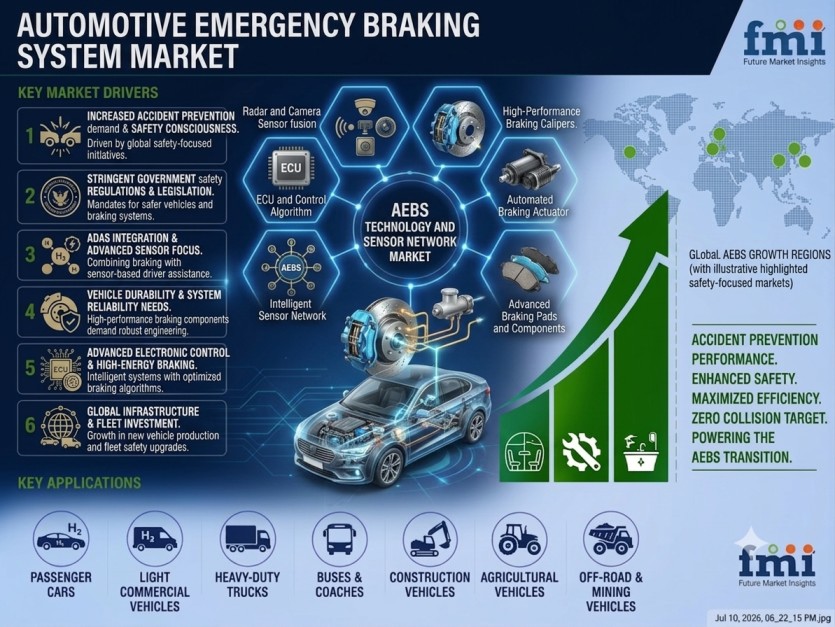
The global Automotive Emergency Braking System (AEBS) Market is entering a period of sustained growth as governments, vehicle safety organizations, and automotive manufacturers prioritize advanced driver assistance technologies to reduce road accidents. Valued at USD 36.9 billion in 2025, the market is expected to reach USD 39.6 billion by the end of 2026 and expand at a compound annual growth rate (CAGR) of 7.5% between 2026 and 2036, reaching USD 81.7 billion by 2036.
Growth is being driven by mandatory implementation of Automatic Emergency Braking (AEB) systems in new vehicles, increasing consumer awareness of vehicle safety, and continuous advancements in sensor technologies, including radar, cameras, LiDAR, and artificial intelligence. As emergency braking evolves from an optional premium feature to standard safety equipment across all vehicle categories, the market is expected to witness widespread adoption worldwide.
Regulatory Mandates Become the Primary Market Driver
Government regulations are transforming the automotive emergency braking system market faster than any previous safety technology. Regulatory agencies across North America, Europe, and Asia-Pacific are introducing mandatory Automatic Emergency Braking requirements aimed at reducing collisions involving vehicles, pedestrians, cyclists, and vulnerable road users.
The European Union’s General Safety Regulation has already made AEB mandatory for many new vehicle models, while the United States National Highway Traffic Safety Administration (NHTSA) continues advancing regulations that will require automatic emergency braking across virtually all new light-duty vehicles.
Safety assessment organizations such as Euro NCAP and the Insurance Institute for Highway Safety (IIHS) have also accelerated adoption by awarding higher safety ratings to vehicles equipped with advanced emergency braking technologies.
As compliance deadlines approach, automotive manufacturers are rapidly expanding AEB deployment across their product portfolios.
Automatic Emergency Braking Systems Dominate Product Demand
Among product categories, Automatic Emergency Braking (AEB) Systems are expected to account for 52.0% of the global market in 2026, making them the largest segment.
Unlike conventional forward collision warning systems that only alert drivers, AEB systems actively intervene when an imminent collision is detected. Using advanced sensor fusion technologies, these systems automatically apply braking force if the driver fails to respond in time.
Modern AEB platforms combine radar sensors, forward-facing cameras, and increasingly LiDAR-based perception systems to monitor surrounding traffic conditions. These technologies enable vehicles to detect obstacles, calculate collision probability, and execute emergency braking under a wide range of driving conditions.
The growing reliability and affordability of sensor technologies continue to strengthen AEB adoption across both premium and mass-market vehicle segments.
Passenger Vehicles Lead Market Adoption
Passenger vehicles are projected to represent 78.0% of total market demand throughout the forecast period.
The combination of regulatory mandates, rising consumer expectations, and competitive safety differentiation has made emergency braking systems nearly standard equipment in many passenger vehicle models.
Family sedans, hatchbacks, sport utility vehicles (SUVs), and crossover vehicles increasingly feature comprehensive emergency braking capabilities as manufacturers seek to achieve top safety ratings while meeting evolving regulatory requirements.
The rapid expansion of Advanced Driver Assistance Systems (ADAS) is expected to further strengthen passenger vehicle demand over the coming decade.
Sensor Fusion Improves Emergency Braking Performance
One of the most significant technological developments shaping the market is the growing use of sensor fusion.
Modern automotive emergency braking systems integrate multiple sensing technologies—including 77 GHz radar, high-resolution cameras, ultrasonic sensors, and LiDAR—to create a highly accurate understanding of the vehicle’s surroundings.
By combining information from multiple sensor types, emergency braking systems achieve greater detection accuracy across varying weather, lighting, and traffic conditions.
Sensor fusion significantly reduces false braking events while improving the system’s ability to recognize pedestrians, cyclists, vehicles, road signs, and unexpected obstacles.
Continuous improvements in artificial intelligence and machine learning algorithms are expected to further enhance collision prediction capabilities during the forecast period.
Emergency Braking Expands Beyond Vehicle-to-Vehicle Protection
The scope of emergency braking technology has evolved considerably over the past decade.
Earlier systems primarily focused on preventing rear-end vehicle collisions. Today’s advanced AEB platforms can identify pedestrians crossing roadways, cyclists traveling alongside traffic, vehicles approaching from intersections, and obstacles encountered during turning maneuvers.
Features such as pedestrian detection, cyclist recognition, junction assist, cross-traffic braking, and intersection collision avoidance are becoming increasingly common across new vehicle models.
Safety organizations now evaluate these expanded capabilities during vehicle testing, encouraging manufacturers to implement more comprehensive emergency braking functions.
Commercial Fleet Adoption Continues to Increase
Although passenger vehicles remain the largest market segment, commercial fleets are increasingly adopting emergency braking technologies to improve operational safety and reduce accident-related costs.
Fleet operators recognize that Automatic Emergency Braking helps reduce insurance premiums, minimize vehicle downtime, improve driver safety, and lower accident-related liabilities.
Logistics companies, ride-sharing operators, public transportation agencies, and commercial vehicle fleets are therefore investing in vehicles equipped with advanced collision mitigation systems.
Growing emphasis on occupational safety and fleet risk management is expected to support continued commercial market expansion.
United States Emerges as the Leading Regional Market
The United States is expected to record the fastest growth among major automotive markets with a CAGR of 7.8% through 2036.
Several factors support this leadership position, including planned NHTSA emergency braking mandates, strong consumer awareness of vehicle safety technologies, and the influence of IIHS Top Safety Pick ratings on purchasing decisions.
Japan closely follows with a 7.7% CAGR, supported by advanced domestic automotive manufacturing capabilities, comprehensive pedestrian safety regulations, and widespread adoption of next-generation driver assistance technologies.
North America, Europe, Japan, South Korea, and China are expected to remain the primary centers for emergency braking system development and deployment.
Competitive Landscape
Competition within the automotive emergency braking system market is centered on sensor accuracy, software intelligence, regulatory compliance, and system integration.
Leading Tier-1 automotive suppliers continue investing heavily in next-generation radar technologies, computer vision, artificial intelligence, and sensor fusion platforms capable of supporting increasingly sophisticated emergency braking applications.
Manufacturers are focusing on improving system performance under low-light conditions, adverse weather, complex urban traffic environments, and mixed road scenarios involving vehicles, pedestrians, cyclists, and motorcycles.
Companies capable of delivering highly reliable, cost-effective, and regulation-compliant AEB solutions across multiple vehicle segments are expected to strengthen their competitive position throughout the forecast period.
Future Outlook
The outlook for the global automotive emergency braking system market remains exceptionally strong as active safety technologies become mandatory across virtually every new vehicle platform.
Growing regulatory pressure, expanding ADAS deployment, advances in sensor technologies, and rising consumer demand for safer vehicles will continue driving sustained market growth through 2036.
As autonomous driving technologies mature, emergency braking systems will become an increasingly important component of intelligent vehicle safety architectures. Suppliers delivering high-performance sensor fusion, reliable collision detection, and comprehensive emergency braking capabilities will play a central role in shaping the future of automotive safety worldwide.
Browse More Reports:
Aircraft Storage, Preservation and Reactivation Services Market – https://www.openpr.com/news/4576801/global-aircraft-storage-preservation-and-reactivation
Battery Pack High-Voltage Wiring System Components Market – https://www.openpr.com/news/4576814/global-battery-pack-high-voltage-wiring-system-components
Seat Comfort and Lumbar Actuator Systems Market – https://www.openpr.com/news/4576829/global-seat-comfort-and-lumbar-actuator-systems-market-forecast