

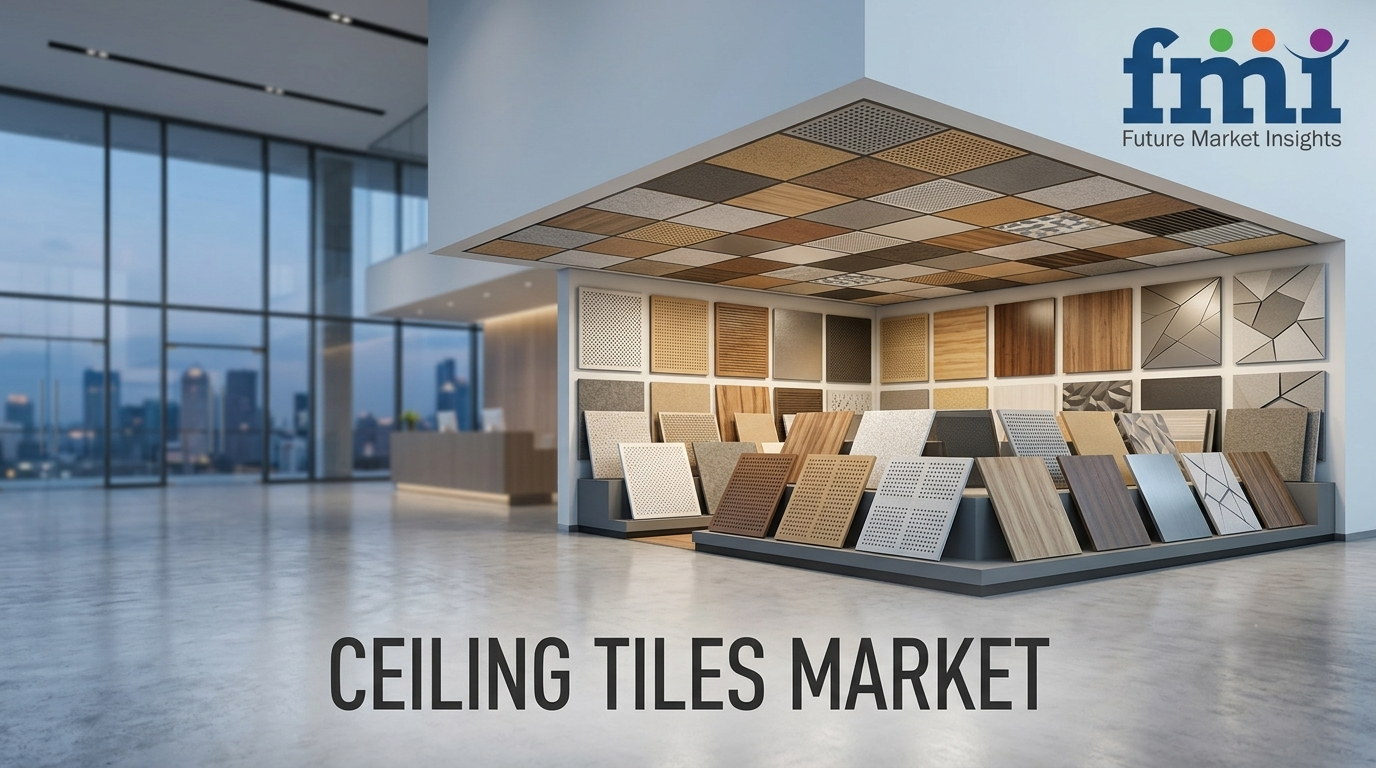
The global ceiling tiles market is poised for steady growth, with Future Market Insights (FMI) estimating market value to increase from USD 10,070.0 million in 2026 to USD 18,033.8 million by 2036, reflecting a CAGR of 6.0%. Growth is being driven by commercial construction, renovation projects, infrastructure modernization, and rising demand for acoustic, fire-rated, and sustainable building materials.
Mineral fiber remains the market leader, accounting for 42.0% of product demand in 2026. Its position is reinforced by the dominance of suspended ceiling systems, which represent 63.0% of installation demand, and commercial applications, which account for 54.0% of total market consumption. Together, these factors create a strong foundation for continued mineral fiber adoption.
Rather than a direct replacement of traditional materials, the market is evolving toward application-based material selection. Metal ceiling tiles are gaining momentum in high-performance and design-focused environments, while gypsum continues to serve fire-rated and smooth-finish construction needs. As building owners increasingly prioritize functionality, aesthetics, sustainability, and lifecycle performance, manufacturers are expanding product innovation across multiple material categories.
Market Overview
The ceiling tiles market is benefiting from increased investments in offices, healthcare facilities, educational institutions, retail developments, and public infrastructure. Modern ceiling systems play a critical role in acoustics, fire safety, energy efficiency, indoor comfort, and access to building services.
Mineral fiber continues to dominate because it addresses the practical requirements of commercial interiors at scale. The material offers a balance of acoustic performance, affordability, installation speed, and maintenance convenience. Its compatibility with suspended grid systems allows easy access to HVAC systems, wiring, sprinklers, and lighting infrastructure, making it a preferred solution across large commercial buildings.
The market’s growth outlook indicates that mineral fiber is not losing relevance; instead, demand is expanding across multiple material categories as project requirements become increasingly specialized.
Key Growth Drivers
- Growing commercial construction and renovation activity worldwide.
- Rising demand for acoustic control in offices, schools, healthcare facilities, and public buildings.
- Strong adoption of suspended ceiling systems, representing 63.0% of installation demand.
- Expansion of public infrastructure, transportation hubs, and institutional facilities.
- Increasing focus on fire-rated, moisture-resistant, and sustainable building materials.
- Large replacement market for aging commercial building interiors.
Technology & Innovation Trends
Innovation in the ceiling tiles market is increasingly focused on performance enhancement. Manufacturers are introducing products with improved acoustic absorption, higher light reflectance, enhanced moisture resistance, and better sag performance.
Sustainability is becoming a major purchasing factor. Suppliers are expanding the use of recycled content, low-emission materials, and environmentally certified products to align with green building standards. Digital design tools and specification-driven procurement processes are also encouraging the adoption of performance-based ceiling solutions.
Metal ceiling systems are evolving through perforated designs combined with acoustic backing, enabling both sound control and architectural appeal. At the same time, gypsum manufacturers are strengthening portfolios with moisture-resistant and fire-rated products designed to meet modern building code requirements.
Market Challenges & Restraints
Despite favorable demand trends, cost remains a significant challenge. Metal ceiling systems typically require higher material and installation investments, limiting their adoption in cost-sensitive projects. Buyers must also evaluate factors such as weight, corrosion resistance, finishing requirements, and acoustic performance.
Gypsum ceilings, while valued for smooth finishes and fire resistance, can be less practical in applications requiring frequent access to building services. In addition, established contractor preferences, procurement specifications, and institutional purchasing standards often favor familiar materials, making product substitution more difficult.
These factors continue to support mineral fiber’s strong market position despite growing competition from alternative materials.
Segment Analysis
Mineral fiber leads the market with a 42.0% share in 2026. Its popularity stems from strong acoustic performance, affordability, ease of replacement, and broad availability across commercial projects. Open-plan offices, schools, healthcare facilities, retail stores, and public buildings remain key demand centers.
Metal ceiling tiles are expanding their presence in airports, hospitals, laboratories, commercial kitchens, industrial offices, and premium retail environments. Their durability, hygiene benefits, fire performance, and architectural flexibility make them attractive for high-traffic and specialized applications.
Gypsum maintains an important role in corridors, lobbies, residential buildings, and institutional interiors where smooth finishes, fire resistance, and design continuity are prioritized. While gypsum is less suited to environments requiring frequent maintenance access, it remains highly relevant in fire-rated and visually integrated spaces.
Suspended ceiling systems account for 63.0% of installation demand, reflecting their importance in commercial buildings where service accessibility is critical. By end use, commercial applications represent 54.0% of total market demand, making offices, healthcare facilities, educational institutions, retail centers, and public infrastructure the primary drivers of material selection.
Regional Analysis
Developed markets continue to provide strong growth opportunities. The United States is expected to expand at a CAGR of 5.7% through 2036, supported by large commercial building inventories, renovation cycles, and infrastructure investments.
The European Union is projected to grow at a CAGR of 5.6% during the same period. Building modernization programs, sustainability regulations, and specification-driven procurement practices continue to support market expansion across the region.
These mature markets favor mineral fiber due to established commercial usage patterns while also creating opportunities for metal and gypsum products in performance-driven projects.
Competitive Landscape and Leading Companies Analysis
Competition is increasingly centered on application-specific performance rather than direct material replacement. Mineral fiber manufacturers are focusing on acoustic improvements, cleanability, recycled content, low-emission certifications, and expanded design options to maintain leadership.
Metal ceiling suppliers are targeting premium segments by combining durability, aesthetic flexibility, hygiene benefits, and acoustic functionality. Meanwhile, gypsum producers continue to strengthen offerings through advanced fire-rated and moisture-resistant solutions.
The market is gradually shifting toward multi-material strategies, with suppliers seeking to address a broader range of building requirements rather than relying on a single product category.
Investment & Strategic Developments and Future Outlook
Investment activity is increasingly focused on sustainable manufacturing, performance innovation, and renovation-driven demand. Ceiling replacement projects offer building owners cost-effective opportunities to improve acoustics, aesthetics, and energy efficiency without major structural modifications.
Looking ahead, ceiling procurement is expected to become more segmented by room function. A single building may utilize mineral fiber in office spaces, metal in high-traffic lobbies, gypsum in corridors, and specialty systems in healthcare environments. This trend supports growth across multiple material categories while preserving mineral fiber’s volume leadership.
Related Reports:
https://www.openpr.com/news/4322676/united-states-2-ethyl-anthraquinone-market-report-2026-2036
https://www.openpr.com/news/4322679/japan-s-lead-zirconate-titanate-market-outlook-2026-2036
https://www.openpr.com/news/4322687/japan-hydro-processing-catalysts-market-forecast-2026-2036
FMI Custom Research: Strategic Intelligence for Confident Decision-Making
In today’s rapidly evolving business environment, leadership teams need more than market data—they need clear, actionable intelligence tailored to their strategic objectives. FMI’s Custom Research solutions are designed around the specific business questions organizations need answered, enabling executives to evaluate growth opportunities, validate investments, assess competitive dynamics, and reduce uncertainty before making critical decisions. By combining deep industry expertise, primary research, and proprietary market intelligence, FMI delivers insights that help organizations move from assumptions to evidence-based strategies with greater speed and confidence.
Key Executive Benefits
- Decision-Ready Insights: Research tailored to your specific business challenges, growth plans, and investment priorities.
- Reduced Strategic Risk: Validate market opportunities, customer demand, and competitive positioning before committing resources.
- Market Entry Confidence: Assess opportunity size, regulatory barriers, channel dynamics, and competitive landscapes with precision.
- Competitive Advantage: Gain proprietary intelligence unavailable through syndicated reports or internal datasets.
- Faster Growth Decisions: Accelerate expansion, product development, portfolio optimization, and investment planning.
- Primary Market Validation: Access real-world customer, buyer, and stakeholder insights that support high-confidence decision-making.
- Global Industry Expertise: Powered by 100+ analysts, 20,000+ published reports, and 1.6 million+ hours of research experience.
- Proven Track Record: Over 7,000 market-entry engagements completed across six regions and 14 industry sectors with strong client retention.
Business Impact
FMI helps organizations transform market complexity into strategic clarity, enabling leadership teams to identify growth opportunities faster, optimize resource allocation, strengthen competitive positioning, and make high-stakes business decisions with confidence.
To explore how FMI Custom Research can support your strategic priorities, please connect with our team at – sales@futuremarketinsights.com
For Press & Corporate Inquiries
Rahul Singh
AVP – Marketing and Growth Strategy
Future Market Insights, Inc.
+91 8600020075
For Sales - sales@futuremarketinsights.com
For Media - Rahul.singh@futuremarketinsights.com