

According to the latest insights by Future Market Insights, the global Platelet Rich Plasma (PRP) Market is entering a phase of accelerated expansion as healthcare providers increasingly adopt regenerative therapies that offer minimally invasive treatment options across orthopedic, aesthetic, sports medicine, and wound care applications. Growing preference for same-day biologic procedures, coupled with advancements in PRP preparation systems, is positioning platelet-rich plasma as a critical component of modern regenerative medicine.
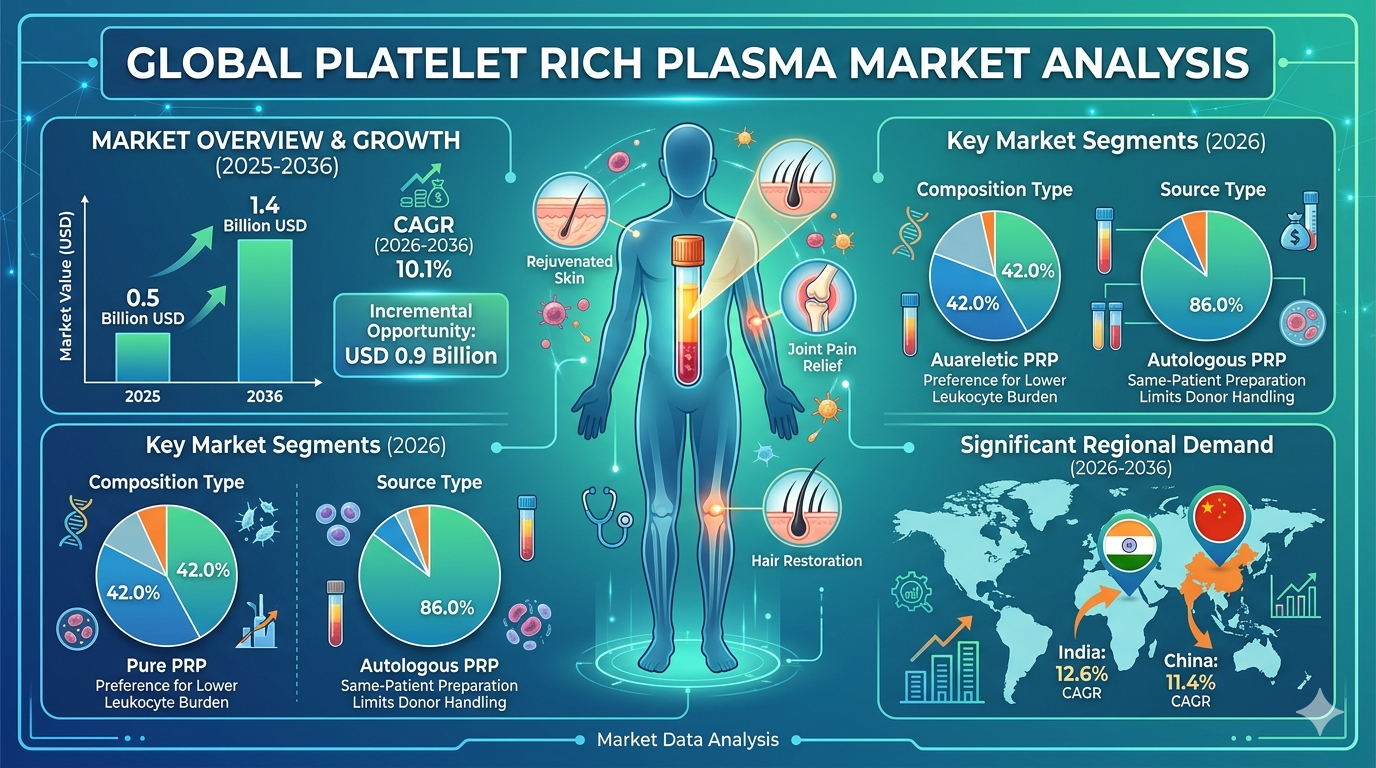
The market was valued at USD 0.5 billion in 2025 and is projected to reach USD 1.4 billion by 2036, expanding at a CAGR of 10.1% during the forecast period. Rising demand for orthopedic pain management, tendon repair, hair restoration therapies, and chronic wound treatment continues to create substantial opportunities for PRP system manufacturers and healthcare providers worldwide.
As clinicians increasingly prioritize patient-specific treatment approaches and healthcare facilities seek cost-effective regenerative solutions, platelet-rich plasma therapies are gaining traction across both developed and emerging healthcare markets.
Quick Market Highlights
- Global platelet rich plasma market projected to grow from USD 0.5 billion in 2025 to USD 1.4 billion by 2036
- Market expected to expand at a CAGR of 10.1% between 2026 and 2036
- Pure platelet-rich plasma anticipated to account for 42.0% of composition type demand in 2026
- Autologous PRP expected to represent 86.0% of source demand due to same-patient preparation advantages
- Orthopedics projected to remain the leading application segment with 34.0% market share in 2026
- India and China expected to emerge as the fastest-growing markets with CAGRs of 12.6% and 11.4%, respectively
Orthopedic Applications Continue to Drive Market Expansion
Orthopedic medicine remains the largest growth engine for platelet-rich plasma therapies as physicians increasingly utilize regenerative biologics to support joint pain management, tendon repair, and musculoskeletal recovery. Growing prevalence of sports injuries, osteoarthritis, and age-related orthopedic conditions is contributing significantly to PRP adoption worldwide.
Clinicians are increasingly seeking treatment alternatives that can complement traditional surgical and pharmaceutical interventions while minimizing recovery times and reducing procedural complexity. PRP therapies provide a practical solution by utilizing a patient’s own blood components, thereby reducing concerns related to donor compatibility and storage requirements.
As healthcare systems continue to emphasize outpatient treatment models and minimally invasive care pathways, orthopedic PRP procedures are expected to witness sustained demand throughout the forecast period.
Aesthetic Medicine Creates Significant Growth Opportunities
The aesthetic healthcare sector is emerging as one of the most dynamic areas of growth for platelet-rich plasma therapies. Dermatology clinics and hair restoration centers are increasingly incorporating PRP into treatment protocols designed to support skin rejuvenation, hair growth stimulation, and overall cosmetic enhancement.
The appeal of PRP within aesthetic medicine stems largely from its ability to be prepared and administered during the same patient visit. This streamlined workflow supports repeat treatment models that generate recurring revenue opportunities for clinics while enhancing patient convenience.
As consumer interest in non-surgical cosmetic procedures continues to rise globally, PRP-based aesthetic treatments are expected to become increasingly mainstream across physician-led specialty clinics.
Wound Care Applications Expand the Clinical Landscape
Beyond orthopedic and aesthetic uses, wound care is emerging as a promising application area for platelet-rich plasma technologies. Healthcare providers are increasingly exploring PRP solutions for diabetic ulcers, venous ulcers, pressure injuries, and other chronic wound conditions that require advanced healing support.
Growing emphasis on reducing long-term wound management costs and improving patient outcomes is encouraging healthcare facilities to evaluate biologic therapies capable of supporting tissue regeneration and healing processes.
As regulatory approvals and clinical evidence continue to expand, wound care applications are expected to create additional revenue streams for manufacturers of PRP preparation systems and biologic treatment platforms.
Autologous PRP Dominates Due to Operational Simplicity
Autologous platelet-rich plasma is projected to account for 86.0% of source demand in 2026, making it the dominant source segment across the global market.
The popularity of autologous PRP stems from its ability to utilize a patient’s own blood, thereby eliminating donor screening requirements, reducing storage complexities, and simplifying clinical workflows. Healthcare providers also view autologous preparation as an efficient approach for delivering personalized regenerative treatments within outpatient settings.
As clinics seek operational efficiency while maintaining high standards of patient safety, autologous systems are expected to retain their leadership position throughout the forecast period.
Advanced Preparation Systems Improve Clinical Consistency
Technology innovation continues to shape competition within the platelet rich plasma market. Healthcare providers increasingly prioritize systems capable of delivering consistent platelet concentrations, simplified preparation workflows, and reduced handling risks.
Manufacturers are focusing investments on:
- Closed-system PRP preparation platforms
- Enhanced platelet recovery technologies
- Improved centrifugation workflows
- Faster point-of-care processing capabilities
- Streamlined clinician training programs
- Greater procedural consistency and reproducibility
As evidence-based medicine gains importance across regenerative healthcare, preparation consistency and clinical reliability are becoming key differentiators among suppliers.
India and China Lead Emerging Market Growth
Asia Pacific continues to offer some of the strongest growth opportunities for platelet-rich plasma providers.
India is expected to register the highest growth rate globally with a CAGR of 12.6% through 2036. Expanding private healthcare infrastructure, growing demand for aesthetic procedures, and increasing adoption of regenerative orthopedic treatments are driving market development across major metropolitan regions.
China is forecast to grow at a CAGR of 11.4% during the assessment period. Rising investments in urban hospitals, expanding specialist care services, and increasing demand for cosmetic and orthopedic treatments continue to support PRP adoption across the country.
Both markets benefit from growing healthcare awareness, increasing disposable incomes, and expanding access to advanced medical technologies.
Competitive Landscape Centers on Clinical Performance and Regulatory Positioning
Competition within the platelet rich plasma market remains moderately fragmented, with global medical device manufacturers and specialized regenerative medicine companies competing for market share.
Leading companies continue to focus on:
- Closed-system preparation technologies
- Faster processing workflows
- Regulatory approvals and clearances
- Physician training initiatives
- Clinical protocol development
- Expansion of specialty clinic partnerships
Organizations capable of delivering reliable preparation systems alongside strong clinical support services are expected to strengthen their competitive position as regenerative medicine adoption accelerates globally.
Key companies operating in the market include Johnson & Johnson, Zimmer Biomet Inc., Arthrex, Inc., Terumo Corporation, EmCyte Corporation, Regen Lab SA, Dr. PRP America LLC, Apex Biologix, CollPlant Biotechnologies Ltd., Nuo Therapeutics, Celling Biosciences, and Royal Biologics.
Outlook: Regenerative Medicine Adoption to Accelerate Through 2036
Looking ahead, platelet-rich plasma therapies are expected to become an increasingly important component of regenerative healthcare strategies worldwide. Growing demand for minimally invasive procedures, expanding clinical evidence, and improvements in preparation technology are creating favorable conditions for long-term market growth.
As orthopedic specialists, dermatologists, wound care centers, and sports medicine providers continue integrating biologic therapies into structured treatment pathways, platelet-rich plasma is expected to move beyond niche applications and become a more standardized element of specialist care.
The coming decade will likely favor suppliers that combine reliable preparation systems, clinical consistency, regulatory compliance, and physician support capabilities to meet the evolving demands of regenerative medicine markets worldwide.
Related Reports:
Europe Platelet Rich Plasma (PRP) Market
Bone Morphogenetic Protein Market
Have a specific Requirements and Need Assistant on Report Pricing or Limited Budget please contact us – sales@futuremarketinsights.com
About Future Market Insights (FMI)
Future Market Insights, Inc. (FMI) is an ESOMAR-certified, ISO 9001:2015 market research and consulting organization, trusted by Fortune 500 clients and global enterprises. With operations in the U.S., UK, India, and Dubai, FMI provides data-backed insights and strategic intelligence across 30+ industries and 1200 markets worldwide.
Contact Us:
Future Market Insights Inc.
Christiana Corporate, 200 Continental Drive,
Suite 401, Newark, Delaware – 19713, USA
T: +1-347-918-3531
Why FMI: https://www.futuremarketinsights.com/why-fmi
For Sales Enquiries: sales@futuremarketinsights.com
Website: https://www.futuremarketinsights.com