

The global fresh food supply chain ecosystem is entering a new era where verified freshness is becoming as valuable as the product itself. Traceability Arbitrage refers to the growing commercial advantage enjoyed by suppliers, processors, distributors, and retailers that can prove origin, handling conditions, temperature integrity, and chain-of-custody records in real time.
According to industry analysis, the blockchain food traceability market is valued at USD 3.03 billion in 2025 and is projected to reach USD 69.22 billion by 2036, expanding at a CAGR of 32.9%. The market’s rapid growth reflects increasing regulatory pressure, retailer audit requirements, rising recall costs, and growing demand for transparency across fresh produce, seafood, dairy, meat, and prepared fresh foods.
As global food systems become increasingly digitized, traceability is evolving from a compliance function into a revenue-generating capability. Companies that can verify freshness and provenance are gaining access to premium retail channels, stronger procurement relationships, and enhanced consumer trust.
Featured Snippet: Key Market Answer
Q: Why are verified freshness premiums persisting in fresh food supply chains?
A: Verified freshness premiums persist because regulators, retailers, and consumers increasingly require proof of origin, handling conditions, and traceability records. Suppliers capable of providing real-time freshness verification reduce recall risks, improve audit performance, strengthen retailer confidence, and gain preferential access to premium shelf space and procurement contracts.
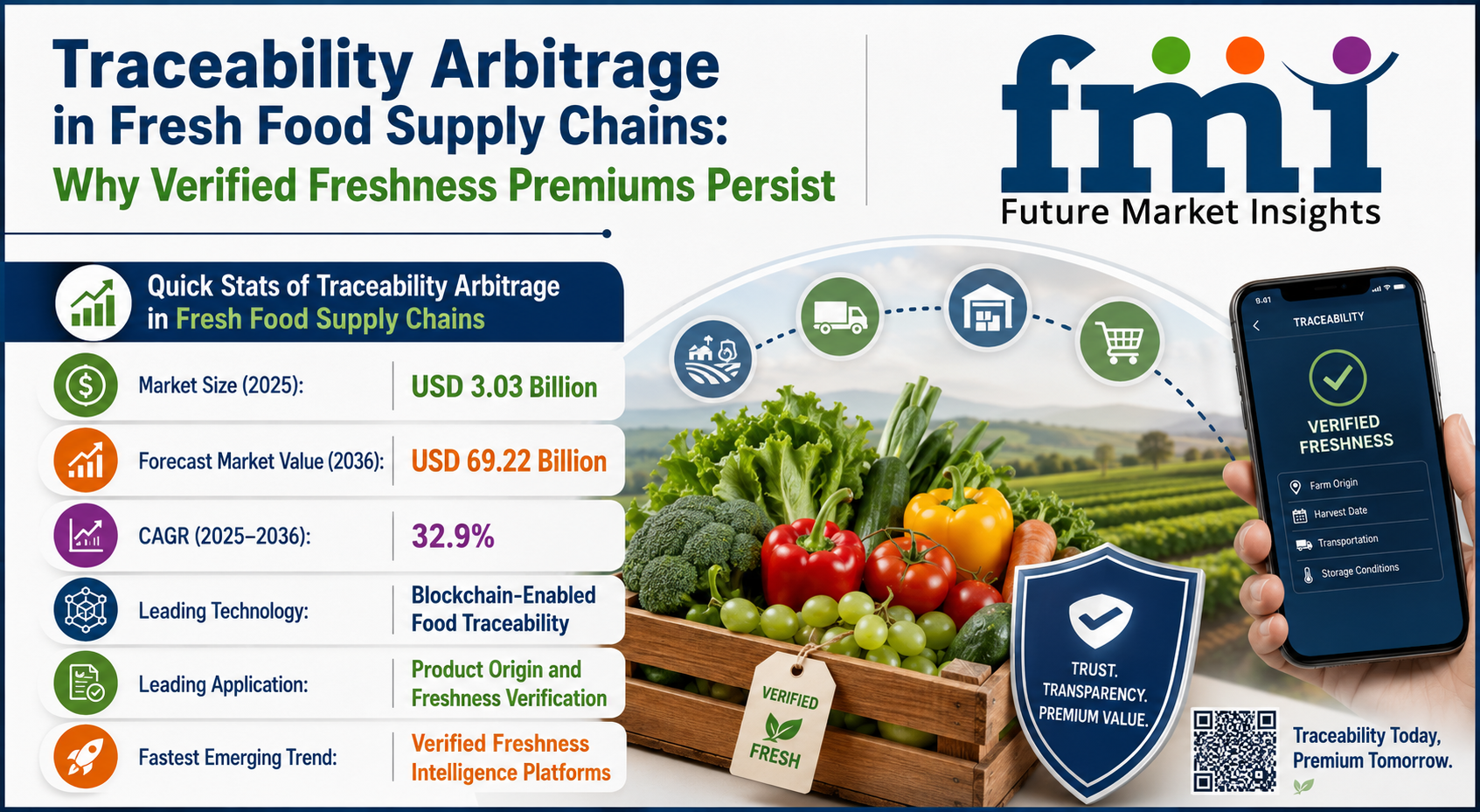
Quick Stats of Traceability Arbitrage in Fresh Food Supply Chains
- Market Size (2025): USD 3.03 Billion
- Forecast Market Value (2036): USD 69.22 Billion
- CAGR (2025–2036): 32.9%
- Leading Technology: Blockchain-Enabled Food Traceability
- Leading Application: Product Origin and Freshness Verification
- Fastest Emerging Trend: Verified Freshness Intelligence Platforms
Market Overview: The Rise of the Proof Economy
Fresh food supply chains are transitioning from product movement to proof movement.
Historically, food businesses relied on paperwork, batch records, and delayed audit documentation to verify compliance. Today, regulators, retailers, and consumers demand real-time visibility into food movement and condition throughout the supply chain.
This shift has created what industry analysts describe as Traceability Arbitrage the value gap between companies that can provide verifiable freshness evidence and those that cannot.
The market encompasses:
- Blockchain food traceability platforms
- FSMA 204 compliance software
- Digital cold-chain monitoring solutions
- Intelligent packaging technologies
- Bio-sensor spoilage detection systems
- Supplier traceability management platforms
- Food safety analytics software
As food recalls become more expensive and supply chains more complex, organizations are investing heavily in technologies that transform compliance records into commercial proof.
Key Growth Drivers
FSMA 204 and Regulatory Compliance Requirements
The FDA’s Food Safety Modernization Act Rule 204 is reshaping food traceability expectations.
Covered entities must maintain Key Data Elements (KDEs) linked to Critical Tracking Events (CTEs) across the food supply chain, significantly increasing demand for automated traceability platforms.
Organizations are investing in software solutions that enable rapid retrieval of traceability records while minimizing compliance risks.
Retailer Audit Pressure
Major retailers increasingly require suppliers to demonstrate traceability readiness before onboarding products.
Verified freshness data has become an important differentiator in supplier evaluation, procurement scoring, and category management decisions.
Rising Recall Costs
Food recalls create significant financial and reputational risks.
Advanced traceability systems help organizations reduce recall radius, identify affected lots faster, and limit disruption to unaffected inventory.
Consumer Demand for Transparency
Consumers increasingly seek evidence regarding food origin, handling conditions, sustainability claims, and freshness.
This trend is accelerating adoption of QR-code-enabled transparency platforms and digital product passports.
Market Trends Shaping the Industry
Predictive Recall Intelligence
The industry is moving from reactive recalls toward predictive containment models.
AI-powered platforms are increasingly capable of estimating affected lots before formal recall notifications are issued.
Blockchain Adoption Accelerates
Blockchain is gaining traction as a trusted framework for sharing traceability information among supply chain participants with disparate systems.
The technology is particularly valuable in environments where multiple stakeholders require shared visibility into product history.
2D Barcode Transformation
GS1 Sunrise 2027 initiatives are driving adoption of 2D barcodes that support richer product information and enhanced traceability capabilities.
These codes connect packaging, logistics systems, retailer operations, and consumer-facing transparency experiences.
Intelligent Packaging Expansion
Smart packaging solutions are becoming important components of freshness verification systems.
Temperature-sensitive indicators, freshness sensors, and interactive packaging technologies are enhancing product visibility throughout the supply chain.
Supplier Readiness Scoring
Retailers and foodservice organizations are increasingly evaluating suppliers based on traceability maturity and compliance readiness.
Supplier traceability scores are emerging as a new procurement metric.
Segment Insights
Technology Leadership: Blockchain Food Traceability
Blockchain-enabled traceability remains the fastest-growing technology segment.
Key benefits include:
- Immutable transaction records
- Enhanced supplier accountability
- Improved recall management
- Cross-organizational data sharing
- Increased consumer trust
The blockchain food traceability market is projected to reach USD 69.22 billion by 2036, making it one of the fastest-growing food technology segments globally.
Application Leadership: Product Traceability and Origin Verification
Product traceability remains the largest application area due to:
- Regulatory compliance requirements
- Retailer verification demands
- Recall preparedness initiatives
- Freshness validation needs
- Consumer transparency expectations
Organizations increasingly view traceability as a strategic asset rather than a compliance obligation.
Related Fresh Food Traceability Markets
FSMA 204 Traceability Data Integration Software
- Market Value (2026): USD 1.2 Billion
- Forecast Value (2036): USD 3.7 Billion
- CAGR: 11.6%
Growth is supported by increasing demand for KDE and CTE management solutions.
Intelligent Packaging Market
- Market Value (2025): USD 28.4 Billion
- Forecast Value (2035): USD 67.2 Billion
- CAGR: 9.0%
Demand is expanding as food companies seek packaging-based freshness verification.
Bio-Sensor Spoilage Labels Market
- Market Value (2026): USD 124.0 Million
- Forecast Value (2036): USD 418.0 Million
- CAGR: 12.9%
Cold-chain perishable foods account for approximately 50% of demand.
Regional Insights
North America
North America remains the leading market due to:
- FSMA-driven compliance requirements
- Strong food safety infrastructure
- Early technology adoption
- Significant retailer influence
The region continues to lead investments in digital food traceability solutions.
Europe
Europe is witnessing robust growth supported by:
- Stringent food safety regulations
- Sustainability reporting initiatives
- Advanced food supply chain networks
- Consumer transparency expectations
Asia-Pacific
Asia-Pacific is expected to register the fastest growth through 2036 owing to:
- Expanding food exports
- Growing cold-chain infrastructure
- Increasing food safety modernization
- Rising demand for premium fresh foods
Emerging Markets
Countries across Southeast Asia, Latin America, and the Middle East are investing heavily in digital traceability systems to improve export competitiveness and food safety standards.
Competitive Landscape
The market is evolving toward integrated freshness intelligence ecosystems that combine traceability, compliance management, sensor monitoring, analytics, and supplier collaboration.
Key Players
- IBM Food Trust
- TraceGains
- Trustwell FoodLogiQ
- Wiliot
- iFoodDS
- GS1 Solution Providers
- SAP Food Traceability Solutions
- Oracle Food Safety Solutions
- Zebra Technologies
- Avery Dennison Smartrac
Competitive Differentiation Factors
- FSMA 204 readiness
- Supplier onboarding capabilities
- Blockchain interoperability
- Sensor integration
- Recall management tools
- Data governance functionality
- Consumer-facing transparency features
- AI-powered analytics
Recent Developments
- Expansion of FSMA 204 readiness programs across North America
- Growing collaboration between supplier management and traceability platforms
- Increased investment in IoT-enabled freshness monitoring
- Adoption of ambient IoT technologies for food safety visibility
- Acceleration of 2D barcode deployment initiatives aligned with GS1 Sunrise 2027
- Development of supplier traceability scoring systems for procurement workflows
Expert Insight
The fresh food industry is entering what can be described as the “Proof Economy Era.”
Historically, suppliers competed on product availability, pricing, and distribution efficiency. The next generation of competitive advantage will come from verified freshness intelligence.
Organizations that can prove origin, handling conditions, cold-chain integrity, and product authenticity in near real time will command stronger retailer relationships, reduced recall exposure, and premium market positioning.
Traceability Arbitrage is therefore not merely a compliance trend it represents a structural transformation in how value is created across food supply chains.
FAQs
What is Traceability Arbitrage in fresh food supply chains?
Traceability Arbitrage refers to the commercial advantage gained by organizations that can provide verifiable proof of origin, freshness, handling conditions, and chain-of-custody records compared to competitors relying on traditional documentation.
Why is FSMA 204 important for the market?
FSMA 204 establishes enhanced traceability record requirements that increase demand for software platforms capable of capturing and managing Critical Tracking Events and Key Data Elements.
Which technology segment is growing the fastest?
Blockchain-enabled food traceability is among the fastest-growing segments, projected to reach USD 69.22 billion by 2036.
How does traceability reduce recall risks?
Advanced traceability platforms help identify affected lots quickly, reduce recall radius, accelerate investigations, and minimize disruption to unaffected inventory.
What role does intelligent packaging play?
Intelligent packaging provides condition-based freshness indicators, temperature monitoring, and consumer-facing transparency features that strengthen product verification.
Which region offers the strongest growth opportunities?
Asia-Pacific is expected to offer the highest long-term growth potential due to food export expansion, supply chain modernization, and increasing food safety investments.
Conclusion
The Traceability Arbitrage market represents one of the most significant transformations occurring across global fresh food supply chains. As regulatory expectations rise and retailer audits become increasingly rigorous, the ability to prove freshness, origin, and product integrity is becoming a strategic business requirement.
Organizations that embrace blockchain traceability, intelligent packaging, predictive recall analytics, and integrated compliance platforms will be better positioned to reduce operational risk, improve supplier performance, and strengthen retailer confidence.
Over the next decade, verified freshness is expected to evolve from a competitive differentiator into a fundamental requirement, making traceability intelligence one of the most valuable layers of the modern food ecosystem.
Related Research Reports
Raw, Fresh and Frozen Dog Food Market is expected to witness steady growth driven by increasing pet humanization trends, rising demand for minimally processed and nutritionally transparent pet food, and growing adoption of personalized subscription-based meal plans for dogs.
Fresh Vegetables Market is expected to witness steady growth driven by rising consumer demand for healthy and nutrient-rich foods, expanding cold-chain and organized retail infrastructure, and increasing preference for organic and pesticide-free fresh produce across global markets.
About Future Market Insights (FMI)
Future Market Insights, Inc. (FMI) is an ESOMAR-certified, ISO 9001:2015 market research and consulting organization, trusted by Fortune 500 clients and global enterprises. With operations in the U.S., UK, India, and Dubai, FMI provides data-backed insights and strategic intelligence across 30+ industries and 1200 markets worldwide.
Contact Us:
Future Market Insights Inc.
Christiana Corporate, 200 Continental Drive,
Suite 401, Newark, Delaware – 19713, USA
T: +1-347-918-3531
Why FMI: https://www.futuremarketinsights.com/why-fmi
For Sales Enquiries: sales@futuremarketinsights.com
Website: https://www.futuremarketinsights.com