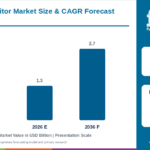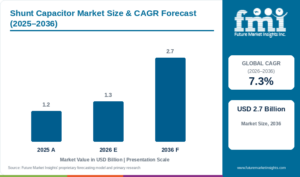


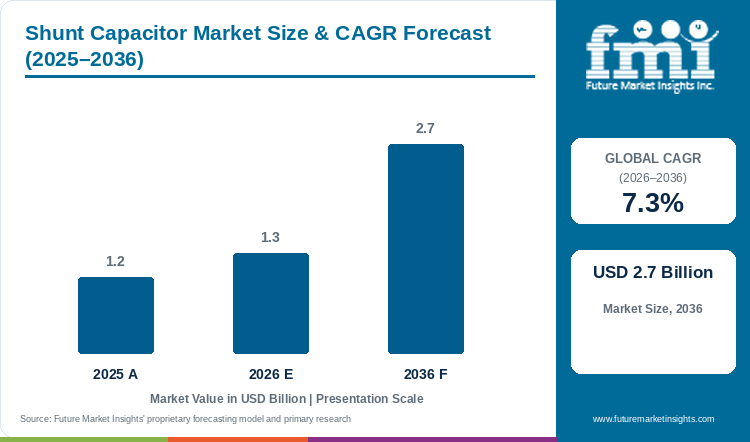
The global shunt capacitor market is gaining momentum as utilities and transmission operators invest in grid reinforcement, voltage regulation, and power system stability. According to Future Market Insights (FMI), the market is estimated at USD 1.3 billion in 2026, up from USD 1.2 billion in 2025, and is projected to reach USD 2.7 billion by 2036, expanding at a CAGR of 7.3% during the forecast period.
Growing electricity consumption and the need to strengthen transmission and distribution infrastructure are increasing demand for shunt capacitor installations. These systems help improve power factor, support voltage regulation, reduce reactive power losses, and enhance the efficiency of electrical networks. Grid reinforcement projects, particularly those undertaken ahead of seasonal peak demand, are creating opportunities for manufacturers and suppliers of shunt capacitor equipment.
Get Detailed Market Forecasts, Competitive Benchmarking & Industry Insights — Request a Sample Report: https://www.futuremarketinsights.com/reports/sample/rep-gb-36182
Shunt Capacitor Market: Key Metrics
- Market Size (2026): USD 1.3 billion
- Forecast Value (2036): USD 2.7 billion
- CAGR (2026–2036):3%
- 2025 Market Valuation: USD 1.2 billion
- Key Demand Drivers: Grid reinforcement, voltage regulation, power factor correction, and electricity network modernization
What Is Driving Demand in the Shunt Capacitor Market?
The growing need to improve power system reliability is a major factor supporting shunt capacitor adoption. Transmission and distribution networks must maintain stable voltage levels while managing increasing electricity loads and changing power demand patterns.
Shunt capacitors provide reactive power compensation, helping utilities improve voltage profiles and reduce the burden on electrical infrastructure. Their deployment is particularly relevant in substations and transmission networks where grid operators seek to strengthen supply capacity and maintain stable operations during peak-demand periods.
Key demand drivers include:
- Grid reinforcement investments: Utilities are upgrading substations and transmission infrastructure to accommodate rising electricity demand and improve network reliability.
- Voltage regulation requirements: Shunt capacitor banks help maintain suitable voltage levels across transmission and distribution networks.
- Power factor correction: Industrial facilities and utilities use capacitor installations to improve power factor and reduce reactive power demand.
- Rising electricity consumption: Growing residential, commercial, and industrial loads are increasing pressure on existing electrical networks.
- Renewable energy integration: Modernizing power infrastructure to accommodate variable renewable generation is increasing the importance of reactive power management and voltage support.
Five Key Trends Shaping the Shunt Capacitor Market
- Grid Modernization and Substation Reinforcement
Utilities are investing in transmission and distribution upgrades to improve electricity supply reliability. Shunt capacitor banks are an important component of these projects, helping strengthen voltage performance and network stability.
- Increasing Focus on Peak-Load Management
Electricity networks face additional pressure during periods of high seasonal consumption. Grid operators are deploying capacitor banks to improve supply capacity and support stable operations during peak-demand conditions.
- Growing Demand for Reactive Power Compensation
Industrial facilities and utilities are increasingly focused on managing reactive power to improve electrical efficiency. Shunt capacitors support power factor correction and help reduce unnecessary reactive power flow through the network.
- Expansion of High-Voltage Transmission Infrastructure
Investment in high-voltage substations and transmission networks is creating opportunities for shunt capacitor installations. These systems help maintain voltage stability across expanding electricity infrastructure.
- Greater Attention to Network Reliability
Power interruptions and voltage fluctuations can affect industrial operations and electricity distribution. Utilities are therefore prioritizing equipment and infrastructure upgrades that improve grid performance and operational resilience.
Real-World Demand Signal: Vietnam’s Transmission Grid Reinforcement
A notable example of shunt capacitor deployment comes from Vietnam’s northern transmission network. On April 30, 2026, EVNNPT energized shunt capacitor banks at 16 substations operating at 220 kV to 500 kV.
The project, titled Installation of Additional 110 kV Shunt Capacitor Banks on the Northern Transmission Grid in 2026, was completed on schedule. The installation improved supply capacity and system stability ahead of the summer peak-demand period.
This development illustrates how transmission operators are using shunt capacitor installations as part of broader grid reinforcement strategies. Similar investments in electricity infrastructure can create opportunities for equipment manufacturers, engineering contractors, and power-system solution providers.
Application Areas and Growth Opportunities
Shunt capacitors serve several applications across power infrastructure and industrial electricity systems.
- Transmission substations: Supporting voltage regulation and reactive power compensation across high-voltage networks.
- Distribution networks: Improving voltage profiles and supporting efficient electricity delivery.
- Industrial facilities: Helping factories and processing plants improve power factor and manage reactive power consumption.
- Renewable energy infrastructure: Supporting voltage management and reactive power requirements in evolving electricity networks.
- Commercial infrastructure: Helping large facilities improve electrical system efficiency and manage power quality.
- Utility grid reinforcement: Strengthening network performance and supporting electricity supply during peak-demand periods.
Competitive Landscape
Competition in the shunt capacitor market is influenced by product reliability, electrical performance, voltage ratings, equipment durability, engineering capabilities, and utility project experience.
Companies operating across relevant power capacitor, reactive power compensation, and electrical infrastructure categories include:
- Hitachi Energy,
- Siemens Energy,
- ABB,
- Schneider Electric,
- Eaton,
- GE Vernova,
- TDK Corporation,
- Vishay Intertechnology,
- Larsen & Toubro,
- Nissin Electric.
Manufacturers are focused on supplying capacitor technologies and power-system solutions that support voltage regulation, reactive power management, and reliable electricity infrastructure. This list represents relevant industry participants and is not a verified market-share ranking.
Implications for Industry Participants
The projected expansion of the shunt capacitor market creates opportunities for electrical equipment manufacturers, utility suppliers, engineering contractors, and power infrastructure developers.
- Manufacturers can strengthen product portfolios with reliable capacitor banks and solutions designed for different voltage levels and operating conditions.
- Utilities and transmission operators can prioritize reactive power compensation as part of grid reinforcement and voltage management programs.
- Engineering and EPC companies can expand their role in substation upgrades and capacitor bank installation projects.
- Industrial electricity users can evaluate power factor correction investments to improve electrical efficiency and manage reactive power costs.
- Technology providers can develop integrated solutions for grid monitoring, voltage management, and power quality improvement.
Future Outlook
The global shunt capacitor market is expected to experience sustained growth through 2036 as electricity networks undergo modernization and utilities strengthen infrastructure to accommodate rising power demand.
With market valuation projected to increase from USD 1.3 billion in 2026 to USD 2.7 billion by 2036, the industry presents opportunities for manufacturers and service providers supporting transmission upgrades, substation expansion, and industrial power quality management.
The long-term outlook will depend on the pace of grid investment, expansion of high-voltage infrastructure, and the growing requirement for reliable reactive power compensation across electricity networks.
Read the Full Report: https://www.futuremarketinsights.com/reports/shunt-capacitor-market
About the Shunt Capacitor Market Report
Future Market Insights’ Shunt Capacitor Market report provides analysis of market size, growth prospects, demand drivers, industry developments, and opportunities across the forecast period.
- Report Updated: November 10, 2026
- Author: Nikhil Kaitwade
- Report Length: 250 pages
- Forecast Period: 2026–2036
- Global Market Size (2026): USD 1.3 billion
- Global Market Forecast (2036): USD 2.7 billion
- CAGR:3%
Frequently Asked Questions
- What is the global shunt capacitor market size in 2026?
The global shunt capacitor market is estimated to reach USD 1.3 billion in 2026.
- What is the projected shunt capacitor market value by 2036?
The market is projected to reach USD 2.7 billion by 2036.
- What is the expected CAGR of the shunt capacitor market?
The market is expected to expand at a CAGR of 7.3% between 2026 and 2036.
- What was the shunt capacitor market value in 2025?
The market was valued at USD 1.2 billion in 2025.
- What factors are driving shunt capacitor market growth?
Key growth drivers include grid modernization, transmission and substation reinforcement, voltage regulation, power factor correction, rising electricity demand, and the need for improved power system stability.
Related Reports:
Conveyor Dryer Market- https://www.futuremarketinsights.com/reports/conveyor-dryer-market
USA Power Tool Market- https://www.futuremarketinsights.com/reports/united-states-power-tool-market
Emulsion Explosive Market- https://www.futuremarketinsights.com/reports/emulsion-explosive-market
About Future Market Insights (FMI)
Future Market Insights (FMI) is a market research and consulting organization providing insights, analysis, and strategic intelligence to businesses across industries. FMI helps organizations understand market trends, identify growth opportunities, and make informed business decisions through data-driven research and industry expertise.
Media Contact
Rahul Singh
AVP – Marketing and Growth Strategy
Future Market Insights, Inc.
Phone: +91 8600020075
Email: sales@futuremarketinsights.com
Rahul.singh@futuremarketinsights.com
Website: www.futuremarketinsights.com