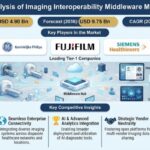


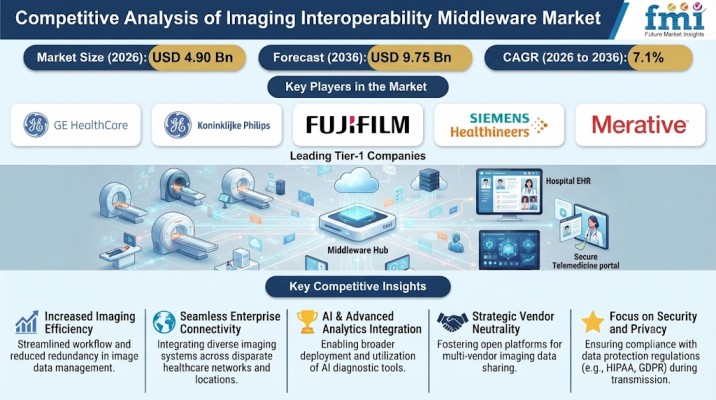
NEWARK, Del., November 25, 2026 — The global Imaging Interoperability Middleware Market is estimated to reach USD 4.90 billion in 2026, compared with USD 4.60 billion in 2025, and is projected to reach USD 9.75 billion by 2036, registering a CAGR of 7.1% between 2026 and 2036. Growth is supported by increasing healthcare digitalization, rising demand for cross-platform medical image exchange, cloud-based imaging infrastructure and the need to eliminate data silos across multi-site healthcare networks.
According to Future Market Insights (FMI), healthcare providers are increasingly investing in interoperability middleware to connect disparate Picture Archiving and Communication Systems (PACS), electronic health records (EHRs), diagnostic imaging platforms and vendor-neutral archives. The technology enables standardized medical image access, metadata normalization and secure information exchange across complex healthcare IT environments.
Request For Sample: https://www.futuremarketinsights.com/reports/sample/rep-gb-32260
Key Growth Indicators
- Market value: USD 4.90 billion in 2026.
- Forecast value: USD 9.75 billion by 2036.
- Growth rate:1% CAGR between 2026 and 2036.
- Key growth driver: Increasing adoption of interoperable healthcare IT infrastructure and demand for seamless medical image exchange.
- Leading component: Software, accounting for 61.4% share in 2026.
- Major deployment: Cloud-based platforms, accounting for 55.0% share in 2026.
- Dominant end user: Hospitals, accounting for 41.7% share in 2026.
- Leading application: Clinical imaging, accounting for 67.2% share in 2026.
Why Is Demand for Imaging Interoperability Middleware Increasing?
The growing volume of medical imaging data is increasing the need for healthcare IT systems that can exchange information across different platforms. Hospitals routinely generate imaging data through MRI, CT, ultrasound, digital radiography and other diagnostic modalities. However, fragmented storage environments and incompatible software architectures can restrict access to these records.
Imaging interoperability middleware addresses these challenges by connecting different imaging systems and enabling standardized data exchange. Healthcare providers can access medical images across departments, facilities and diagnostic networks without depending exclusively on proprietary platforms.
The expansion of multi-site hospital networks is another important growth factor. Healthcare organizations involved in mergers, acquisitions and regional expansion frequently operate multiple imaging systems. Middleware solutions help consolidate these environments and improve information accessibility across clinical departments.
The adoption of cloud-based healthcare infrastructure is also supporting demand. Cloud-native middleware platforms allow healthcare organizations to manage increasing imaging workloads, improve scalability and reduce dependence on localized IT infrastructure.
Imaging Interoperability Middleware and Healthcare Data Exchange Shape Market Demand
Imaging interoperability middleware functions as an integration layer between medical imaging equipment, storage repositories, diagnostic viewers and healthcare information systems. These solutions facilitate the translation, normalization and routing of imaging data across different technical environments.
Software accounted for 61.4% of market demand in 2026, reflecting the importance of metadata normalization, API-based connectivity and automated imaging workflows.
Key capabilities include:
- DICOM integration: Supporting standardized exchange of medical imaging information across compatible healthcare systems.
- FHIR-based interoperability: Connecting imaging metadata with broader healthcare information exchange frameworks.
- Metadata normalization: Standardizing inconsistent imaging records and proprietary data formats.
- Patient identity reconciliation: Helping match imaging records with the correct patient information across healthcare networks.
- Vendor-neutral image routing: Enabling medical images to move between different storage and diagnostic viewing environments.
- Cross-platform accessibility: Supporting authorized access to imaging information across hospitals and diagnostic facilities.
The increasing use of RESTful APIs, DICOM standards and FHIR-based architectures is encouraging healthcare providers to move away from fragmented, proprietary imaging environments.
Hospitals and Cloud-Based Infrastructure Influence Procurement
Hospitals represent the largest end-user segment, accounting for 41.7% of market demand in 2026. Their adoption is supported by the need to consolidate imaging information across radiology, cardiology, oncology and other clinical departments.
Large healthcare networks require interoperability platforms that enable physicians to access diagnostic images without navigating multiple disconnected systems.
Cloud-based deployment accounts for 55.0% of the market in 2026, reflecting growing preference for scalable infrastructure and reduced dependence on on-premise data centers.
Cloud-based middleware offers several operational advantages, including:
- Scalability: Supporting growing volumes of high-resolution medical imaging data.
- Centralized access: Connecting multiple hospitals and diagnostic facilities through shared infrastructure.
- Disaster recovery: Supporting data availability through distributed infrastructure.
- Lower infrastructure requirements: Reducing dependence on extensive localized hardware investments.
- Integration flexibility: Supporting connections between different imaging applications and healthcare information systems.
Hospitals also evaluate vendors based on data security, system compatibility, implementation complexity, maintenance support and compliance with healthcare information exchange standards.
Regional Growth Opportunities in Imaging Interoperability Middleware
Regional adoption is influenced by healthcare digitalization, government-supported interoperability initiatives, hospital modernization and investments in cloud-based medical imaging infrastructure.
China is projected to record the highest country-level growth rate among the countries highlighted in the FMI report.
- China: Demand is projected to grow at a CAGR of 9.5% from 2026 to 2036, supported by interconnected medical center initiatives and investments in regional healthcare information exchange.
- India: The market is expected to expand at 9.1% CAGR, supported by corporate hospital expansion, digital healthcare investments and cloud-native hospital infrastructure.
- United States: Demand is forecast to increase at 8.2% CAGR, reflecting healthcare IT modernization and increasing emphasis on standardized medical image accessibility.
- United Kingdom: The market is projected to grow at 8.0% CAGR, supported by NHS integration initiatives and investments in connected healthcare systems.
- Germany: Demand is expected to rise at 7.5% CAGR, supported by hospital digitalization and investments in interoperable clinical infrastructure.
- Japan: The market is forecast to expand at 7.1% CAGR, reflecting healthcare modernization and increasing demand for connected regional care networks.
- Brazil: The market is expected to register 6.8% CAGR, supported by investments in cost-efficient imaging exchange and healthcare IT modernization.
Competitive Landscape: Vendor-Neutral Imaging and API-Based Integration Define Competition
The Imaging Interoperability Middleware Market includes established medical imaging manufacturers, healthcare IT providers and specialized enterprise imaging software companies. Competition is shaped by system compatibility, metadata normalization, cloud deployment capabilities, FHIR integration and the ability to connect heterogeneous imaging environments.
Notable companies include:
- GE HealthCare
- Koninklijke Philips N.V.
- FUJIFILM Corporation
- Siemens Healthineers
- Merative
- Agfa-Gevaert Group
- Sectra AB
- Mach7 Technologies
GE HealthCare, Philips, FUJIFILM and Siemens Healthineers participate in the broader enterprise imaging and healthcare technology ecosystem, leveraging their established imaging infrastructure and healthcare IT capabilities.
Sectra AB and Mach7 Technologies strengthen the competitive environment through enterprise imaging, vendor-neutral image management and interoperability-oriented solutions.
Merative and Agfa-Gevaert Group also participate in healthcare imaging and information management markets, supporting the broader ecosystem of connected clinical imaging technologies.
The competitive environment increasingly favors vendors that can integrate different imaging formats, support cloud-based deployment and provide reliable connections with existing hospital IT infrastructure.
As healthcare organizations seek to reduce vendor dependency, companies offering open architecture, automated metadata normalization and cross-enterprise image exchange capabilities may gain stronger competitive positioning.
Access Full Report: https://www.futuremarketinsights.com/reports/imaging-interoperability-middleware-market
What Should Imaging Interoperability Middleware Manufacturers Prioritize?
Manufacturers should prioritize software platforms that enable seamless medical image exchange across different healthcare information systems. Compatibility with DICOM, FHIR and RESTful API architectures will remain important as hospitals modernize their imaging infrastructure.
Investment in automated metadata normalization and patient identity reconciliation can help address interoperability challenges associated with fragmented imaging records.
Companies should also strengthen cloud-based deployment capabilities, data security and integration with existing EHR and PACS platforms. Flexible implementation models can help healthcare providers modernize their systems without replacing their entire imaging infrastructure.
Emerging markets, particularly China and India, offer additional growth opportunities as hospital networks expand and healthcare providers invest in connected diagnostic infrastructure.
Frequently Asked Questions
- How large is the Imaging Interoperability Middleware Market in 2026?
The global market is estimated to reach USD 4.90 billion in 2026, supported by increasing healthcare digitalization and demand for seamless medical image exchange.
- What is the projected market value by 2036?
The market is projected to reach USD 9.75 billion by 2036, registering approximately 7.1% CAGR between 2026 and 2036.
- What is driving demand for imaging interoperability middleware?
Increasing medical imaging data volumes, healthcare IT modernization, cloud-based deployments, multi-site hospital expansion and demand for standardized image exchange are supporting market growth.
- Which component segment accounts for the largest market share?
Software accounts for the largest component share, representing approximately 61.4% of the market in 2026, supported by demand for metadata normalization, API connectivity and automated imaging integration.
- Which deployment segment dominates the market?
Cloud-based platforms account for approximately 55.0% of market demand in 2026, reflecting increasing preference for scalable healthcare imaging infrastructure.
- Which end-user segment dominates the market?
Hospitals account for approximately 41.7% of the market in 2026, supported by the need to integrate imaging information across multiple clinical departments and healthcare facilities.
- Which country is expected to record the fastest market growth?
China is projected to record the fastest growth among the highlighted countries, with a CAGR of 9.5% between 2026 and 2036.
- Who are the key companies in the Imaging Interoperability Middleware Market?
GE HealthCare, Koninklijke Philips N.V., FUJIFILM Corporation, Siemens Healthineers, Merative, Agfa-Gevaert Group, Sectra AB and Mach7 Technologies are among the key companies.
Related Reports:
- Provider Directory Accuracy Management Market – https://www.futuremarketinsights.com/reports/provider-directory-accuracy-management-market
- Immunostimulants Market – https://www.futuremarketinsights.com/reports/immunostimulants-market
- Gabapentin Market – https://www.futuremarketinsights.com/reports/gabapentin-market
About Future Market Insights (FMI)
Future Market Insights (FMI) is a global market intelligence and consulting firm providing comprehensive market research, competitive intelligence, and strategic business insights across industries. The firm delivers detailed forecasts, technology analysis, and data-driven recommendations that support informed decision-making for manufacturers, investors, distributors, and policymakers worldwide.
For Press & Corporate Inquiries
Rahul Singh
AVP – Marketing and Growth Strategy
Future Market Insights, Inc.
+91 8600020075
For Sales – sales@futuremarketinsights.com
For Media – Rahul.singh@futuremarketinsights.com
For Web – https://www.futuremarketinsights.com