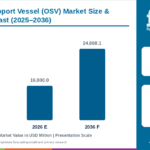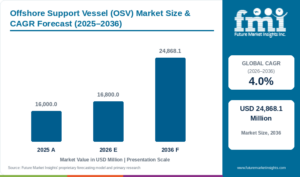


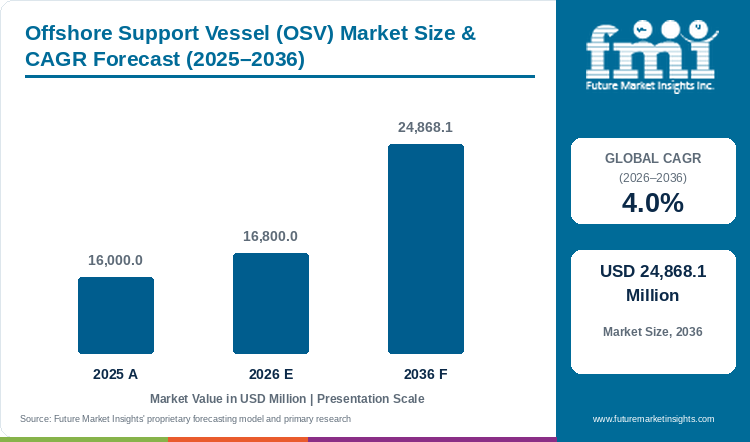
The global offshore support vessel (OSV) market is experiencing steady growth as offshore energy operators, subsea contractors, and marine service providers require specialized vessels to support increasingly complex offshore operations. According to Future Market Insights (FMI), the market is estimated at USD 16,800.0 million (USD 16.8 billion) in 2026, up from USD 16,000.0 million in 2025, and is projected to reach USD 24,868.1 million (approximately USD 24.9 billion) by 2036, expanding at a CAGR of 4.0% during the forecast period.
Offshore support vessels play a critical role in transporting equipment, supplies, and personnel to offshore installations while supporting subsea operations, construction projects, and maintenance activities. Demand is increasingly influenced by the type and complexity of offshore work being performed, with specialized services offering opportunities beyond conventional cargo and platform supply operations.
Get Detailed Market Forecasts, Competitive Benchmarking & Industry Insights — Request a Sample Report: https://www.futuremarketinsights.com/reports/sample/rep-gb-36188
Offshore Support Vessel (OSV) Market: Key Metrics
- Market Size (2026): USD 16,800.0 million
- Forecast Value (2036): USD 24,868.1 million
- CAGR (2026–2036):0%
- 2025 Market Valuation: USD 16,000.0 million
- Leading Vessel Type: Platform Supply Vessels (PSVs) in FMI’s 2026 outlook
- Emerging Growth Area: Service and construction support, projected to overtake platform supply vessels by 2036
What Is Driving Demand in the Offshore Support Vessel Market?
The continued requirement for offshore logistics, energy infrastructure maintenance, and specialized marine services is a major factor supporting OSV market growth. Offshore operators depend on these vessels to transport supplies, equipment, and personnel while maintaining safe and efficient operations in challenging marine environments.
The market is also evolving as subsea intervention and offshore project execution require vessels equipped with specialized systems and technical capabilities. These activities can involve advanced equipment, skilled personnel, and operational support beyond the requirements of conventional supply vessels.
Key demand drivers include:
- Offshore energy operations: Continued activity across offshore oil and gas developments supports demand for vessels transporting personnel, equipment, and essential supplies.
- Subsea intervention requirements: Complex underwater operations require specialized vessels with suitable equipment and technical support capabilities.
- Offshore construction projects: Installation, maintenance, and project execution activities create demand for construction-support vessels.
- Charter market dynamics: Vessel utilization, operating capability, and day rates influence charter earnings and fleet deployment decisions.
- Specialized marine services: Demand for vessels capable of performing higher-value offshore tasks is creating opportunities beyond traditional platform supply operations.
Five Key Trends Shaping the Offshore Support Vessel Market
- Platform Supply Vessels Retain a Leading Position
Platform Supply Vessels (PSVs) remain the leading individual vessel type in FMI’s 2026 market outlook. These vessels transport essential supplies, equipment, and materials to offshore platforms, making them an important part of offshore logistics operations.
- Service and Construction Support Gains Importance
FMI projects that service and construction support will overtake platform supply vessels by 2036. This shift reflects increasing demand for specialized offshore activities, including subsea intervention, infrastructure installation, and complex project execution.
- Specialized Vessel Capabilities Influence Charter Demand
Charter earnings increasingly reflect the type of work a vessel can perform rather than fleet size alone. Vessels with specialized equipment, technical systems, and skilled personnel can address more complex offshore requirements.
- Day-Rate Performance Shapes Market Economics
Charter day rates remain an important indicator of offshore vessel market conditions. Tidewater reported that its average day rate increased by 6.1% in 2025, while revenue grew by 0.5%. This highlights how changes in vessel pricing and utilization can influence operator performance.
- Subsea Intervention Creates Higher-Value Opportunities
Subsea intervention and offshore project execution often require more than basic cargo transportation. Specialized equipment and personnel are creating opportunities for vessels designed to support technically demanding offshore operations.
Application Areas and Growth Opportunities
Offshore support vessels serve a wide range of marine and offshore energy activities.
- Offshore oil and gas operations: Transporting personnel, supplies, equipment, and materials to offshore production facilities.
- Platform supply services: Delivering essential cargo and operational supplies to offshore installations.
- Subsea intervention: Supporting underwater inspection, maintenance, repair, and intervention activities.
- Offshore construction: Assisting with installation, infrastructure development, and offshore project execution.
- Maintenance and repair: Providing marine logistics and technical support for offshore facilities.
- Offshore renewable energy: Supporting suitable marine logistics, construction, and maintenance activities associated with offshore wind infrastructure.
Competitive Landscape
Competition in the offshore support vessel market is influenced by fleet capability, vessel availability, technical specifications, charter rates, operational efficiency, geographic presence, and the ability to support specialized offshore projects.
Companies operating across relevant offshore vessel ownership, marine services, and offshore support categories include Tidewater Inc., SEACOR Marine Holdings Inc., Edison Chouest Offshore, DOF Group, Solstad Offshore, Bourbon, Maersk Supply Service, Swire Pacific Offshore, Siem Offshore, and MMA Offshore.
Market participants are focused on fleet optimization, vessel upgrades, operational efficiency, and specialized service capabilities to address changing offshore project requirements. This list represents relevant industry participants and is not a verified market-share ranking.
Implications for Industry Participants
The projected expansion of the OSV market creates opportunities for vessel owners, charter operators, offshore contractors, shipbuilders, and marine equipment suppliers.
- Vessel owners and operators can focus on fleet optimization and specialized vessel capabilities to serve evolving offshore project requirements.
- Charter service providers can strengthen commercial strategies around vessel utilization, day rates, and long-term customer relationships.
- Shipbuilders and equipment manufacturers can develop vessels and onboard systems suited to subsea intervention and offshore construction.
- Offshore energy companies can work with specialized marine operators to improve project logistics and operational efficiency.
- Marine technology providers can support vessel performance through navigation, monitoring, automation, and operational management solutions.
Future Outlook
The global offshore support vessel market is expected to expand steadily through 2036 as offshore energy operations, subsea intervention, and specialized marine construction activities sustain demand for support vessels.
With market valuation projected to increase from USD 16.8 billion in 2026 to approximately USD 24.9 billion by 2036, the industry presents opportunities for operators that can align vessel capabilities with higher-value offshore work.
The anticipated shift toward service and construction support also highlights the importance of specialized equipment, technical expertise, and operational flexibility. Long-term market performance will depend on offshore project activity, charter-rate conditions, fleet utilization, and investment in advanced marine capabilities.
Read the Full Report: https://www.futuremarketinsights.com/reports/offshore-support-vessel-osv-market
About the Offshore Support Vessel (OSV) Market Report
Future Market Insights’ Offshore Support Vessel (OSV) Market report provides insights into market size, growth prospects, vessel-type developments, demand drivers, competitive dynamics, and opportunities across the forecast period.
- Report Updated: November 11, 2026
- Author: Nikhil Kaitwade
- Report Length: 250 pages
- Forecast Period: 2026–2036
- Global Market Size (2026): USD 16,800.0 million
- Global Market Forecast (2036): USD 24,868.1 million
- CAGR:0%
Frequently Asked Questions
- What is the global offshore support vessel market size in 2026?
The global offshore support vessel market is estimated to reach USD 16,800.0 million in 2026.
- What is the projected OSV market value by 2036?
The market is projected to reach USD 24,868.1 million by 2036.
- What is the expected CAGR of the offshore support vessel market?
The market is expected to expand at a CAGR of 4.0% between 2026 and 2036.
- Which vessel type holds the leading position in the 2026 outlook?
Platform Supply Vessels (PSVs) retain the leading individual vessel-type share in FMI’s 2026 outlook.
- Which vessel segment is projected to gain importance by 2036?
Service and construction support is projected to overtake platform supply vessels by 2036, reflecting demand for specialized offshore services and project execution.
Related Reports
Biomass Boiler Market
https://www.futuremarketinsights.com/reports/biomass-boiler-market
Industrial Cooling Systems Market: https://www.futuremarketinsights.com/reports/industrial-cooling-systems-market
Ductless Heating & Cooling Systems Market: https://www.futuremarketinsights.com/reports/ductless-heating-and-cooling-systems-market
About Future Market Insights (FMI)
Future Market Insights (FMI) is a market research and consulting organization providing insights, analysis, and strategic intelligence to businesses across industries. FMI helps organizations understand market trends, identify growth opportunities, and make informed business decisions through data-driven research and industry expertise.
Media Contact
Rahul Singh
AVP – Marketing and Growth Strategy
Future Market Insights, Inc.
Phone: +91 8600020075
Email: sales@futuremarketinsights.com
Rahul.singh@futuremarketinsights.com
Website: www.futuremarketinsights.com