

The global sustainable packaging market is projected to increase from US$319.3 billion in 2026 to US$561.1 billion by 2036, registering a compound annual growth rate (CAGR) of 5.8% during the 2026–2036 forecast period, according to Future Market Insights (FMI). The market was valued at US$301.8 billion in 2025. Growing consumer demand, expansion of organized retail and changing product quality, labeling and sustainability requirements are supporting the industry’s long-term development.
Sustainable packaging encompasses commercially traded packaging products and solutions across material types, packaging formats, sustainability categories, barrier properties and end-of-life options. Manufacturers are increasingly evaluating recyclable, reusable and compostable formats while balancing product protection, cost efficiency and regulatory compliance.
>> Get Detailed Market Forecasts, Competitive Benchmarking, and Pricing Trends: https://www.futuremarketinsights.com/reports/sample/rep-gb-16824
Paper and Paperboard Lead Sustainable Packaging Demand
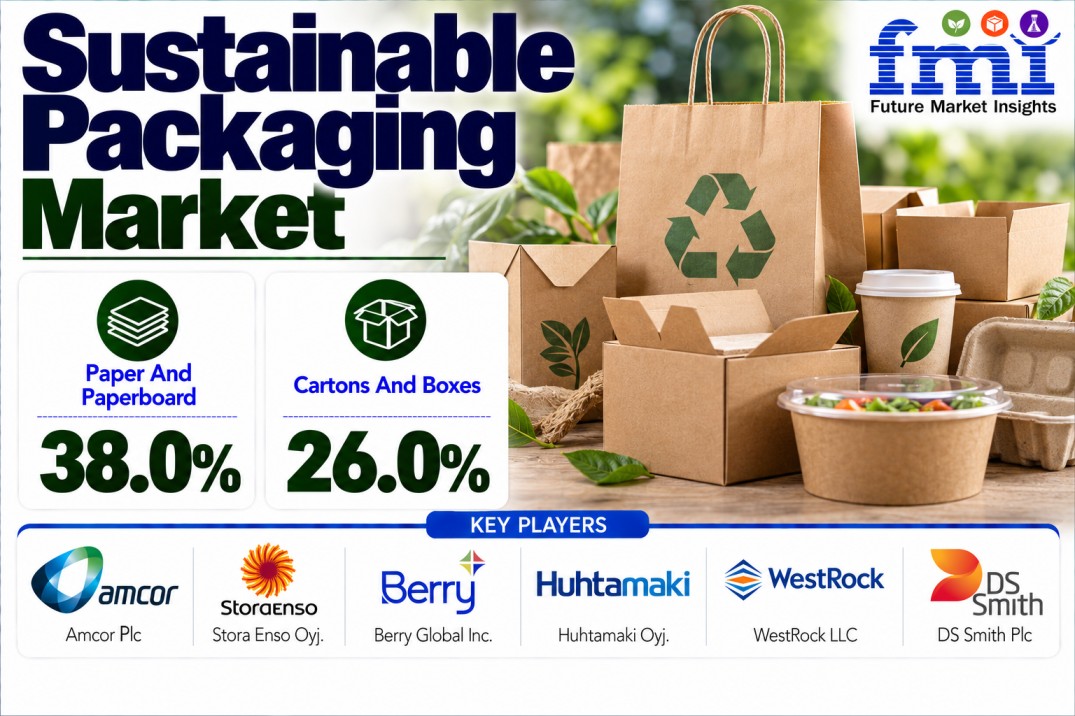
FMI projects that paper and paperboard will account for 38.0% of the material type segment in 2026, making it the leading material category. Established end-use applications and procurement requirements support demand for paper-based packaging solutions.
By packaging type, cartons and boxes are expected to hold a 26.0% share in 2026. Their use across retail, shipping, e-commerce and product protection supports their position as the leading packaging format.
The market also includes plastic, polylactic acid (PLA), metal, glass, fabric and wood-based materials. Packaging formats extend across bags and sacks, trays and clamshells, cans, bottles and jars, films and wraps, pouches and sachets, drums and intermediate bulk containers, vials and ampoules, tapes and labels.
This diversity reflects the different performance requirements of food, consumer goods, healthcare, industrial and retail packaging applications.
Retail Modernization and Sustainability Requirements Drive Growth
The expansion of organized retail is increasing demand for packaging products that meet consistent quality, labeling and specification requirements. Retail chains and foodservice operators are strengthening procurement standards, creating opportunities for suppliers with broad product portfolios and dependable manufacturing capabilities.
Urbanization and rising per capita consumption are also supporting market expansion. In India and China, growing organized retail networks and e-commerce distribution are creating additional procurement channels for sustainable packaging products.
Regulatory requirements are another important influence. Packaging suppliers must increasingly account for product safety, labeling and environmental standards when developing materials and selecting packaging structures. Compliance is becoming an essential requirement for suppliers seeking to maintain access to major markets.
Recyclable, Compostable and Reusable Formats Shape Innovation
FMI’s segmentation highlights several sustainability approaches that are influencing product development:
- Recyclable packaging: Mono-material structures and recycled-content packaging are important categories for companies seeking to support material recovery and circularity.
- Compostable packaging: Industrially compostable and home-compostable formats provide alternatives for selected applications where suitable materials and disposal systems are available.
- Barrier-performance development: Moisture, oxygen, grease and oil barrier properties remain important for maintaining product quality and packaging functionality.
- Reusable packaging: Returnable containers and multi-use packaging systems support applications where collection and reuse infrastructure can be established.
- Material diversification: Paperboard, molded fiber, PLA-based materials, metal and glass provide different options depending on product protection, cost and end-use specifications.
For manufacturers, the challenge is to match sustainability objectives with packaging performance, production economics and the availability of appropriate end-of-life infrastructure.
Regional Outlook: India and China Lead Growth
FMI’s country-level analysis identifies India as the fastest-growing market, with a projected CAGR of 6.9% between 2026 and 2036. Urbanization, organized retail expansion and rising per capita consumption are supporting the country’s growth outlook.
Other country-level forecasts include:
- China: 6.7% CAGR, supported by consumer market scale, e-commerce distribution and domestic manufacturing capacity.
- Spain: 5.4% CAGR, driven by sustainability regulations and tourism-related consumption.
- United States: 4.7% CAGR, supported by consumer spending, sustainability requirements and retailer packaging specifications.
- Canada: 4.5% CAGR, influenced by consumer quality expectations and sustainability mandates.
- Germany: 4.3% CAGR, supported by packaging regulations, extended producer responsibility requirements and retailer commitments.
- United Kingdom: 4.2% CAGR, reflecting evolving packaging requirements and procurement standards.
These differences create opportunities for suppliers to align their regional strategies with local market conditions. India and China offer stronger growth potential through retail and manufacturing expansion, while European and North American markets present opportunities for suppliers capable of meeting established sustainability and procurement specifications.
Competitive Landscape: Top Players in the Sustainable Packaging Market
The global sustainable packaging market includes diversified packaging manufacturers, paper and fiber specialists, flexible packaging producers and suppliers of protective packaging solutions. Competition is influenced by product breadth, geographic reach, manufacturing capacity, technology capabilities and established end-use relationships.
Companies identified in FMI’s report include:
- Amcor Plc
- Stora Enso Oyj
- Berry Global Inc.
- Huhtamaki Oyj
- WestRock LLC
- DS Smith Plc
- The Mondi Group plc
- International Paper Company
- Detmold Group
- Sealed Air Corporation
- Dart Container Corporation
- Duni AB
FMI identifies Amcor Plc as a leading participant, supported by its product breadth and geographic distribution infrastructure. Stora Enso, Berry Global and Huhtamaki are among the other established companies profiled in the competitive landscape.
The report indicates that competition is concentrated among a group of leading companies, with regional and specialized suppliers serving additional applications and markets. Product portfolio expansion, geographic reach, cost management and technical capabilities are important competitive considerations.
Access Detailed Market Insights: https://www.futuremarketinsights.com/reports/sustainable-packaging-market
Business Priorities for Sustainable Packaging Manufacturers
The market outlook highlights several strategic priorities for packaging suppliers and investors.
Manufacturers can strengthen their portfolios by developing recyclable and recycled-content solutions while maintaining required barrier properties and product protection. Investment in material efficiency and manufacturing capacity can also help suppliers address cost pressures and growing procurement volumes.
Regional expansion deserves particular attention. India’s projected 6.9% CAGR and China’s 6.7% CAGR create opportunities for companies to strengthen distribution networks, develop local partnerships and serve expanding retail and manufacturing channels.
Suppliers should also evaluate the complete packaging lifecycle. Material selection, product performance, recycling availability, reuse infrastructure and regulatory requirements all influence whether a packaging solution can meet customer sustainability objectives.
Realted Report Of Packaging Industry :
Bi-Injected Snap Hinge Closure Market: https://www.futuremarketinsights.com/reports/bi-injected-snap-hinge-closure-market
Bioplastics for Packaging Market: https://www.futuremarketinsights.com/reports/bioplastics-packaging-market
Multi Pocket Holders Market: https://www.futuremarketinsights.com/reports/multi-pocket-holders-market
MEDIA CONTACT
Contact Person: Media Relations Team
Designation: Corporate Communications
Email: sales@futuremarketinsights.com
Phone: +1-347-918-3531
Website: https://www.futuremarketinsights.com/
ABOUT FUTURE MARKET INSIGHTS
Future Market Insights, Inc. (FMI) is an ESOMAR-certified market research and consulting firm headquartered in Delaware, USA, with offices in the United Kingdom, the United Arab Emirates, and India. FMI delivers syndicated and custom research across food and beverage, healthcare, chemicals, technology, packaging, consumer goods, and industrial sectors. Its research helps organizations assess market opportunities, understand industry developments, and make informed strategic decisions.