


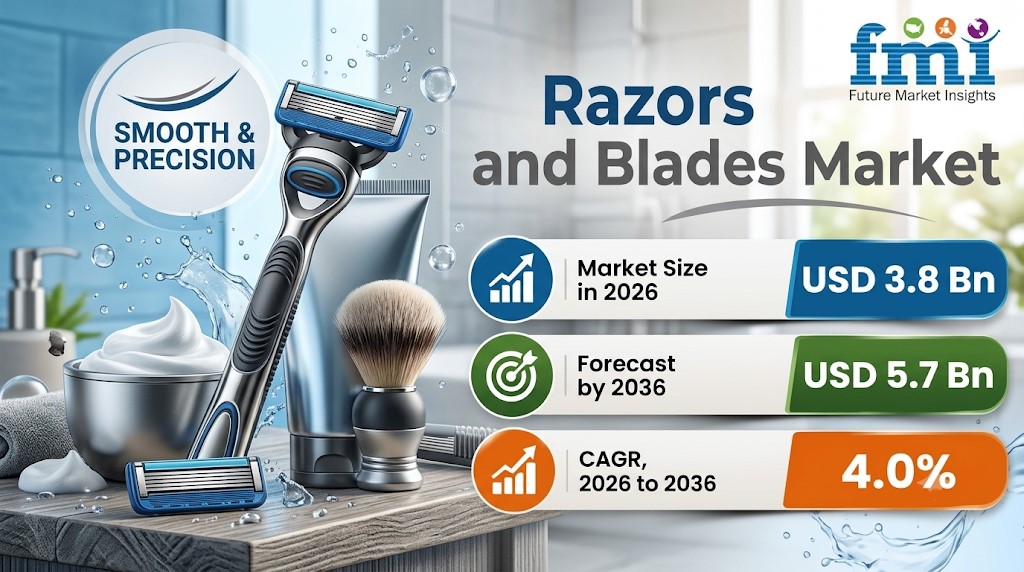
The global razors and blades market is projected to reach USD 5.7 billion by 2036, rising from USD 3.7 billion in 2025 and an estimated USD 3.8 billion in 2026, according to a latest market analysis by Future Market Insights (FMI). The market is expected to expand at a compound annual growth rate (CAGR) of 4.0% between 2026 and 2036, adding approximately USD 1.9 billion in revenue over the forecast period.
Recurring cartridge replacement, demand for multi-blade shaving systems and the growing adoption of premium disposable razors are shaping market development. While established shaving markets continue to generate repeat purchases, emerging markets are creating additional opportunities as consumers move from basic twin-blade products to three- and five-blade alternatives.
Razors and Blades Market: Size and Growth Forecast
FMI’s updated analysis, published on October 22, 2026, identifies the following market indicators:
- 2025 Market Value: USD 3.7 billion
- 2026 Estimated Market Size: USD 3.8 billion
- 2036 Projected Market Value: USD 5.7 billion
- Forecast CAGR: 4.0% (2026–2036)
- Incremental Revenue Opportunity: USD 1.9 billion
- Market Expansion Multiple: 1.5x
The market benefits from recurring replacement cycles. Consumers purchasing cartridge-based handles continue to generate demand for compatible refill blades, creating repeat revenue opportunities for manufacturers. However, distribution losses, private-label competition and changing grooming preferences remain important considerations for suppliers.
Get detailed market forecasts, competitive benchmarking, and pricing trends: https://www.futuremarketinsights.com/reports/sample/rep-gb-14794
Key Market Segments: Stainless Steel and Cartridge Systems Lead
Material Type: Stainless Steel Holds 58.7% Share
Stainless steel is expected to account for 58.7% of material type sales in 2026, compared with 41.3% for carbon steel. Coated stainless steel blades offer corrosion resistance across repeated shaving sessions, supporting their adoption in cartridge systems, disposable razors and premium shaving products.
Carbon steel continues to serve cost-conscious consumers and traditional double-edge shaving applications.
Product Type: Cartridge Systems and Refill Blades Dominate
Cartridge systems and refill blades are projected to capture 54.6% of product type sales in 2026, making them the leading product category.
Other product segments include:
- Disposable razors: 31.2%
- Double-edge safety razors: 9.7%
- Single-edge and straight razors: 4.5%
The recurring replacement requirements of cartridge systems support their leading position. Meanwhile, premium disposable products are attracting consumers seeking improved shaving performance without committing to rechargeable handles.
Price Range: Medium-Priced Products Lead
Medium-priced razors are expected to represent 46.9% of price range sales in 2026. Low-priced products account for 33.8%, while premium razors hold approximately 19.3%.
Three-blade disposables and mid-range cartridge refills support demand in the medium-priced category, offering consumers an alternative to basic shaving products.
Consumer Orientation and Sales Channels
Men are projected to account for 71.4% of consumer orientation sales in 2026, compared with 28.6% for women.
Hypermarkets and supermarkets remain the largest distribution channel, representing approximately 34.5% of sales, followed by online retailers at 21.8% and drug and pharma stores at 15.2%.
Regional Outlook: India, Brazil and Australia Lead Growth
Country-level forecasts indicate differences between emerging and mature shaving markets.
- Australia and New Zealand: 5.0% CAGR through 2036, supported by online grooming purchases and premium refill adoption.
- India: 4.8% CAGR, driven by accessible three-blade products and expanding demand in smaller towns and rural markets.
- Brazil: 4.4% CAGR, supported by consumer movement towards premium disposable razors.
- China: 3.6% CAGR, with electric shavers providing competition in urban grooming.
- France: 3.1% CAGR, reflecting mature shaving habits and changing beard preferences.
- Germany: 3.0% CAGR, supported by steady cartridge replacement demand.
- United States: 2.7% CAGR, with private-label competition and retail distribution changes influencing the outlook.
India’s market development is reflected in Gillette India’s reported fiscal-year sales of INR 3,100 crore for the year ended March 2026, representing an 8% increase over the comparable period.
Major Market Trends and Growth Drivers
Recurring Refill Purchases: Cartridge systems generate continuing demand for replacement blades, making retail distribution and customer retention important to manufacturers.
Premium Disposable Razors: Consumers moving from twin-blade to three- and five-blade products are supporting higher-value purchases, particularly in India and Brazil.
Changing Manufacturing Strategies: Manufacturers are reviewing production structures and operational costs. Edgewell Personal Care is consolidating Wet Shave operations as part of its restructuring programme.
Online Distribution: Online retailers are expanding their role through subscription purchases and bulk refill packs, providing additional access to shaving products.
Market restraints include beard adoption, alternative hair-removal methods, electric shavers and competition from private-label products.
Competitive Landscape: Major Companies and Strategic Developments
The razors and blades market includes established blade manufacturers, direct-to-consumer brands and electric shaving specialists.
Key companies profiled by FMI include:
- Procter & Gamble (Gillette)
- Edgewell Personal Care
- BIC
- Dorco
- Harry’s
- Dollar Shave Club
- Feather Safety Razor
- Panasonic
- Philips
- Wahl
Recent company developments highlight the importance of product positioning and distribution. BIC’s September 2026 strategic plan maintained non-rechargeable razors as a core business priority. Edgewell reported private-label supply constraints affecting its Wet Shave business in the June 2026 quarter. Gillette India introduced Gillette Guard 3in1, targeting consumers seeking accessible three-blade shaving products.
Analyst Perspective
“Razor makers earn on the refill, so every lost shelf slot costs years of blade sales, and the winners in 2026 are the brands that hold retail distribution and trade shoppers up to three and five blades. I expect the strongest gains through 2036 in Brazil, India and Australia, and I would put marketing money behind premium disposables, which convert value shoppers faster than new handles, unlocking a second wave of refill buyers.”
— Rahul Pandita, Principal Consultant, Future Market Insights
Market Outlook and Research Scope
FMI’s analysis covers material type, product type, price range, consumer orientation, sales channel and regional markets. The forecast period extends from 2026 to 2036, with coverage spanning North America, Latin America, Western Europe, Eastern Europe, East Asia, South Asia and Pacific, and the Middle East and Africa.
The research methodology incorporates razor manufacturer results, strategic plans, stock exchange announcements and company releases from May 2025 onward. Market sizing and forecasting use the 2026 market baseline and projected growth rate, with reported company figures matched against relevant corporate or exchange disclosures.
As the market advances towards 2036, manufacturers will need to balance refill-led revenue models with premium product development, competitive pricing and retail distribution strength. Growth opportunities in India, Brazil and Australia and New Zealand offer important areas for market participants to monitor.
Explore More Related Reports Links:
Body Firming Creams Market: https://www.futuremarketinsights.com/reports/body-firming-creams-market
Home Beer Brewing Machine Market : https://www.futuremarketinsights.com/reports/home-beer-brewing-machine-market
Canada Home Care Services Market: https://www.futuremarketinsights.com/reports/canada-home-care-services-market
About Future Market Insights (FMI)
Future Market Insights (FMI) is an ESOMAR-certified market research and consulting organisation providing market intelligence, business insights and strategic advisory services across industries. Its research covers sectors including consumer products, food and beverage, healthcare, chemicals, technology, packaging and industrial markets. FMI supports businesses with market sizing, demand forecasting, competitive analysis and strategic decision-making.
Media Contact:
Corporate Communications Team
Future Market Insights (FMI)
Email: sales@futuremarketinsights.com
Phone: +1-347-918-3531
Official Report Page: Razors and Blades Market – Future Market Insights