


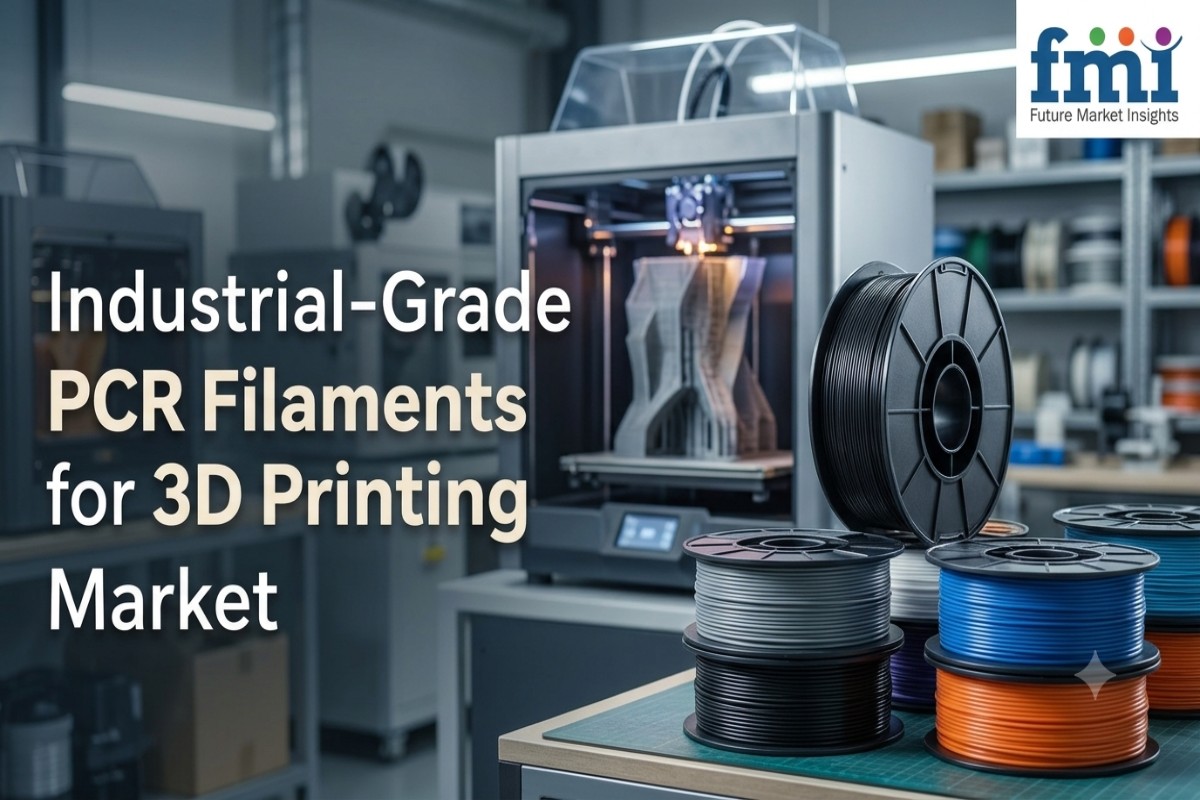
The global industrial-grade PCR filaments for 3D printing market is estimated at USD 640.3 million in 2026, rising from USD 562.8 million in 2025, according to Future Market Insights (FMI). The market is projected to reach USD 2.48 billion by 2036, expanding at a compound annual growth rate (CAGR) of 14.5% between 2026 and 2036. This growth represents an incremental revenue opportunity of USD 1.84 billion over the forecast period.
The expansion reflects the increasing use of additive manufacturing for industrial prototyping, tooling, manufacturing jigs, fixtures, and engineering components. Manufacturers are evaluating post-consumer recycled (PCR) filaments as functional production materials, with particular attention to extrusion consistency, mechanical strength, dimensional accuracy, and repeatable printing performance.
Industrial Market Background: Reliability Becomes a Purchasing Priority
Industrial-grade PCR filaments are spooled feedstock materials compounded from post-consumer recycled polymers. They are manufactured to meet the diameter, moisture, and melt-flow tolerances required by factory-grade 3D printers.
The transition of additive manufacturing from design validation toward practical industrial applications is a major factor supporting market expansion. Manufacturers increasingly use printed tools, jigs, and fixtures in recurring production workflows. Consequently, material consistency has become an important purchasing consideration.
Three factors are shaping adoption:
- Industrial workflow expansion: Greater use of 3D printing for tooling, fixtures, and low-volume production is increasing demand for dependable recycled materials.
- Procurement resilience: PCR filaments offer opportunities to manage material costs and reduce exposure to virgin polymer price volatility, provided performance requirements are maintained.
- Circular manufacturing: Corporate sustainability commitments are encouraging manufacturers to incorporate recycled polymers into production operations.
However, material variability remains a significant restraint. Differences in melt flow, strength, and dimensional accuracy can create production risks. Qualification costs and internal material validation processes also influence adoption decisions.
Segment Analysis: High-Strength Materials and Tooling Lead Demand
FMI identifies high-strength filaments as the leading product category, accounting for 50.0% of market demand in 2026. Their share is projected to reach 47.0% by 2036. Industrial buyers prioritize durability, load-bearing capability, and dimensional stability when selecting materials for fixtures and manufacturing tools.
PCR PETG, PCR ABS, and PCR PLA collectively account for 55.0% of material demand in 2026 and are projected to grow at a 14.0% CAGR. Their established processing characteristics and compatibility with industrial printer fleets support their adoption.
PCR polyamide and fiber-reinforced grades represent another important opportunity, with a projected CAGR of 16.4%.
Industrial prototyping and tooling leads end-use demand with a 45.0% share in 2026 and a projected CAGR of 13.9%. Engineering components represent the fastest-growing end-use category, recording a projected CAGR of 16.2%.
FDM and FFF-compatible compounds account for 55.0% of printing technology alignment, reflecting their relevance to existing industrial printer installations.
Regional Outlook: India Leads Growth
The United States represents the largest national market, accounting for 31.0% of global market share in 2026. China follows with 12.0%, while Germany holds 10.0%.
India is projected to record the fastest country-level growth at 16.0% CAGR through 2036. Increasing use of additive manufacturing for tooling, localized production, and shorter manufacturing lead times supports its expansion.
China follows at 15.4% CAGR, supported by manufacturing scale and the growing economic importance of material efficiency. The United States is forecast to expand at 13.8%, reflecting established industrial additive manufacturing workflows.
Other country projections include:
- Germany: 13.2% CAGR, supported by engineering validation and material qualification practices.
- Brazil: 12.0% CAGR, supported by manufacturing modernization and local production requirements.
- Japan: 11.0% CAGR, reflecting precision-led adoption and strict quality expectations.
These differences highlight the importance of regional manufacturing requirements, material qualification, and industrial adoption patterns.
Executive Perspective: Consistency Will Define Supplier Competitiveness
“Factories do not buy recycled filament to feel better about a fixture; they buy it once the supplier can show the tenth spool prints like the first. Whoever controls sorting and compounding well enough to publish a tight property window will sell to purchasing departments, and everyone else stays in the hobby channel.”
Nikhil Kaitwade, Principal Consultant, Future Market Insights (FMI)
The findings indicate that suppliers must demonstrate consistent material properties, controlled compounding, and reliable extrusion performance to strengthen their position in industrial procurement. Quality documentation, filtration, blending, and material characterization will remain important competitive factors.
Competitive Landscape and Industry Developments
The competitive environment is shaped by suppliers’ ability to deliver predictable mechanical performance and repeatable printing outcomes. Companies are increasingly competing through compounding expertise, quality assurance, industrial credibility, and partnerships with printer manufacturers and industrial users.
Key companies profiled in the market include:
- Stratasys, including Forward AM
- 3D Systems Materials
- Evonik
- eSUN
- Polymaker
- Mitsubishi Chemical Advanced Materials
A notable industry development involved Forward AM. Following its management buyout from BASF in mid-2024, the business filed for insolvency in November 2024 and closed its United States operations in early 2025. Stratasys acquired key assets and operations in May 2025 and continues to operate the Forward AM brand.
In December 2025, BigRep published guidance recommending recycled filaments for concept models and comparing material options for jigs, fixtures, and molds.
Future Outlook and Research Scope
FMI expects industrial-grade PCR filament adoption to benefit from investments in controlled recycling, industrial-grade compounding, and quality assurance. Closed-loop manufacturing offers an additional opportunity, allowing manufacturers to convert failed prints, support structures, and end-of-life tooling into recycled feedstock.
The study evaluates industrial-grade recycled polymer filaments used in prototyping, tooling, fixtures, engineering components, and selected end-use applications. Its scope covers the United States, Germany, China, Japan, India, and Brazil, across North America, Latin America, Europe, Asia Pacific, and the Middle East and Africa.
The analysis excludes virgin filaments, hobby-grade spools, powders, resins, pellet feedstock, printer hardware, and printing services.
About Future Market Insights (FMI)
Future Market Insights (FMI) provides market intelligence and research analysis across industries, including chemicals and materials, manufacturing, technology, healthcare, food and beverage, packaging, and consumer goods. Its research supports business professionals, manufacturers, investors, and decision-makers in evaluating market opportunities, industry developments, and long-term growth prospects.
Related Report:
https://www.openpr.com/news/4681411/kyanite-market-to-reach-usd-211-0-million-by-2036-as-top-players
https://www.openpr.com/news/4681418/prepreg-market-to-reach-usd-31-8-billion-by-2036-as-top-players