

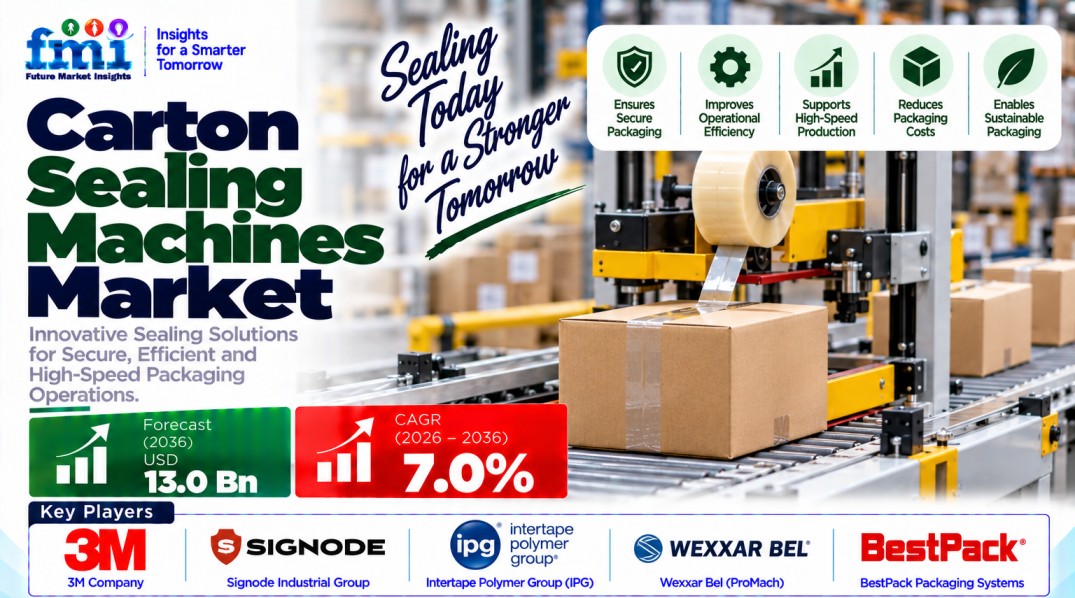
According to the latest market intelligence report published by Future Market Insights (FMI), the global carton sealing machines market is projected to grow from USD 6.2 billion in 2025 to USD 6.6 billion in 2026, reaching USD 13.0 billion by 2036. The market is forecast to expand at a compound annual growth rate (CAGR) of 7.0% from 2026 to 2036, generating an additional USD 6.4 billion in market revenue over the forecast period.
The expansion reflects increasing investment in end-of-line packaging automation as food processors, manufacturing facilities and e-commerce distribution centers seek consistent carton closure, higher throughput and reduced dependence on manual taping. FMI identifies labor turnover, parcel-dispatch requirements and the need for reliable sealing of corrugated cartons as important factors shaping equipment demand.
Market Size & Growth Forecasts
- 2025 Baseline Market Value: USD 6.2 billion
- 2026 Estimated Market Size: USD 6.6 billion
- 2036 Projected Market Value: USD 13.0 billion
- Forecast CAGR: 7.0% from 2026 to 2036
- Incremental Revenue Opportunity: USD 6.4 billion
The report evaluates carton sealing equipment by machine configuration, automation, sealing medium and end use. Its scope includes uniform case sealers, random case sealers, top-and-bottom sealers, side-belt sealers and factory-integrated tape heads. Standalone consumable tape rolls, strapping tools and downstream palletizing equipment are excluded.
>> Get Detailed Market Forecasts, Competitive Benchmarking, and Pricing Trends: https://www.futuremarketinsights.com/reports/sample/rep-gb-35886
Key Market Segments
By Machine Configuration
Uniform case sealers are projected to account for 39.4% of machine configuration demand in 2026. These systems support continuous production runs involving standardized carton dimensions. Fixed-mast designs and synchronized side-belt drives help maintain consistent closure across repeated box formats.
The report also covers random case sealers, top-and-bottom sealers and side-belt sealers. Random case sealing is relevant to facilities handling mixed carton sizes on shared conveyor lines.
By Automation
Fully automatic systems are estimated to represent 33.6% of the automation segment in 2026. Automated flap-folding mechanisms, conveyor indexing and integrated controls help reduce manual handling at packing stations. Semi-automatic, manual and robotic-integrated systems are also included in the market assessment.
By Sealing Medium and End Use
- Pressure-sensitive tape: Expected to account for 42.1% of sealing-medium revenue in 2026, supported by convenient tape-cartridge replacement and the absence of thermal warm-up requirements.
- Food and beverage: Forecast to represent 43.2% of end-use demand in 2026, reflecting the need for dependable carton closure in continuous food-processing and beverage-packaging operations.
Other sealing media include hot-melt adhesive, water-activated tape and staples. Additional end-use categories include e-commerce and logistics, pharmaceuticals and consumer goods.
By Country / Region
FMI projects the following country-level CAGRs for 2026–2036:
- United States: 7.4%, supported by fulfillment automation and the deployment of random case sealers.
- France: 7.0%, with demand associated with food-sector packaging modernization and recyclable packaging requirements.
- United Kingdom: 6.9%, reflecting warehouse upgrades and shelf-ready packaging requirements.
- Italy: 6.8%, supported by packaging machinery expertise and automated production-line investments.
- Germany: 6.7%, with opportunities in industrial automation and integration with factory control systems.
- Japan: 6.6%, as compact facilities prioritize space-efficient equipment and flexible production runs.
The report covers North America, Latin America, Western Europe, Eastern Europe, East Asia, South Asia and Pacific, and the Middle East and Africa.
Major Market Trends & Drivers
Automation of packing operations: Manufacturing plants and logistics hubs are replacing manual taping stations with automated systems to support throughput targets and reduce reliance on operator-dependent carton closure.
Demand for consistent sealing quality: Uneven pressure and inconsistent carton-flap closure can contribute to split seams during transportation. Automated sealing systems help standardize tape application and carton compression.
Adaptation to recycled corrugated board: Variations in board stiffness and paper dust can complicate sealing performance. Equipment suppliers must address tape adhesion, compression settings, maintenance and changeover requirements to support different carton materials.
>> Access Detailed Market Insights: https://www.futuremarketinsights.com/reports/carton-sealing-machines-market
Competitive Landscape
The competitive environment includes integrated tape and machinery suppliers, specialist case-sealing manufacturers and end-of-line packaging equipment providers. Buyers evaluate machine configuration, automation capabilities, changeover speed, tape-head compatibility and service support when selecting equipment.
Key Companies Profiled Include: 3M Company, Signode Industrial Group, Intertape Polymer Group (IPG), Wexxar Bel (ProMach), BestPack Packaging Systems, Combi Packaging Systems, SOCO SYSTEM A/S, and SIAT S.p.A. (M.J. Maillis Group).
Analyst Perspective / Insight
“End-of-line packaging engineers no longer evaluate carton sealers as standalone tape applicators. Buyers demand servo-adjusted random sealers and quick-swap tape cartridges that handle recycled corrugated board without flute crushing.”
— Nandini Roy Choudhury, Principal Consultant, Future Market Insights