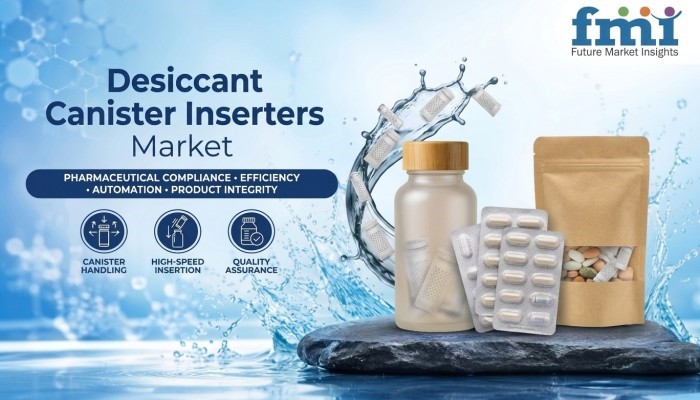
The global desiccant canister inserters market is expanding as pharmaceutical and nutraceutical manufacturers invest in reliable moisture-protection systems for bottled products. Market revenue is projected to increase from USD 68.5 million in 2025 to USD 72.8 million in 2026 and reach USD 132.9 million by 2036. According to the latest market analysis by Future Market Insights (FMI), demand is anticipated to grow at a compound annual growth rate (CAGR) of 6.2% between 2026 and 2036.
Desiccant canister inserters sort and place rigid moisture-absorbing canisters into bottles and compatible containers. Their role is particularly relevant to solid-dose pharmaceutical packaging, where moisture protection must be maintained without interrupting the production sequence.
Get detailed market forecasts, competitive benchmarking, and pricing trends:
https://www.futuremarketinsights.com/reports/sample/rep-gb-35772
KEY MARKET TAKEAWAYS
- Market Valuation: USD 72.8 million in 2026, projected to reach USD 132.9 million by 2036.
- Growth Rate: Expanding at a 6.2% CAGR from 2026 to 2036.
- Leading Automation Segment: Fully automatic systems are projected to account for 78.0% of automation demand in 2026.
- Leading Line-Speed Category: The 100–200 bottles-per-minute category is estimated to hold 46.0% of line-speed demand.
- Leading End Use: Pharmaceutical applications are projected to account for 68.0% of end-use demand.
- Fastest-Growing Country: India leads the profiled markets with an 8.1% CAGR through 2036.
- Core Growth Driver: Higher pharmaceutical bottle-line throughput is increasing demand for synchronized, reliable canister insertion.
INDUSTRY SHIFTS & MARKET DYNAMICS
Pharmaceutical packaging operations are placing greater emphasis on consistent moisture protection and uninterrupted production. As tablet and capsule manufacturers increase bottle-line output, desiccant insertion must keep pace with counting, capping, and inspection equipment. The scale of this requirement becomes clear at higher operating speeds. A line running at 150 bottles per minute processes 72,000 bottles during an eight-hour shift. At one canister per bottle, the inserter must complete 72,000 placements. A three-canister configuration raises the requirement to 216,000 placements without increasing bottle output.
This operating environment is supporting demand for equipment in the 100–200 bottles-per-minute category. Fully automatic systems are also gaining importance because programmable controls, synchronized feeding, and bottle-detection functions help maintain insertion consistency. Equipment suppliers offer different configurations to meet these requirements. CVC markets systems around 150 and 200 bottles per minute, while Cremer’s BF 200 supports applications from 50 to 200 bottles per minute and single, double, or triple canister drops.
However, equipment selection is not determined by rated speed alone. Manufacturers must consider compatibility with existing conveyors, tablet counters, cappers, and inspection systems. Integrated desiccant closures present another challenge because they can eliminate the need for a separate canister insertion stage. At the same time, retrofit installations offer an opportunity for equipment suppliers to provide drop verification, recipe control, audit-trail functions, and reject handling without replacing an entire bottle line.
REGIONAL MARKET SUMMARY
FMI identifies the following country growth rates for the desiccant canister inserters market through 2036:
- India: 8.1% CAGR, supported by pharmaceutical manufacturing and export activity.
- South Korea: 7.4% CAGR, reflecting its established pharmaceutical production base.
- China: 6.9% CAGR, with manufacturing quality controls increasing the importance of repeatable packaging processes.
- United States: 6.5% CAGR, supported by opportunities in new pharmaceutical facilities and existing-line upgrades.
- Brazil: 6.1% CAGR, with a substantial volume of medicine packages moving through domestic packaging operations.
- Germany: 5.6% CAGR, where replacement demand and equipment upgrades remain relevant.
- Japan: 4.8% CAGR, with demand linked more closely to replacement cycles and automated bottle-line improvements.
India records the highest projected growth among the profiled countries. Its pharmaceutical export activity provides an important manufacturing backdrop, although demand for canister inserters specifically depends on the proportion of medicines packaged in bottles using separate desiccants.
ANALYST INSIGHTS
“Line reliability is central to the buying decision. When an inserter handles tens of thousands of bottles in a shift, buyers pay close attention to placement checks, changeover time and how well the machine fits the existing conveyor and bottle line,” stated Nandini Roy Choudhury, Principal Consultant at Future Market Insights. “As pharmaceutical packaging operations pursue higher throughput, equipment that combines dependable feeding, flexible canister configurations and compatibility with existing production systems will remain important.”
COMPETITIVE LANDSCAPE
The desiccant canister inserters market includes equipment manufacturers offering dedicated insertion systems, integrated bottle-line modules, and flexible retrofit solutions. Key companies profiled by FMI include CVC Technologies, Uhlmann Pac-Systeme / Cremer, Omega Design, BellatRx, Countec Group, PHARMAPACK Technologies, SED Pharma, and YOKO.
CVC Technologies offers dedicated canister insertion machines for pharmaceutical bottle lines. Uhlmann and Cremer address both modular and integrated packaging configurations, while Omega Design provides standalone and integrated feeding options. BellatRx offers flexible operating modes, and Countec supplies equipment with output capabilities of up to 200 bottles per minute. PHARMAPACK Technologies, SED Pharma, and YOKO broaden the supplier base across different line-speed requirements.
Product development is also influencing the competitive environment. Modular bottle-line configurations allow manufacturers to add or reconfigure equipment, while integrated desiccant closures offer an alternative to separate canister insertion. These developments make line compatibility, installation architecture, and the specific moisture-control format important considerations for equipment buyers.
ABOUT THE REPORT
The FMI report on the desiccant canister inserters market examines industry revenue, demand trends, competitive developments, and growth opportunities from 2026 to 2036. It segments the market by automation, line speed, canister count, end use, and installation architecture. Regional coverage includes North America, Latin America, Western Europe, Eastern Europe, East Asia, South Asia and Pacific, and the Middle East and Africa. The analysis profiles key equipment suppliers and evaluates factors influencing adoption, replacement, and retrofit demand.
For more information on the full report: https://www.futuremarketinsights.com/reports/desiccant-canister-inserters-market
Explore More Related Reports Links:
https://www.openpr.com/news/4678721/biodegradable-disposable-tableware-market-is-expected-to-reach
https://www.openpr.com/news/4678724/corrugated-box-market-is-anticipated-to-reach-usd-273-9-billion
FMI Custom Research: Strategic Intelligence for Confident Decision-Making
In today’s rapidly evolving business environment, leadership teams need more than market data—they need clear, actionable intelligence tailored to their strategic objectives. FMI’s Custom Research solutions are designed around the specific business questions organizations need answered, enabling executives to evaluate growth opportunities, validate investments, assess competitive dynamics, and reduce uncertainty before making critical decisions. By combining deep industry expertise, primary research, and proprietary market intelligence, FMI delivers insights that help organizations move from assumptions to evidence-based strategies with greater speed and confidence.
Business Impact
FMI helps organizations transform market complexity into strategic clarity, enabling leadership teams to identify growth opportunities faster, optimize resource allocation, strengthen competitive positioning, and make high-stakes business decisions with confidence.
To explore how FMI Custom Research can support your strategic priorities, please connect with our team at – sales@futuremarketinsights.com
About Future Market Insights (FMI)
Future Market Insights, Inc. (FMI) is an ESOMAR-certified, ISO 9001:2015 market research and consulting organization, trusted by Fortune 500 clients and global enterprises. With operations in the U.S., UK, India, and Dubai, FMI provides data-backed insights and strategic intelligence across 30+ industries and 1200 markets worldwide.
Contact Us:
Future Market Insights Inc.
Christiana Corporate, 200 Continental Drive,
Suite 401, Newark, Delaware – 19713, USA
T: +1-347-918-3531
For Sales Enquiries: sales@futuremarketinsights.com
Website: https://www.futuremarketinsights.com
LinkedIn| Twitter| Blogs | YouTube