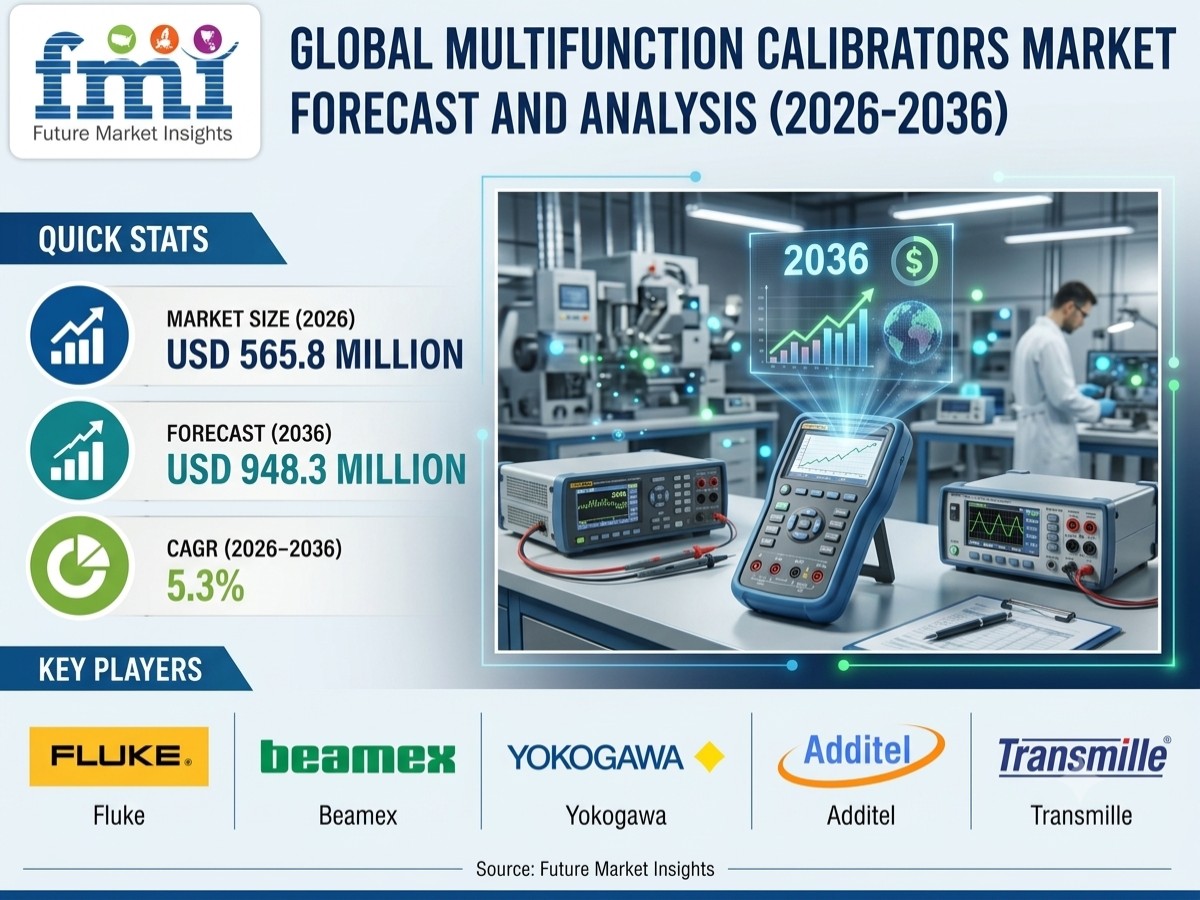
NEWARK, Del. — The global Multifunction Calibrators Market is projected to increase from USD 565.8 million in 2026 to USD 948.3 million by 2036, registering a compound annual growth rate (CAGR) of 5.3% during the forecast period, according to Future Market Insights (FMI). The market was valued at USD 537.3 million in 2025. Demand is supported by laboratories and industrial maintenance teams seeking instruments that can source and measure multiple quantities within defined calibration workflows.
Multifunction calibrators help technicians verify the performance of measurement instruments used across industrial processes, laboratories, and field-service environments. Their ability to support multiple measurement tasks can reduce the need to carry or maintain separate single-function instruments. However, buyers increasingly evaluate equipment based on the measurement ranges, uncertainty requirements, connections, and procedures relevant to their actual workloads.
Access the Sample Report — Explore Key Insights Today!
https://www.futuremarketinsights.com/reports/sample/rep-gb-17921
Multifunction Calibrators Market: Key Findings
- Market size in 2026: USD 565.8 million
- Projected market size by 2036: USD 948.3 million
- Forecast CAGR, 2026–2036: 5.3%
- Market size in 2025: USD 537.3 million
- Revenue increase, 2026–2036: USD 382.56 million
- Companies profiled: Fluke, Beamex, Yokogawa, Additel, and Transmille
Demand for Measurement Accuracy Supports Market Growth
Manufacturing facilities and calibration laboratories depend on reliable measurement instruments to monitor operating conditions and verify equipment performance. Pressure, temperature, electrical, and other process measurements need to remain within specified limits to support quality procedures and consistent operations.
Multifunction calibrators address this requirement by combining several measurement capabilities in one instrument. A laboratory may use a benchtop configuration for controlled calibration work, while maintenance technicians may prefer portable equipment for on-site verification. The appropriate configuration depends on the instruments being serviced, the required ranges, and the uncertainty levels needed for each task.
Calibration requirements also create recurring demand. Instruments need periodic verification, and calibration teams must maintain records that connect results with equipment and procedures. This makes documentation, software compatibility, and continuing technical support important considerations alongside the initial instrument purchase.
Workload Requirements Shape Instrument Selection
The market’s development is closely linked to the need for equipment that matches specific calibration workloads. A broad function list alone does not guarantee that a calibrator is suitable. Buyers need to assess supported quantities, ranges, connections, and measurement uncertainty against the instruments they intend to service.
Laboratory buyers may prioritize configuration flexibility and compatibility with established procedures. Field-service teams may place greater emphasis on portability, practical operation, and the ability to document results while working at customer sites.
FMI highlights India’s National Physical Laboratory procurement of a high-precision multiproduct or multifunction calibrator as an example of a defined institutional requirement. This illustrates how equipment specifications and acceptance procedures can influence purchasing decisions.
Digital Documentation and Field Calibration Create Opportunities
Calibration workflows increasingly involve more than taking a measurement. Teams must record results, associate them with the relevant instrument, and retain information for subsequent verification and quality reviews.
Digital result handling can help technicians transfer measurement records into existing documentation processes. Field-calibration systems that connect measurement activity with digital records can be useful for maintenance teams performing recurring tasks across different locations.
For suppliers, opportunities extend beyond selling the instrument itself. Configuration assistance, software connections, training, service, and continuing verification can contribute to the long-term usefulness of a calibrator. These capabilities may be especially relevant when customers introduce new instruments into established laboratory or industrial procedures.
Regional Outlook: India and China Lead Growth Forecasts
FMI’s country-level outlook identifies the following CAGRs for 2026–2036:
- India: 6.2% CAGR. Procurement requirements from institutions such as the National Physical Laboratory provide evidence of demand for high-precision multiproduct calibration equipment.
- China: 6.0% CAGR. Production and testing environments create requirements for instruments matched to specific measurement quantities and operating conditions.
- United States: 5.5% CAGR. Laboratory buyers assess calibrators based on measurement workloads, configuration, software compatibility, and continuing performance support.
- Japan: 5.4% CAGR. Replacement decisions can depend on maintaining established measurement procedures while introducing new functions and documentation arrangements.
- Germany: 5.3% CAGR. The country’s calibration ecosystem includes the German Calibration Service, which supports technical exchange and consistent practices among calibration organisations.
- United Kingdom: 5.1% CAGR. Calibration providers evaluate whether multiproduct systems extend their service capabilities and fit existing customer requirements.
These country forecasts indicate opportunities across both established calibration markets and countries expanding their laboratory and industrial measurement capabilities.
Competitive Landscape: Top Companies in the Multifunction Calibrators Market
FMI identifies Fluke, Beamex, Yokogawa, Additel, and Transmille as notable companies in the Multifunction Calibrators Market.
Fluke offers multiproduct calibration instruments designed for different laboratory workloads. Beamex focuses on process calibration systems and field workflows that connect calibration activity with digital documentation. Yokogawa participates in electrical measurement and calibration, while Additel offers process calibration instruments. Transmille provides multiproduct calibration systems for laboratory applications.
Competition is shaped by the ability to match instrument configurations with customer requirements. Buyers compare supported quantities, measurement ranges, connections, software arrangements, and service availability. Suppliers that clearly explain how their equipment fits a customer’s procedures can strengthen their position in specification-led purchasing decisions.
The companies named above are drawn from FMI’s report and are not presented as a ranking by market share.
Outlook for the Multifunction Calibrators Market
The Multifunction Calibrators Market is expected to expand as industrial users and laboratories continue to prioritize measurement reliability and documented calibration procedures. Demand will depend on the fit between instrument capabilities and customer workloads, as well as the ability to maintain performance over the equipment’s operating life.
Suppliers can address future opportunities through task-matched configurations, practical field-calibration systems, digital result handling, and dependable technical support. As customers update their measurement programmes, multifunction calibrators that integrate effectively with existing procedures can remain valuable tools for laboratory and industrial operations.
For detailed market forecasts, country analysis, competitive coverage, and industry developments, visit the Future Market Insights: https://www.futuremarketinsights.com/reports/multifunction-calibrators-market
Explore More Related Reports –
Computer Aided Facility Management (CAFM) Market – https://www.futuremarketinsights.com/reports/computeraided-facility-management-cafm-market
Digital Transformation in Healthcare Market – https://www.futuremarketinsights.com/reports/digital-healthcare-market
Enterprise Laboratory Informatics Market – https://www.futuremarketinsights.com/reports/enterprise-laboratory-informatics-market