

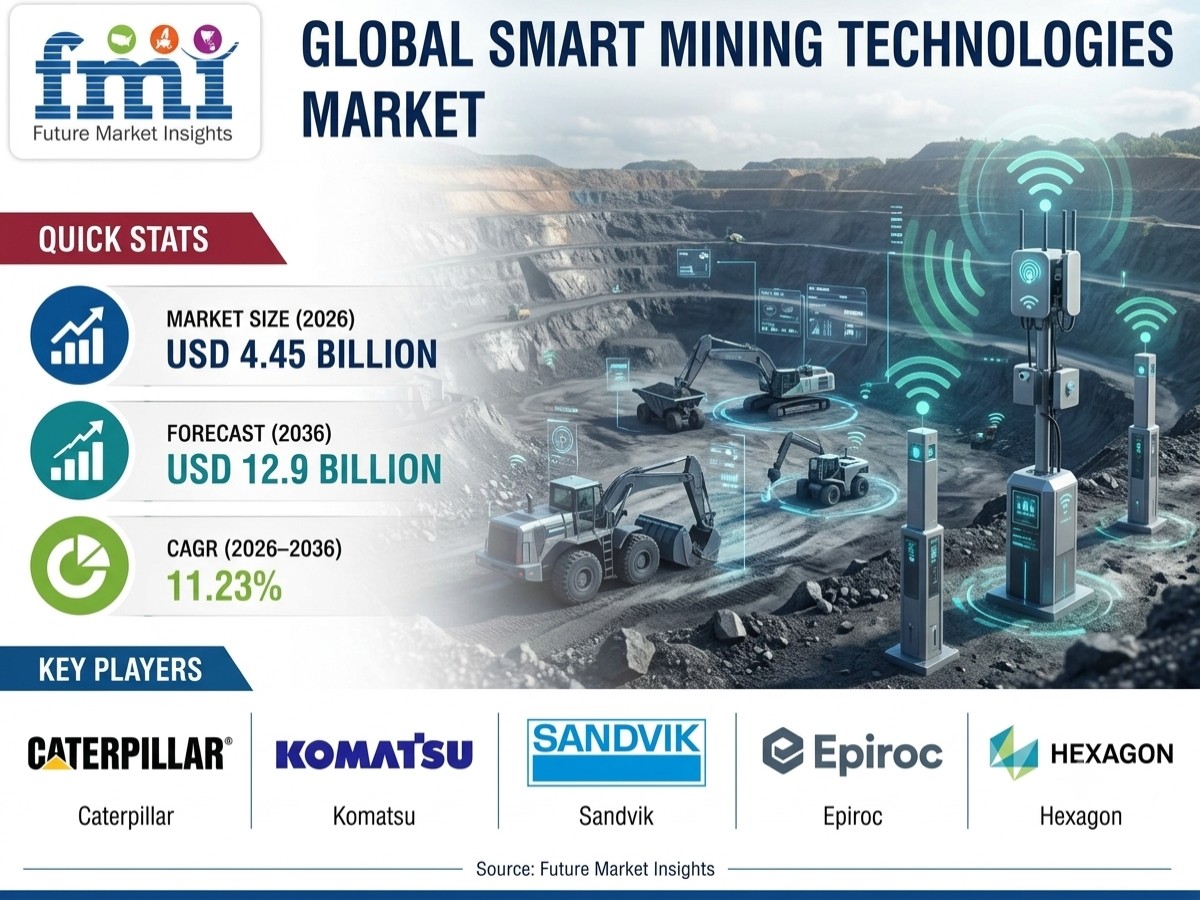
NEWARK, Del. — The global Smart Mining Technologies Market is projected to increase from USD 4.45 billion in 2026 to USD 12.9 billion by 2036, registering a compound annual growth rate (CAGR) of 11.23% during the forecast period, according to Future Market Insights (FMI). The market was valued at USD 4.0 billion in 2025. Demand is being shaped by mining companies’ efforts to connect equipment, sensing, software, and operational information with specific production and maintenance requirements.
Smart mining technologies include mine-specific automation and remote operations, as well as connected safety, monitoring, and optimization systems. These solutions help operators improve visibility across mining activities and support decisions involving equipment, material movement, and site operations.
Access the Sample Report — Explore Key Insights Today!
https://www.futuremarketinsights.com/reports/sample/rep-gb-15036
Smart Mining Technologies Market: Key Findings
- Market size in 2026: USD 4.45 billion
- Projected market size by 2036: USD 12.9 billion
- Forecast CAGR, 2026–2036: 11.23%
- Leading technology solution: AI/ML-enabled supply chain management, with a 31.8% share in 2026
- Leading application: Mining operations and process control, with a 38.6% share in 2026
- Companies profiled: Caterpillar, Komatsu, Sandvik, Epiroc, and Hexagon
Automation and Connected Operations Support Market Growth
Mining companies operate in environments where equipment availability, worker safety, material movement, and maintenance schedules are closely connected. Delays in one activity can affect production across the site. Smart mining technologies help operators collect and use information from equipment and operational systems to improve coordination.
Automation and remote-operation systems can support tasks that require equipment control in demanding or difficult-to-access locations. Connected monitoring and analytics can also help personnel assess operating conditions and identify issues that require attention.
However, technology adoption depends on more than the availability of advanced equipment. Mines must consider compatibility with existing machinery, communications infrastructure, workforce responsibilities, commissioning requirements, and ongoing technical support. Suppliers that can demonstrate how their solutions fit a mine’s actual operating environment may have an advantage during procurement.
China’s selection of 77 intelligent-technology coal-mine upgrade pilots illustrates the importance of defined implementation targets and acceptance requirements. These projects provide a practical setting for suppliers to demonstrate how technology can move from a proposed capability into an operational system.
AI/ML-Enabled Supply Chain Management Leads Technology Solutions
FMI estimates that AI/ML-enabled supply chain management accounts for 31.8% of technology-solution demand in 2026. Mining supply chains involve equipment, spare parts, consumables, procurement, and material movement. Delays or gaps in information can affect production planning and maintenance coordination.
AI and machine learning tools can help analyze operational and supply-chain information, allowing teams to identify patterns and support planning decisions. The commercial value of these systems depends on data quality and integration with existing procurement, logistics, and maintenance processes.
Mining analytics platforms, blockchain-based metal trading platforms, emissions management software, and other solutions form additional technology categories within the market.
Mining Operations and Process Control Drive Application Demand
The mining operations and process control segment represents an estimated 38.6% of application demand in 2026, according to FMI. This category connects technology spending with the activities involved in managing equipment, production processes, and material movement.
Equipment compatibility remains an important purchasing consideration. Mines often operate machinery from different manufacturers, making integration a practical challenge when introducing automation. Epiroc’s agnostic automation offering for mixed equipment fleets illustrates the relevance of solutions designed to work across different machine configurations.
Risk and compliance management, mining data warehousing, and other applications also contribute to the market’s demand structure.
Regional Outlook: China Leads Country Growth Forecasts
FMI identifies several countries with strong growth prospects during 2026–2036:
- China: Projected to grow at a 13.7% CAGR, supported by intelligent coal-mine upgrade initiatives and defined technology implementation targets.
- Australia: Forecast to expand at a 13.2% CAGR. CSIRO research into underground sensing and mission-control concepts highlights opportunities to connect information collection with operational decisions.
- Chile: Expected to register a 12.4% CAGR, with remote-operation systems relevant to surface-mine operations and equipment coordination.
- United States: Projected to record a 12.2% CAGR as mines assess automation, equipment integration, and connected operating systems.
- Canada: Forecast to grow at an 11.7% CAGR. Research applying AI to energy use in electric mining vehicles demonstrates an emerging application for operational analytics.
- South Africa: Expected to register an 11.5% CAGR, with connected monitoring and operational information relevant to mine-site requirements.
These country growth rates are FMI’s projections for the 2026–2036 period. <Cite refs={[“turn795290search0”]}/>
Competitive Landscape: Top Companies in the Smart Mining Technologies Market
FMI identifies Caterpillar, Komatsu, Sandvik, Epiroc, and Hexagon among the notable companies in the Smart Mining Technologies Market.
Caterpillar and Komatsu participate through mining equipment and automation capabilities. Sandvik brings underground equipment and automation offerings, while Epiroc provides mining equipment and connected systems, including automation designed for mixed fleets. Hexagon contributes sensing and software capabilities that connect site information with operational decisions.
Competition is shaped by equipment compatibility, integration requirements, commissioning, and continuing support. Mining companies assess whether a proposed system can work with their installed machinery and communications infrastructure. These factors influence the suitability of a technology solution for each mine. The companies listed are report-identified participants, not a ranking by market share. <Cite refs={[“turn795290search1”]}/>
Outlook for the Smart Mining Technologies Market
The Smart Mining Technologies Market is expected to benefit from continued interest in automation, connected monitoring, and analytics that support mine operations. Opportunities will depend on how effectively suppliers connect technical capabilities with specific site requirements.
Integration complexity and the time needed to commission and validate new systems remain important considerations. Suppliers that provide clear implementation plans, equipment compatibility, and ongoing support can help mining companies move from technology trials to dependable daily operations.
For detailed market forecasts, technology and application segmentation, country-level analysis, and competitive insights, visit the Future Market Insights Smart Mining Technologies Market report: https://www.futuremarketinsights.com/reports/smart-mining-technologies-market
Explore More Related Reports –
Computer Aided Facility Management (CAFM) Market – https://www.futuremarketinsights.com/reports/computeraided-facility-management-cafm-market
Digital Transformation in Healthcare Market – https://www.futuremarketinsights.com/reports/digital-healthcare-market
Enterprise Laboratory Informatics Market – https://www.futuremarketinsights.com/reports/enterprise-laboratory-informatics-market