

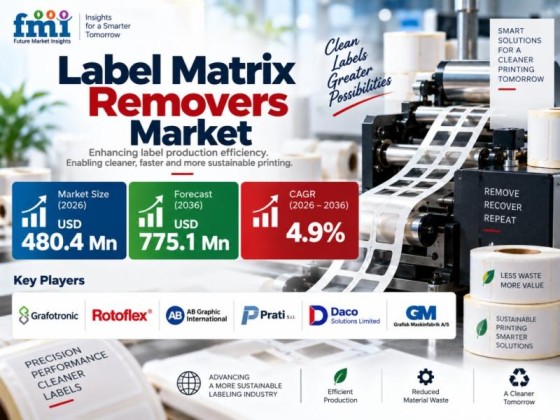
The global label matrix removers market is projected to reach USD 775.1 million by 2036, up from USD 480.4 million in 2026, expanding at a 4.9% CAGR during the forecast period, according to a new market analysis by Future Market Insights (FMI).
Label matrix removal is becoming an important consideration for converters operating faster printing and finishing lines. When the waste lattice breaks or a full matrix roll requires manual intervention, production can stop even when printing and die cutting remain capable of continuous operation.
The market is increasingly influenced by the shift toward high-mix, short-run label production. Frequent digital jobs and automated changeovers can increase the number of finishing adjustments required during a production day. In this environment, stable matrix handling can help protect productive press and finishing time.
Packaged-food relabeling is another factor influencing finishing requirements. Artwork changes associated with product information and packaging programs can increase the number of jobs moving through existing die-cutting and rewinding equipment. However, capital decisions remain closely tied to the economics of individual production lines. Converters need to determine whether a matrix remover can reduce stoppages or labor requirements enough to justify the investment.
👉 Get Detailed Market Forecasts, Competitive Benchmarking, and Pricing Trends: https://www.futuremarketinsights.com/reports/sample/rep-gb-35328
Matrix Rewinders and Pressure-Sensitive Labels Remain Key Segments
By remover type, matrix rewinders are projected to account for 27.0% of the market in 2026. Their position reflects compatibility with established die-cutting and rewind layouts. Driven waste rolls can maintain controlled movement of the stripped lattice while downstream processes continue operating.
Pressure-sensitive labels are expected to represent 42.0% of demand by label type in 2026. Their liner-backed construction creates a continuous surrounding waste lattice after the label material is die cut, making controlled stripping an important part of the finishing process.
The 250-500 mm web width segment is projected to hold 38.0% share in 2026. This range fits many narrow-web finishing platforms and can allow converters to integrate matrix-removal equipment without redesigning the complete material path.
Food and beverage labels are forecast to account for 31.0% of demand by end use in 2026. High label volumes combined with artwork variation create recurring requirements for reliable finishing and waste removal.
By sales channel, label press OEMs are expected to hold 37.0% share in 2026. OEM-led integration can address web tension and line-control requirements during the initial equipment specification and commissioning process.
Automation Creates a Focused Retrofit Opportunity
Automation is emerging as a practical route for reducing matrix-related interruptions. The commercial case is particularly relevant where waste handling is repeatedly identified as a cause of finishing-line stoppage.
At the same time, installed-line economics remain an important restraint. Existing presses and finishers can retain useful operating life, making full equipment replacement difficult to justify when a targeted upgrade can address a specific bottleneck.
FMI’s analysis highlights retrofit modules as an opportunity for converters seeking to improve matrix handling without replacing productive printing and finishing assets. The investment case depends on verified web-path compatibility, substrate trials, and measurable improvements in stoppage performance.
Nandini Roy Choudhury, Principal Consultant at Future Market Insights, stated: “Matrix removal becomes commercially important at the point where waste handling begins to dictate the speed of a more expensive print-and-finish line. The better purchase case is a verified reduction in stoppage time on difficult jobs without forcing replacement of productive equipment that still has useful operating life.”
Regional Outlook
FMI profiles market growth across major label-producing economies. Mexico is forecast to expand at a 6.0% CAGR, followed by Brazil at 5.7%, Italy at 5.3%, and the USA at 5.0%. Germany is projected at 4.7%, France at 4.3%, and Japan at 4.0%.
Country-level investment decisions remain dependent on installed equipment, service availability, substrate mix, job complexity, and the ability to demonstrate a measurable reduction in production interruptions.
>> Access detailed market insights: https://www.futuremarketinsights.com/reports/brochure/rep-gb-35328
Competitive Landscape
Notable companies covered in the Label Matrix Removers Market include Grafotronic, Rotoflex, AB Graphic International, Prati S.r.l., Daco Solutions Limited, GM (Grafisk Maskinfabrik A/S), Spartanics, CARTES S.r.l., SMAG X, and LEMORAU.
The competitive landscape includes modular automation platforms, integrated label-converting systems, and focused matrix-removal and compact finishing solutions.
Recent developments include expanded routes to market for Rotoflex equipment, new demonstrations and finishing-system activity by CARTES, and a collaboration involving GM for premium label-finishing demonstrations.
Report Scope
The Label Matrix Removers Market report covers remover type, label type, web width, end use, sales channel, and region. The study covers North America, Latin America, Western Europe, Eastern Europe, East Asia, South Asia and Pacific, and the Middle East and Africa.
The forecast period runs from 2026 to 2036. Market estimates are presented in USD million, with analysis based on primary and secondary research, market triangulation, segment analysis, company participation, pricing and volume indicators, adoption levels, and country-level demand conditions.