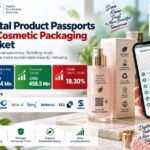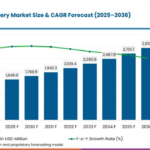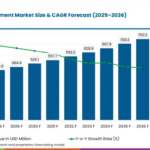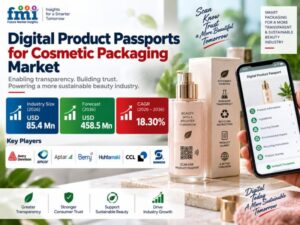


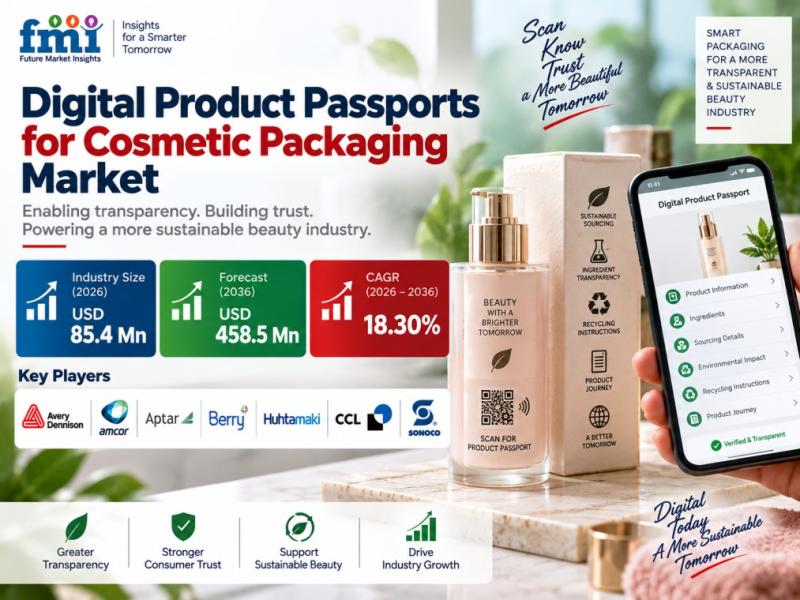
The global Digital Product Passports for Cosmetic Packaging Market is projected to reach USD 458.5 million by 2036, rising from USD 85.4 million in 2026 at a CAGR of 18.30%, according to Future Market Insights (FMI).
The market was valued at USD 72.5 million in 2025. Growth is being shaped by the increasing use of digital identifiers within cosmetic packaging to provide verifiable information on material composition, origin, recyclability, and carbon footprint.
Digital Product Passports (DPPs) connect physical packaging with digital records through technologies such as QR codes, NFC/RFID tags, blockchain platforms, and IoT sensors. For cosmetic brands, the technology provides a way to connect packaging with lifecycle information that can be accessed by consumers, regulators, recyclers, and other stakeholders.
Regulatory requirements are becoming an important part of packaging procurement decisions. The report identifies EU ESPR compliance as a key demand driver, with beauty brand procurement teams increasingly considering digital traceability capabilities when specifying new packaging.
👉 Get Detailed Market Forecasts, Competitive Benchmarking, and Pricing Trends: https://www.futuremarketinsights.com/reports/sample/rep-gb-32222
QR Codes Lead Technology Demand
QR Code-Based solutions are projected to account for 38.5% of market share in 2026. Their accessibility and relatively low implementation barrier make them an entry point for brands establishing digital traceability across cosmetic packaging.
QR codes can also provide a consumer-facing connection to product information. This allows packaging to support both compliance-related data access and broader product communication.
By packaging format, Bottles & Jars are expected to hold 42.0% share in 2026. Rigid formats used for skincare and serum products provide suitable surfaces for QR or NFC integration while maintaining established packaging designs.
Skincare represents another significant segment, with an estimated 45.0% share in 2026. The segment’s focus on product information, sustainability claims, and premium positioning creates demand for packaging that can connect physical products with verifiable digital records.
By material, plastic is projected to account for 52.0% share in 2026.
Compliance and Consumer Transparency Shape Adoption
The adoption of DPP-enabled cosmetic packaging is being driven by several interconnected requirements.
EU ESPR-related compliance requirements are encouraging brands to consider digital identifiers during packaging development rather than adding them after production systems are established. Consumer expectations around sustainability credentials are also creating demand for accessible information about recycled content and end-of-life routes.
Counterfeiting concerns in premium skincare are another factor identified in the report. Blockchain-linked records and other digital verification systems can provide additional product-authentication capabilities across distribution networks.
For packaging suppliers, the transition introduces both technical and commercial considerations. Integrating NFC or blockchain layers into high-speed filling and packaging lines can require new technical expertise. Multi-supplier data architectures also need to remain compatible with existing enterprise systems.
This creates opportunities for suppliers offering pre-validated DPP modules, interoperable data platforms, and packaging formats designed for digital integration from the beginning of the product-development process.
Ismail Sutaria, Principal Consultant for Packaging at Future Market Insights, said: “In my analysis, I have observed that the real tension lies between the perceived cost of DPP integration and the hidden revenue upside from enhanced consumer trust and premium positioning. Brands that treat compliance as a checkbox miss the window where scanned packaging becomes a direct engagement channel that drives repeat purchase and loyalty programs. Packaging engineers who embed verifiable data early will capture share from competitors still relying on static labels that cannot prove circularity claims to regulators or end-users.”
Germany Leads Country Growth
Germany is projected to record a 16.5% CAGR from 2026 to 2036, followed by France at 15.0% and the United Kingdom at 14.0%.
The United States is forecast to expand at 12.5%, while China is projected at 11.0%. India is expected to register 10.5%, followed by Japan at 9.5%.
Across Europe, regulatory requirements are encouraging brands to consider DPP functionality during initial packaging development. In Asia Pacific, export requirements and access to regulated Western beauty markets are supporting investment in digital traceability.
>> Access detailed market insights: https://www.futuremarketinsights.com/reports/brochure/rep-gb-32222
Competitive Landscape
Key companies profiled in the Digital Product Passports for Cosmetic Packaging Market include Avery Dennison, Amcor, AptarGroup, Berry Global, Huhtamaki, CCL Industries, and Sonoco.
The competitive environment includes packaging and material suppliers developing digital identifiers, traceability platforms, NFC solutions, and DPP-ready packaging formats.
The report also highlights recent developments involving moisture-resistant NFC inlays, cloud-connected material provenance platforms, modular DPP systems, blockchain-linked traceability solutions, and paper-based digital passport formats.
Report Scope
The FMI report covers technology, packaging format, cosmetic category, material, and region.
Technologies analyzed include QR Code-Based solutions, NFC/RFID Tags, Blockchain Platforms, and IoT Sensors. Packaging formats include Bottles & Jars, Tubes, Jars & Pots, and Pouches & Sachets.
Cosmetic categories covered include Skincare, Makeup, Haircare, and Fragrance. Materials include Plastic, Glass, Paper & Paperboard, and Metal.
The study covers Europe, North America, Asia Pacific, Latin America, Middle East & Africa, Oceania, and South Asia, with country-level analysis across Germany, France, the United Kingdom, the United States, China, India, Japan, and more than 40 countries.
FMI’s methodology combines primary interviews, desk research, bottom-up market sizing, regional regulatory adoption curves, and cross-validation against industry and regulatory data.