

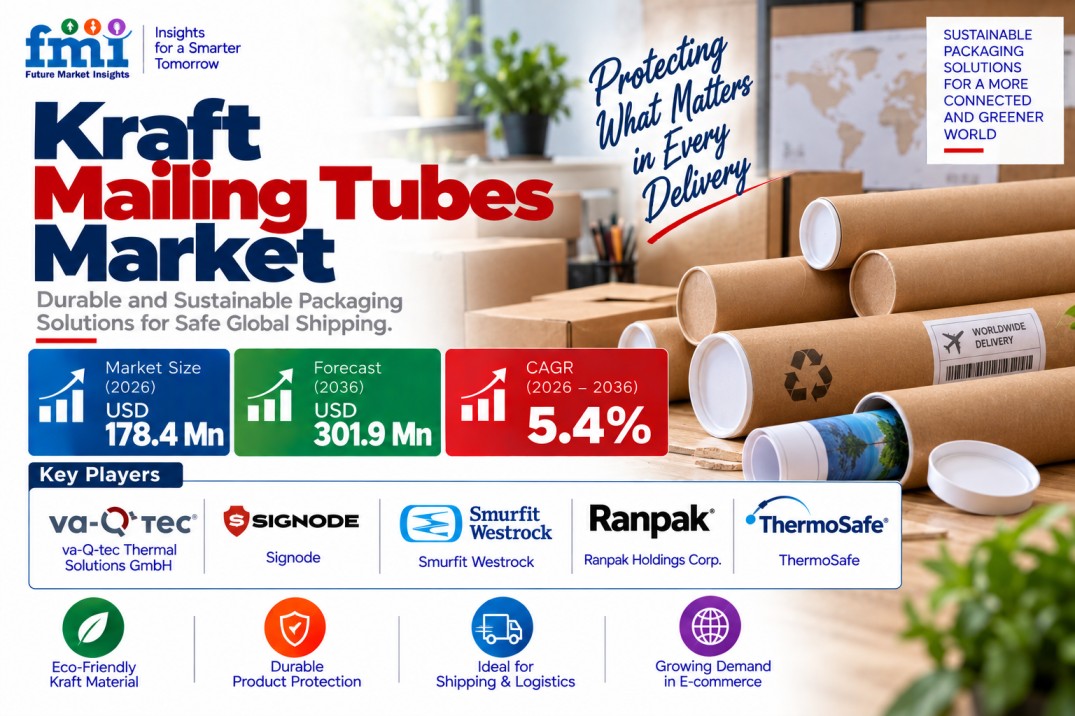
The global Kraft Mailing Tubes Market is projected to reach USD 301.9 million by 2036, rising from USD 178.4 million in 2026 at a 5.4% CAGR, according to Future Market Insights (FMI).
Kraft mailing tubes continue to serve shipping applications where products need bending protection but do not justify the volume of an oversized carton. Rolled posters, drawings, documents, and other elongated products can require cylindrical packaging to maintain their shape throughout fulfillment and parcel handling.
The market is also being shaped by the economics of modern parcel networks. High-volume fulfillment operations increasingly need repeatable packaging specifications that can move through established packing and delivery processes without additional handling.
USPS recorded 6.8 billion shipping and package pieces in fiscal 2025, highlighting the scale of the national parcel environment. At the same time, carrier treatment can affect the economics of cylindrical packaging. USPS classified cylindrical tubes and rolls as nonstandard parcels in April 2025, while a characteristics-based nonstandard fee for cylindrical tubes and rolls became effective in July 2025.
For packaging managers, this makes dimensional specifications part of the purchasing decision. A lower packaging cost can lose its advantage if carrier charges increase the delivered cost.
👉 Request Your Sample Now – Growth Potential and Discover Key Market Opportunities: https://www.futuremarketinsights.com/reports/sample/rep-gb-35332
Standard Formats Lead the Format Category
Standard formats are projected to account for 41.0% share in 2026. Repeatable diameters and dimensions make them suitable for routine commercial shipments and simplify replenishment for direct accounts.
By material, paper-based systems are estimated to hold 27.0% share in 2026. Familiar fiber recovery routes support their use in recyclable packaging programs, particularly where businesses want packaging structures with straightforward disposal requirements.
Standard-duty tubes are expected to represent 37.0% share in the performance class. These formats address lightweight rolled goods without the heavier construction required for more demanding applications.
The e-commerce and parcel segment is projected to hold 28.0% share in 2026. Online fulfillment continues to create demand for packaging capable of protecting crease-sensitive goods that are difficult to ship efficiently in flat formats.
By sales channel, direct accounts are forecast to represent 48.0% share in 2026. Large commercial shipping programs can standardize tube dimensions, delivery schedules, and inventory requirements, supporting recurring purchases.
Automation and Carrier Economics Influence Packaging Decisions
The report identifies fulfillment throughput as an important driver for kraft mailing tube demand. High-volume sites need consistent packaging specifications that can fit established packing workflows.
At the same time, cylindrical packaging faces a specific challenge: carrier treatment.
Nonstandard parcel characteristics can increase shipping costs and change the economics of using tubes. Packaging buyers therefore need to assess protection performance alongside dimensional charges and handling requirements.
There is also an opportunity to develop fiber-based protection systems. Paper cushioning can complement kraft tube walls where manufacturers want additional internal protection while maintaining clearer recovery pathways.
FMI Principal Consultant Nandini Roy Choudhury notes: “Repeat orders follow after diameter and closure strength prove bending protection without avoidable carrier charges. Strong offers give fulfillment teams stable dimensions and material records that survive pack-line and recycling reviews.”
Country Markets Show Different Growth Patterns
Saudi Arabia is forecast to record the highest CAGR among the countries profiled at 6.9%, followed by the UAE at 6.6% and South Korea at 6.3%. The USA is projected to grow at 6.0%, Germany at 5.7%, the UK at 5.4%, France at 5.1%, and Japan at 4.8%.
The country outlook reflects differences in parcel infrastructure, carrier treatment, packaging requirements, recycling systems, and fulfillment maturity.
Saudi Arabia’s parcel market, for example, is supported by expanding formal delivery infrastructure, while Japan’s mature parcel network places greater emphasis on predictable dimensions and routine sortation.
Competitive Landscape
Notable companies profiled in the Kraft Mailing Tubes Market include va-Q-tec Thermal Solutions GmbH, Signode, Smurfit Westrock, Ranpak Holdings Corp., ThermoSafe, Cold Chain Technologies, Peli BioThermal, Sealed Air, Pregis LLC, and Storopack.
The competitive landscape covers fiber-based mailing and protection platforms, transit-protection and end-of-line systems, and temperature-assured shipping specialists.
Recent developments include Storopack’s launch of PAPERwrap, ThermoSafe’s Orion Express reusable shipper configuration, and Cold Chain Technologies’ TRUEtemp Naturals parcel shipper.
>> Access detailed market insights: https://www.futuremarketinsights.com/reports/brochure/rep-gb-35332
Report Scope
The FMI report segments the Kraft Mailing Tubes Market by format type, material, performance class, end use, sales channel, and region.
Format types include standard, recyclable-optimized, premium and branded, and custom-engineered formats. Materials include paper-based, foam, air and film, and thermal insulated systems.
Performance classes cover standard duty, heavy duty, and temperature-assured formats. End-use segments include e-commerce and parcel, electronics and industrial, pharma and healthcare, and food and grocery.
The report covers North America, Latin America, Western Europe, Eastern Europe, East Asia, South Asia and Pacific, and the Middle East and Africa. Country analysis includes the USA, Germany, France, UK, Japan, South Korea, Saudi Arabia, UAE, and more than 25 additional countries.
FMI uses primary and secondary research with market triangulation. The research process includes industry interviews, desk research, market sizing, forecasting, and data validation.