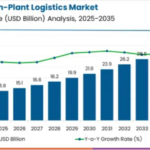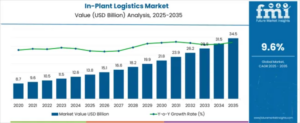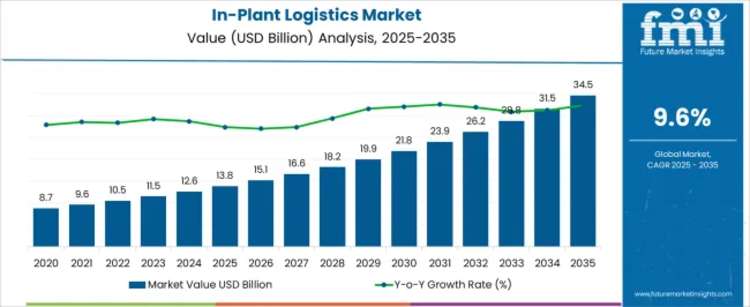
The global in-plant logistics market is projected to grow from USD 13.8 billion in 2025 to USD 34.5 billion by 2035, registering a compound annual growth rate (CAGR) of 9.6% during the forecast period. Increasing adoption of automation, rising demand for efficient internal material movement, and the need to streamline manufacturing and warehouse operations are expected to support market expansion.
Material handling is anticipated to dominate the market, accounting for a 36.2% share, while medium-sized facilities are projected to lead the facility size segment with a 41.2% share. These trends highlight the importance of efficient material movement and scalable logistics solutions for facilities seeking to improve operational productivity.
Get detailed market forecasts, competitive benchmarking, and pricing trends: https://www.futuremarketinsights.com/reports/sample/rep-gb-24114
Global Segment Leaders
- Material Handling: Expected to account for 36.2% of the market, reflecting the importance of moving materials efficiently between production, storage, and distribution areas.
- Medium-Sized Facilities: Projected to hold a 41.2% share of the facility size segment, highlighting demand for in-plant logistics solutions suited to medium-scale operating environments.
Market Growth Drivers
The in-plant logistics market is expected to benefit from several factors shaping industrial operations and internal supply chains:
- Growing Factory Automation: Manufacturers are increasingly adopting automated technologies to improve material movement, reduce manual handling, and support consistent production workflows.
- Operational Efficiency Requirements: Businesses are seeking ways to reduce internal transport delays, improve material availability, and streamline movement between production stages.
- Manufacturing and Warehouse Modernization: Investments in modern facilities are creating opportunities for integrated logistics systems that coordinate material handling, storage, and internal transportation.
- Demand for Scalable Logistics Solutions: Facilities require systems that can accommodate their operating scale, layout, throughput, and changing production needs.
Material Handling Maintains Market Leadership
Material handling is projected to account for 36.2% of the in-plant logistics market. It covers the movement, storage, control, and protection of materials throughout internal industrial operations.
Efficient material handling helps coordinate the flow of components, work-in-progress, and finished goods between different areas of a facility. Businesses may evaluate equipment suitability, movement efficiency, integration with production systems, and operating requirements when selecting material handling solutions.
As manufacturers focus on improving workflow coordination and reducing avoidable delays, material handling is expected to remain a central component of in-plant logistics strategies. Solutions tailored to facility layouts and production requirements can help organizations support more consistent internal operations.
Medium-Sized Facilities Support Market Demand
Medium-sized facilities are forecast to represent 41.2% of the facility size segment. These facilities may require logistics solutions that balance operational capacity, available floor space, and investment requirements.
The right in-plant logistics setup depends on production volume, material flow, facility layout, storage needs, and the degree of automation. Businesses may combine different material handling approaches to improve internal movement without disrupting existing production processes.
The projected share of medium-sized facilities highlights the importance of solutions that can accommodate varied operational needs while supporting efficient use of space and resources.
Automation and Integrated Material Flow Create Opportunities
In-plant logistics connects internal transportation and material handling with manufacturing and storage activities. Better coordination can help reduce bottlenecks, improve material availability at workstations, and support smoother movement through production processes.
Automation can also help businesses standardize repetitive material movement and improve coordination between logistics and production operations. Depending on their requirements, facilities may consider automated transport systems, material handling equipment, storage solutions, and digital coordination tools.
Adoption decisions are likely to depend on facility complexity, integration requirements, expected throughput, and investment priorities. These factors create opportunities for suppliers offering solutions suited to different industrial operating environments.
Market Outlook: Strong Expansion Through 2035
The global in-plant logistics market is projected to reach USD 34.5 billion by 2035, with a reported CAGR of 9.6%. The supplied forecast analysis also identifies a growth trajectory from USD 8.7 billion in 2024 to USD 9.6 billion in 2025 and USD 10.5 billion in 2026, reflecting increasing adoption of efficient logistics solutions.
The supplied market figures contain a discrepancy: the key insight and headline market size indicate USD 13.8 billion for 2025, while the detailed forecast paragraph states USD 9.6 billion for 2025. The figures should be reconciled against the original report before publication.
Material handling is expected to remain the leading market category, with a 36.2% share, while medium-sized facilities are projected to account for 41.2% of the facility size segment. Suppliers that address internal material flow, facility-specific requirements, and operational efficiency may be positioned to benefit from continued market development.
Competitive Landscape
Competition in the in-plant logistics market is shaped by system integration capabilities, material handling performance, automation options, scalability, reliability, and suitability for different facility layouts. Buyers may also consider installation requirements, compatibility with existing production systems, and ongoing maintenance needs.
Manufacturers and logistics solution providers need to address the operational requirements of industrial facilities of varying sizes. Solutions that improve internal material flow and support efficient coordination between production and logistics functions can help suppliers respond to changing customer priorities.
The supplied market information does not identify individual leading companies, so specific competitor rankings are not included in this release.
Key Players:
- Toyota Material Handling
- KION Group
- Daifuku Co., Ltd.
- Jungheinrich AG
- Honeywell Intelligrated
- Mitsubishi Logisnext Co., Ltd.
- SSI SCHÄFER
Get the Complete Story—Read More About Our Latest Report: https://www.futuremarketinsights.com/reports/in-plant-logistics-market
The Future Market Insights report on the in-plant logistics market provides further analysis of market size, forecast trends, material handling, facility size segments, and the factors influencing demand through 2035.
Analyst Perspective
According to Nikhil Kaitwade, Future Market Insights, “The in-plant logistics market is expected to benefit from the growing emphasis on efficient internal material movement and streamlined industrial workflows. Material handling and medium-sized facilities represent important market segments, reflecting the need for logistics solutions that can improve operational coordination and adapt to different facility requirements.”
Related Reports
Asphalt Mixing Plants Market- https://www.futuremarketinsights.com/reports/asphalt-mixing-plants-market
Clean Steam Separator Market- https://www.futuremarketinsights.com/reports/clean-steam-separator-market
Cooling Tower Fans Market- https://www.futuremarketinsights.com/reports/cooling-tower-fans-market
About Future Market Insights (FMI)
Future Market Insights, Inc. (FMI) is an ESOMAR-certified, ISO 9001:2015 market research and consulting organization, trusted by Fortune 500 clients and global enterprises. With operations in the U.S., UK, India, and Dubai, FMI provides data-backed insights and strategic intelligence across 30+ industries and 1200 markets worldwide.
For Press & Corporate Inquiries
Rahul Singh
AVP – Marketing and Growth Strategy
Future Market Insights, Inc.
Phone: +91 8600020075
For Sales: sales@futuremarketinsights.com
For Media: Rahul.singh@futuremarketinsights.com
Website: https://www.futuremarketinsights.com/