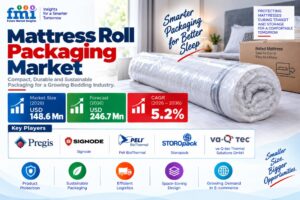


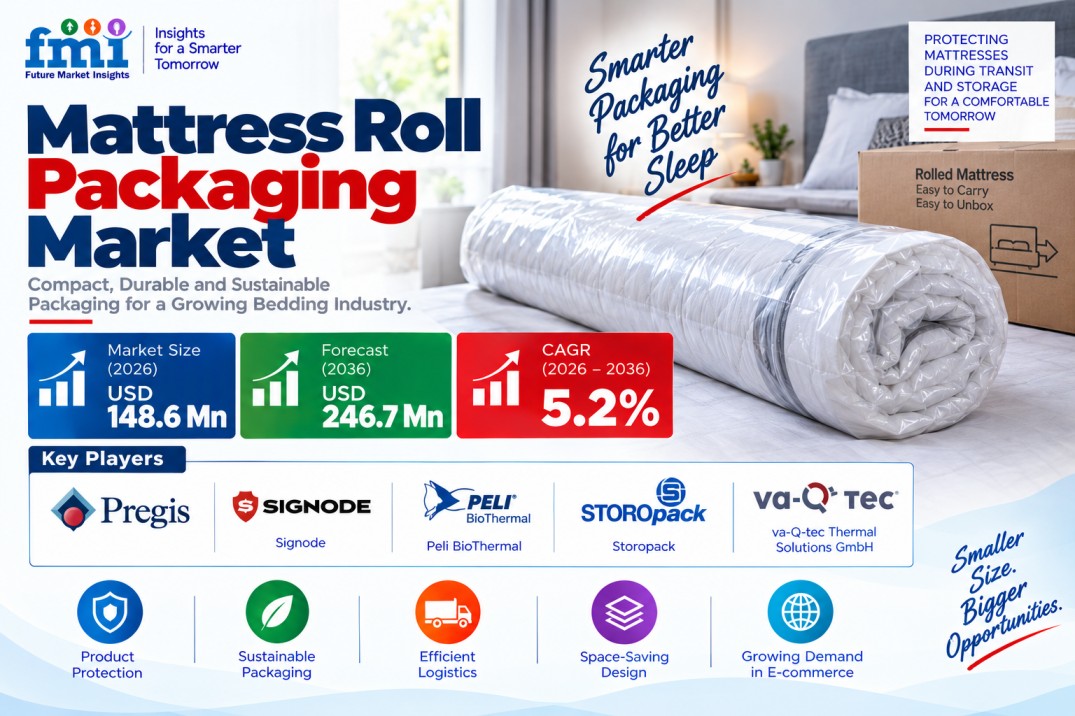
The global Mattress Roll Packaging Market is projected to reach USD 246.7 million by 2036, rising from USD 148.6 million in 2026 at a 5.2% CAGR, according to Future Market Insights (FMI).
Mattress roll packaging is becoming increasingly relevant as bedding manufacturers and direct-to-consumer sellers look to reduce the shipping and storage space occupied by finished mattresses. Compression and rolling allow bulky products to move through fulfillment networks in a more compact form, but the packaging must keep the compressed unit stable throughout handling and delivery.
The market was valued at USD 148.6 million in 2026. Its projected expansion reflects continued demand for packaging that can support compact mattress distribution while meeting performance and material requirements.
Production speed is an important consideration. C3 stated in April 2026 that its RC9500 line can process more than 120 full-size mattress packages per hour. At these speeds, film tension, seal performance, and roll diameter can affect the stability of packages entering downstream boxing and handling operations.
Roll-Pack Films Lead Product Type
By product type, roll-pack films are projected to account for 45.0% share in 2026. These films directly contain mattresses during compression and rolling before secondary packaging or handling.
By material, paper-based systems are estimated to hold 27.0% share in 2026. Paper-based outer protection provides an option for reducing plastic use in selected applications while leaving flexible film to perform the compression-containment function.
Standard-duty packaging is forecast to hold 43.0% share in the performance class in 2026, reflecting the requirements of routine ambient mattress distribution.
E-commerce and parcel applications are expected to represent 33.0% share in 2026, supported by the shipping advantages of compact mattress rolls. Direct accounts are projected to account for 44.0% share, reflecting the importance of line-specific material qualification and scheduled replenishment.
Compression Performance Remains Central to Packaging Selection
The business case for roll packaging depends on more than reducing package size.
A compressed mattress must retain its roll geometry during warehouse storage, transportation, and final delivery. Film tension, seal settings, puncture resistance, and roll diameter therefore remain important qualification factors.
FMI Principal Consultant Nandini Roy Choudhury notes: “Mattress roll packaging earns its economics at compression because roll diameter changes warehouse and trailer capacity. Material reduction is useful only after film and seal trials confirm the compressed mattress stays stable through delivery.”
Material recovery adds another consideration. European packaging requirements are placing greater attention on recyclability, creating pressure to review structures that rely on difficult-to-separate multilayer materials.
This creates an opportunity for manufacturers to replace selected outer protection with paper while retaining flexible film where elastic recovery remains necessary for compression.
E-commerce Supports Demand for Compact Mattress Packages
E-commerce and parcel distribution is forecast to lead the end-use category with 33.0% share in 2026.
Direct shipment changes the packaging requirements for bulky products. A smaller compressed mattress package can reduce warehouse and transportation space compared with shipping the finished product in an uncompressed form.
The report also identifies direct accounts as the leading sales channel, with a projected 44.0% share in 2026. Mattress manufacturers often need to qualify film gauge, sealing conditions, and packaging performance against their specific compression equipment.
This makes direct supplier relationships relevant where material changes need to be tested before they are introduced across high-volume production.
Regional Outlook
The UAE is forecast to record a 6.6% CAGR from 2026 to 2036, followed by Saudi Arabia at 6.3% and South Korea at 6.0%.
The USA is projected to grow at 5.7%, Germany at 5.4%, the UK at 5.1%, France at 4.8%, and Japan at 4.5%.
Regional requirements vary according to e-commerce penetration, fulfillment infrastructure, packaging regulations, material recovery systems, and established manufacturing practices.
Competitive Landscape
Companies profiled in the Mattress Roll Packaging Market include Pregis, Signode, Peli BioThermal, Storopack, va-Q-tec Thermal Solutions GmbH, Sealed Air, ThermoSafe, Cold Chain Technologies, Smurfit Westrock, and Ranpak.
The competitive landscape includes flexible protective packaging and automation providers, fiber-based protection suppliers, and specialized temperature-controlled packaging companies.
Recent developments highlighted in the report include Pregis’ launch of the Sharp Lynx 18 automated bagger for paper and poly mailers, Sealed Air’s AUTOBAG 850HB hybrid bagging machine, and Ranpak’s multi-year partnership with Rabot for vision-based pack-station analysis.
>> Access detailed market insights: https://www.futuremarketinsights.com/reports/brochure/rep-gb-35341
Report Scope
The FMI report segments the Mattress Roll Packaging Market by product type, material, performance class, end use, sales channel, and region.
Product types include roll-pack films, compression bags, cartons and wraps, and handling accessories. Material segments cover paper-based systems, foam systems, air and film systems, and thermal insulated systems.
Performance classes include standard duty, heavy duty, and temperature-assured formats. End-use segments include e-commerce and parcel, electronics and industrial, pharma and healthcare, and food and grocery. Sales channels include direct accounts, packaging distributors, and online B2B.
The study covers North America, Latin America, Western Europe, Eastern Europe, East Asia, South Asia and Pacific, and the Middle East and Africa. Country analysis includes the USA, Germany, France, UK, Japan, South Korea, Saudi Arabia, UAE, and more than 20 additional countries.
FMI applies primary and secondary research with market triangulation, including industry interviews, desk research, market sizing, forecasting, and data validation.