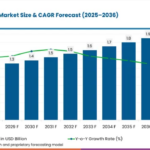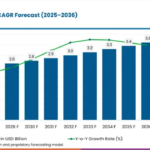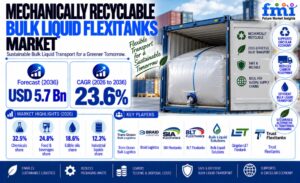


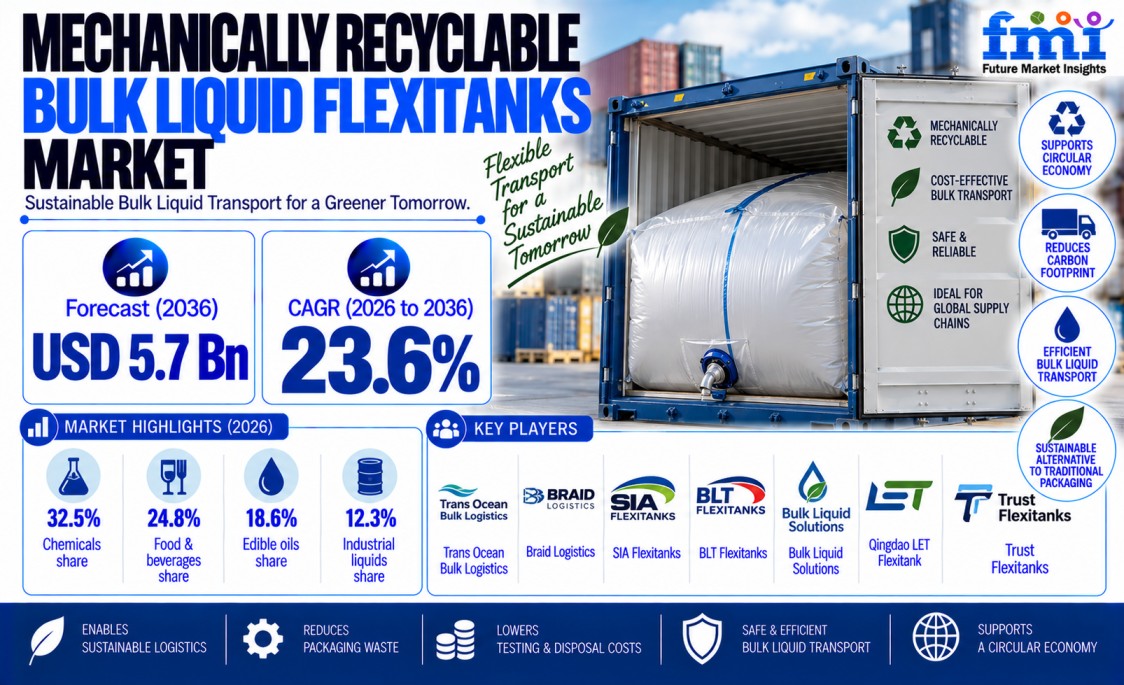
The global Mechanically Recyclable Bulk Liquid Flexitanks Market is projected to reach USD 5.7 billion by 2036, rising from USD 0.7 billion in 2026 at a 23.6% CAGR, according to Future Market Insights.
The market registered USD 0.5 billion in 2025, with procurement advances expected to take market value to USD 0.7 billion in 2026.
Demand is being shaped by logistics operators, shippers and terminal authorities seeking bulk liquid containment formats that can enter established mechanical recycling streams after discharge. Mono-polymer structures, particularly mono-PE architectures, are gaining attention as an alternative to traditional multi-material flexitanks containing incompatible nylon or metallic barrier layers.
The market covers specialized flexible containment systems manufactured from compatible polymer families and designed for transporting non-hazardous liquids inside standard twenty-foot shipping containers.
Single-Use Recyclable Flexitanks Lead Tank Type Demand
Single-use recyclable flexitanks are projected to account for 60.0% of the market in 2026.
Their appeal is closely linked to logistics economics and end-of-life handling. Single-trip structures eliminate the reverse logistics and return freight associated with empty reusable bladders. Verified recycling pathways at destination ports can also reduce disposal delays.
Terminal waste policies are becoming an important consideration for logistics procurement. Fixed disposal and recycling charges can directly affect the economics of bulk liquid shipments, increasing the importance of specifying materials with established recovery pathways.
Food & Beverage Represents a Major End-Use Segment
The food & beverage segment is projected to hold a 45.0% share in 2026.
High-volume edible oil and juice concentrate export flows create a significant application base for flexible bulk liquid containment. Food-grade migration requirements must be considered alongside corporate sustainability targets when exporters select transport packaging.
Mono-polymer structures can support these requirements while allowing discharged liners to be directed toward mechanical recycling streams where appropriate.
Medium-Capacity Units Account for Half of Volume Share
Medium-capacity flexitanks are projected to capture 50.0% of volume share.
Standardized medium-capacity configurations provide a balance between payload requirements, container limitations and intermodal compatibility. Exporters using ocean, rail and road networks need containment specifications that fit standard transport infrastructure and avoid overweight or transfer delays.
Bulk filling represents 55.0% of regional demand, reflecting throughput requirements across agricultural and chemical processing operations.
Mono-PE Structures Support Material Transition
Mono-PE multilayer films are projected to account for 46.0% of the material segment.
Film converters are working to replace incompatible nylon barrier layers with oriented polyethylene structures while maintaining the strength required for bulk liquid transportation.
This development is important because mechanical recyclability depends not only on the liner’s use phase but also on whether the discharged structure can enter a compatible recycling process without complex separation or delamination.
Asia Pacific Records Strong Growth
India is projected to record a 27.0% CAGR through 2036, followed by China at 25.0% and Brazil at 24.0%.
The USA is forecast to expand at 20.0%, while Germany, the UK and Japan are projected to record CAGRs of 18.0%, 17.0% and 16.0%, respectively.
India’s market is supported by conversion from rigid steel drums toward containerized flexible liquid transport. China’s large manufacturing base and expanding trade corridors support demand for mono-material flexitanks.
In Europe, regulatory enforcement and port-level waste handling are important factors shaping procurement. Germany’s demand is linked to chemical exports and circular-economy requirements, while the UK market is influenced by food and beverage logistics and sustainability expectations.
Brazil benefits from agricultural and industrial exports, including edible oils and other bulk liquid shipments.
Procurement Moves Beyond the Liner Specification
For logistics directors, mechanically recyclable flexitanks introduce several procurement considerations beyond basic containment performance.
Destination-port waste policies need to be evaluated before selecting a liner. Buyers also need to assess whether suppliers can provide verified mono-polymer extrusion capabilities and whether local recycling infrastructure can accept the discharged material.
Installation, filling, discharge and secondary packaging also form part of the operational equation. Compatible stretch films, weather-protection layers and localized film extrusion capacity can influence the reliability of the overall logistics system.
Analyst Perspective
“Most shippers view mechanical recyclability as an environmental compliance box, but the actual operational bottleneck is port-level waste handling. Terminals are actively refusing mixed-material liner disposal. Operators who fail to transition their liquid export lanes to verified mono-polymer flexitanks will forfeit their berth priority to competitors deploying zero-waste discharge systems.”
— Ismail Sutaria, Principal Consultant for Packaging, Future Market Insights
Competitive Landscape
The market includes logistics providers and flexitank specialists developing solutions around bulk liquid containment and recycling requirements.
Key players include Trans Ocean Bulk Logistics, Braid Logistics, SIA Flexitanks, BLT Flexitanks, Bulk Liquid Solutions, Qingdao LET Flexitank, and Trust Flexitanks.
The competitive environment is increasingly influenced by polymer extrusion capability, localized technical support, recycling partnerships and access to reliable resin supply.
Recent developments include Maersk introducing centralized flexitank removal at major European ports in February 2026 with a fixed charge of EUR 695 per container covering destruction and recycling handling. In September 2025, TotalEnergies and SML announced recyclable downgauging film solutions aligned with lighter-weight transport packaging films.
Report Scope
The Mechanically Recyclable Bulk Liquid Flexitanks Market report covers tank type, capacity, end use, filling method, material and region.
Tank types include single-use recyclable, reusable and hybrid/other formats. Capacity categories include medium, large and small capacity. End-use segments cover food & beverage, chemicals, pharma raw materials and others.
Filling methods include bulk filling and tanker-to-container, while material categories include mono-PE multilayer, recyclable barrier mono-polymer and others.
The report covers North America, Latin America, Europe, East Asia, South Asia, Oceania, and the Middle East and Africa, with analysis across the United States, Canada, Mexico, Brazil, Argentina, Germany, France, the United Kingdom, Italy, Spain, China, India, Japan, South Korea, Indonesia, Australia and more than 40 countries.