

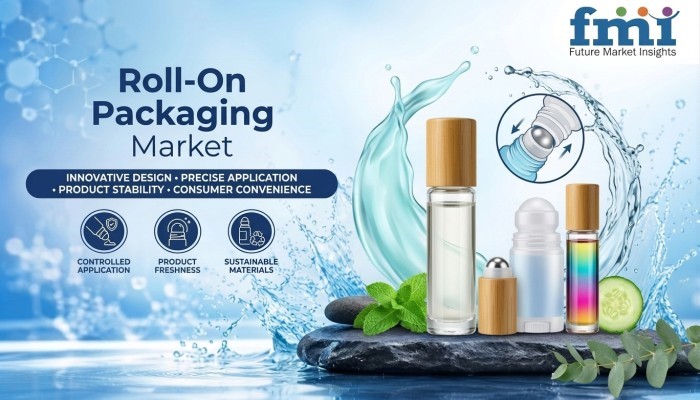
The global Roll-On Packaging Market is projected to reach USD 456.8 million by 2036, rising from USD 283.1 million in 2026 at a 4.9% CAGR, according to Future Market Insights (FMI). Demand is being supported by wider use of rolling applicators for deodorants, skincare, fragrance, wellness formulas, and other products requiring controlled-contact dosing.
The market is also being shaped by changes in material selection. Beauty brands and packaging suppliers are assessing PCR resins, lightweight structures, refill systems, and documented material composition while maintaining the leakage control and roller performance expected from established roll-on formats.
Controlled Application Expands Roll-On Use Beyond Deodorants
Roll-on packaging has traditionally been associated with deodorant products, but the application format is finding wider use in targeted skincare and wellness applications. Rolling heads allow brands to deliver formulas directly onto localized areas while maintaining a compact package format.
Skincare brands are expected to account for 35.0% of end use in 2026. The segment benefits from the suitability of rolling applicators for serums, oils, and localized treatments where controlled application is part of the product experience.
Quadpack launched Freedom Dropper in July 2025 for low-viscosity skincare and makeup formulas using a rolling applicator inside a dropper format. The development illustrates how applicator design is expanding into applications beyond conventional roll-on deodorant packaging.
Get detailed market forecasts, competitive benchmarking, and pricing trends:
https://www.futuremarketinsights.com/reports/sample/rep-gb-34865
Standard Components Remain Central to Packaging Qualification
Standard components are estimated to account for 44.0% of the Roll-On Packaging Market in 2026, making them the leading product-type segment. Established neck, ball, and closure interfaces can reduce engineering changes during filling and sealing qualification.
Silgan Dispensing presented SealPack at CMPL Expo in May 2026 as a simplified three-piece polypropylene roll-on incorporating bottle, ball, and cap manufacturing. For packaging teams, familiar component interfaces can simplify trials when a new product moves from design to production.
The qualification process remains closely tied to formula viscosity, ball-fitment geometry, leakage performance, and line compatibility.
PCR Resins Put Material Performance Under Closer Review
Plastics and PCR resins are projected to represent 38.0% of material demand in 2026. Their position reflects the flexibility of plastic molding for lightweight bodies, fitments, and closures.
Somater reported in February 2025 that its Biotherm 2.0 roll-on uses 100% PCR material and weighs 26% less than the previous pack. The example shows how recycled resin can enter an established beauty-packaging format while retaining the familiar rolling application.
Nandini Roy Choudhury, Principal Consultant at Future Market Insights, said:
“Roll-on programs earn value from the interface between formula viscosity and the ball-fitment geometry that controls flow. Packaging teams should compare leakage results and line compatibility before paying for decoration or recycled-content claims that alter proven component tolerances.”
Refill Formats Offer Another Route to Material Reduction
Refill-ready architectures are emerging as an opportunity for brands seeking lower material consumption without abandoning the roll-on application experience.
Somater’s June 2026 CSR report documents two refillable roll-on concepts using either a secondary refill bottle or a replaceable formula-containing component. The commercial opportunity depends on maintaining cleanliness, leak control, and applicator performance through refill cycles.
Recyclability also raises the technical qualification threshold. Roll-on systems can combine separate body, fitment, ball, and closure materials, creating additional considerations for material declarations and recycling compatibility.
Regional Growth Varies Across Key Markets
Saudi Arabia records the highest CAGR among the profiled countries at 5.5% through 2036, followed by the USA at 5.1%, the UK at 4.8%, France at 4.5%, and Germany at 3.9%.
Regional requirements influence packaging specifications and qualification processes. Saudi cosmetic importers must coordinate registration and Arabic-facing pack information. In the USA, California’s SB 54 regulations create additional material-reduction considerations for packaging programs.
In Europe, recyclability and material transparency are becoming more relevant during packaging development and approval. These differences mean that suppliers serving multinational beauty brands need to account for local documentation and technical requirements alongside pack performance.
Competitive Landscape
The Roll-On Packaging Market includes integrated dispensing groups and specialist beauty packaging suppliers. Notable companies profiled by FMI include Silgan Dispensing Systems, Amcor plc, Quadpack, Somater, PPK Packaging, Sensoplast Packmitteltechnik GmbH, BELPACK Packaging, and SRS Packaging.
Recent developments include Amcor’s Shadow roll-on introduced in November 2025 with PCR options, Sensoplast’s SENSOrollON introduced in October 2025 for liquids, creams and oils, and BELPACK’s roll-on tubes with metallic roller balls introduced in September 2025.
Find Out More—Read the Complete Report for Full Insights!
https://www.futuremarketinsights.com/reports/roll-on-packaging-market
Report Scope
FMI’s Roll-On Packaging Market study covers product type, material, capacity, decoration, end use, and region. The study includes North America, Latin America, Europe, East Asia, South Asia and Pacific, and the Middle East and Africa.
The forecast period covers 2026 to 2036, with market values measured in USD million. The research combines primary and secondary research with market triangulation, including manufacturer, distributor, procurement, end-user, regulatory, trade, company, and industry inputs.
Related Report Links:
FMI Custom Research: Strategic Intelligence for Confident Decision-Making
In today’s rapidly evolving business environment, leadership teams need more than market data—they need clear, actionable intelligence tailored to their strategic objectives. FMI’s Custom Research solutions are designed around the specific business questions organizations need answered, enabling executives to evaluate growth opportunities, validate investments, assess competitive dynamics, and reduce uncertainty before making critical decisions. By combining deep industry expertise, primary research, and proprietary market intelligence, FMI delivers insights that help organizations move from assumptions to evidence-based strategies with greater speed and confidence.
Business Impact
FMI helps organizations transform market complexity into strategic clarity, enabling leadership teams to identify growth opportunities faster, optimize resource allocation, strengthen competitive positioning, and make high-stakes business decisions with confidence.
To explore how FMI Custom Research can support your strategic priorities, please connect with our team at – sales@futuremarketinsights.com
About Future Market Insights (FMI)
Future Market Insights, Inc. (FMI) is an ESOMAR-certified, ISO 9001:2015 market research and consulting organization, trusted by Fortune 500 clients and global enterprises. With operations in the U.S., UK, India, and Dubai, FMI provides data-backed insights and strategic intelligence across 30+ industries and 1200 markets worldwide.
Contact Us:
Future Market Insights Inc.
Christiana Corporate, 200 Continental Drive,
Suite 401, Newark, Delaware – 19713, USA
T: +1-347-918-3531
For Sales Enquiries: sales@futuremarketinsights.com
Website: https://www.futuremarketinsights.com
LinkedIn| Twitter| Blogs | YouTube