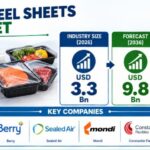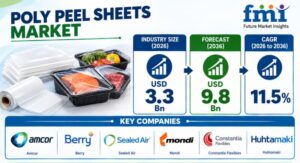


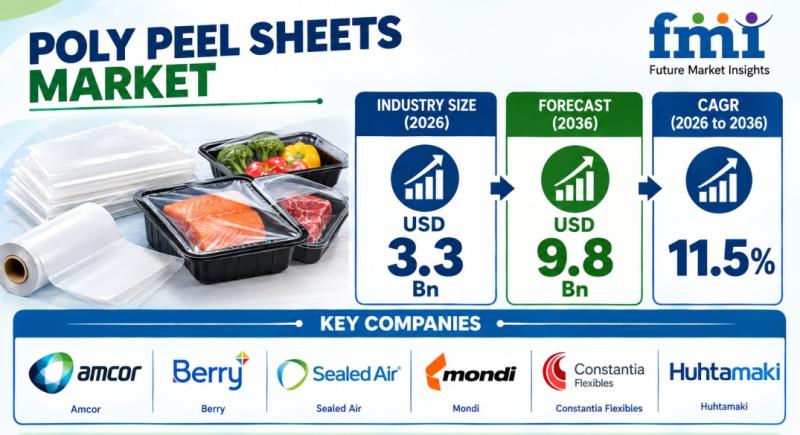
The global poly peel sheets market is valued at USD 3.3 billion in 2026 and is projected to reach USD 9.8 billion by 2036, expanding at a 11.5% CAGR during the forecast period.
Market growth is increasingly shaped by packaging compliance, recyclability requirements, and validation standards across food, pharmaceutical, and medical packaging. In Europe, the Packaging and Packaging Waste Regulation (PPWR), which entered into force on February 11, 2025, is accelerating the redesign of packaging structures toward improved recyclability. In the United States, FDA food-contact requirements place greater emphasis on documented authorization pathways for polymers, adhesives, coatings, and other packaging components.
Supplier consolidation is also changing the competitive landscape. Amcor completed its combination with Berry Global on April 30, 2025, creating a broader packaging platform serving global customers. For poly peel sheets, this scale is increasingly important as multinational food and healthcare customers seek consistent specifications, regulatory documentation, and supply continuity across multiple regions.
👉 Get Detailed Market Forecasts, Competitive Benchmarking, and Pricing Trends: https://www.futuremarketinsights.com/reports/sample/rep-gb-31846
Featured Snippet: Poly Peel Sheets Market Key Answer
What is the outlook for the poly peel sheets market from 2026 to 2036?
The global poly peel sheets market is projected to grow from USD 3.3 billion in 2026 to USD 9.8 billion by 2036, registering an 11.5% CAGR. Growth is supported by demand for controlled-opening packaging, recyclable peel structures, food-contact compliance, and validated sealing performance.
What Is the Growth Outlook for the Poly Peel Sheets Market?
FMI projects the poly peel sheets market to expand at an 11.5% CAGR between 2026 and 2036, reaching USD 9.8 billion by 2036.
The market is moving beyond basic sealability toward engineered peel performance, recyclability, regulatory compliance, and repeatable opening forces. Packaging converters and brand owners increasingly require materials that can operate within established food-contact and healthcare validation frameworks while supporting packaging redesign programs.
FMI Research Approach: Forecasting is anchored in food and healthcare packaging compliance cycles, sealant redesign, converter capacity concentration, and demand across food lidding, pharmaceutical packaging, and sterile barrier systems.
How Do FMI Analysts Expect the Poly Peel Sheets Market to Evolve?
FMI anticipates a shift toward recyclability-focused and validation-ready peel structures. Seal performance, opening-force stability, material compatibility, and regulatory documentation are becoming increasingly important procurement criteria.
The transition is particularly visible in Europe, where PPWR is encouraging packaging suppliers to reconsider complex multilayer structures. Meanwhile, food-contact authorization systems in the United States and sterile packaging validation requirements are supporting demand for repeatable and documented material configurations.
What Is the Definition of Poly Peel Sheets?
Poly peel sheets are polymer-based sheet and film structures engineered to provide controlled opening, seal integrity, and predictable peel performance in packaging systems.
They are used across food, pharmaceutical, medical device, personal care, and industrial packaging. Common material structures include polyethylene, polypropylene, polyester, and composite polymer designs incorporating heat-sealable or pressure-sensitive peel interfaces.
Which Country Holds a Significant Share of the Poly Peel Sheets Market?
China represents a significant market, supported by large-scale packaged food production, e-commerce fulfillment, and increasing emphasis on food-contact material compliance.
China’s expanding converting capacity also enables qualified peel structures to be deployed rapidly across high-volume food and consumer goods packaging programs.
How Large Will the Poly Peel Sheets Market Be by 2036?
The global poly peel sheets market is expected to reach USD 9.8 billion by 2036, up from USD 3.3 billion in 2026.
This expansion reflects increasing use of peelable structures in food lidding, pharmaceutical packaging, sterile medical packaging, and other applications where controlled opening and sealing performance are critical.
What Are the Key Forces Accelerating Poly Peel Sheets Adoption?
Several structural factors are accelerating demand through 2036.
Recyclability Requirements
European packaging regulation is encouraging converters to redesign structures around recyclability. This is increasing interest in simplified polymer systems and peel structures that can fit within emerging recycling requirements.
Food-Contact Compliance
FDA food-contact requirements create documented pathways for packaging materials and components. This increases the importance of established polymer families and suppliers capable of maintaining compliance documentation.
Healthcare Packaging Validation
Medical device packaging requires controlled and validated sealing processes. Predictable peel performance therefore becomes an important material-selection criterion for sterile barrier systems.
Packaging Supplier Consolidation
Global packaging consolidation is increasing the ability of major suppliers to provide harmonized specifications across multiple markets, particularly for multinational food and healthcare customers.
How Is the Poly Peel Sheets Market Segmented?
The market is segmented by:
- Material Type
- Product Type
- End Use Industry
- Distribution Channel
- End User
- Region
Material selection is increasingly influenced by recyclability, migration requirements, and regulatory acceptance. Product architecture depends on sealing conditions, opening-force requirements, and packaging-line performance. End-use demand is concentrated in food packaging, pharmaceutical packaging, and medical device applications.
Why Does Polyethylene Lead the Material Type Segment?
Polyethylene accounts for 57% of the poly peel sheets market by material type.
Its leadership reflects the combination of established regulatory histories, broad resin availability, mature extrusion capabilities, and adaptability to simplified packaging structures.
Polyethylene-based peel sheets can be engineered with compatible sealant layers while supporting packaging redesign initiatives. Their established manufacturing ecosystem also provides converters with supply continuity when brands undertake downgauging, recyclability, or packaging standardization programs.
👉 Competitive Benchmarking, and Pricing Trends: https://www.futuremarketinsights.com/reports/sample/rep-gb-31846
What Is the Future Outlook for the Poly Peel Sheets Market?
The poly peel sheets market is entering a period where material performance and regulatory readiness are becoming equally important. From 2026 to 2036, demand is expected to increasingly favor peel structures that combine controlled opening, reliable sealing, recyclability, and documented compliance.
Polyethylene is positioned as the leading material with a 57% share, while single-sided peel sheets account for 41.3% of product demand. Food packaging remains the largest end-use segment at 38.5%, reflecting the high-volume requirement for reliable peelable packaging.
Geographically, China leads country growth with a projected 15.6% CAGR, followed by India at 14.5% and Germany at 13.3%. Meanwhile, supplier consolidation and regulatory complexity are increasing the importance of scale, technical qualification, and compliance documentation.
With the market projected to increase from USD 3.3 billion in 2026 to USD 9.8 billion by 2036, the competitive landscape is likely to increasingly reward suppliers capable of combining material innovation with regulatory readiness, converter compatibility, and global supply reliability.
Conclusion
The global poly peel sheets market is projected to reach USD 9.8 billion by 2036, expanding at an 11.5% CAGR from 2026 to 2036. The market’s evolution is being shaped by recyclable packaging requirements, food-contact compliance, healthcare validation, and supplier consolidation. Polyethylene leads with a 57% share, single-sided peel sheets hold 41.3%, and food packaging accounts for 38.5% of end-use demand.
China’s 15.6% CAGR makes it the fastest-growing country market among those covered, while India, Germany, Brazil, the USA, the UK, and Japan each reflect different combinations of packaging demand, regulatory frameworks, and supplier qualification practices. Overall, future market development will increasingly depend on the ability of peel sheet manufacturers and converters to deliver consistent peel performance, compliant material systems, recyclable designs, and reliable supply at scale.