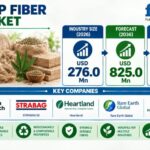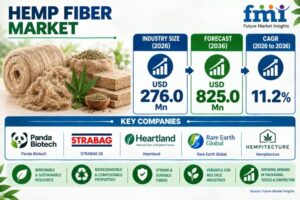


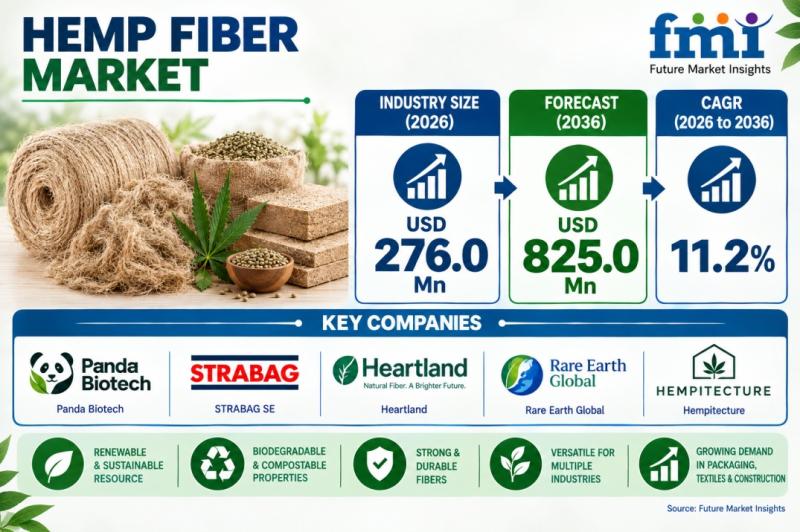
The global hemp fiber market is valued at USD 276.0 million in 2026 and is projected to reach USD 825.0 million by 2036, expanding at a 11.2% CAGR during the forecast period.
The market is gaining momentum as manufacturers increasingly evaluate renewable fiber inputs for automotive composites, construction materials, insulation, nonwovens, packaging, and other industrial applications. Demand is being reinforced by efforts to reduce reliance on synthetic polymers, lower embodied carbon, and introduce bio-based materials into high-volume manufacturing systems.
At the same time, localized hemp processing infrastructure is addressing one of the industry’s historical constraints: the availability of consistent industrial-grade fiber. Expansion of decortication facilities closer to cultivation zones is helping transform agricultural biomass into standardized feedstock suitable for industrial applications.
👉 Get Detailed Market Forecasts, Competitive Benchmarking, and Pricing Trends: https://www.futuremarketinsights.com/reports/sample/rep-gb-32131
Featured Snippet: Hemp Fiber Market Key Answer
What is the outlook for the hemp fiber market from 2026 to 2036?
The global hemp fiber market is projected to grow from USD 276.0 million in 2026 to USD 825.0 million by 2036, registering an 11.2% CAGR. Growth is supported by increasing adoption of bio-based construction materials, automotive lightweighting, industrial textiles, composites, and expanding hemp processing infrastructure.
What Is the Growth Outlook for the Hemp Fiber Market?
FMI projects the hemp fiber market to expand from USD 276.0 million in 2026 to USD 825.0 million by 2036, representing an 11.2% CAGR.
Growth is increasingly linked to industrial adoption rather than consumer hemp applications. Automotive manufacturers are assessing natural fiber composites for lightweight components, while construction companies are incorporating hemp-based materials into insulation and other low-carbon building applications.
The expansion of localized decortication infrastructure is also improving the availability of technical-grade fiber and hurd, enabling manufacturers to move from pilot-scale trials toward larger procurement programs.
How Do FMI Analysts Expect the Hemp Fiber Market to Evolve?
FMI expects the market to transition toward standardized, industrial-grade hemp fiber supply chains.
The commercialization pathway is particularly promising in molded fiber packaging, automotive composites, insulation, nonwovens, and bio-based construction materials. However, fiber refinement, moisture control, surface characteristics, and consistent grading remain important engineering considerations.
FMI Principal Consultant Ismail Sutaria highlights molded fiber packaging as an immediate commercialization pathway, noting that hemp-based pulp can offer strength-to-weight and compostability advantages while requiring continued improvements in fiber refinement and moisture and surface control.
What Is the Definition of Hemp Fiber?
The hemp fiber market covers commercially traded bast fibers and inner hurd fractions obtained from processing industrial hemp stalks.
These materials are supplied as industrial raw materials for:
Composite plastics
Nonwoven textiles
Insulation
Sustainable construction materials
Packaging and biodegradable materials
Agricultural applications
Consumer goods
Market valuation focuses on primary processed material supply, rather than finished consumer products.
What Are the Key Demand Drivers for Hemp Fiber?
Several structural forces are supporting hemp fiber adoption through 2036.
Automotive Lightweighting
Automotive manufacturers are evaluating natural fiber composites for interior components and other applications where weight reduction and renewable material content can provide sustainability benefits.
Bio-Based Construction
Construction companies are increasingly evaluating low-carbon and bio-based insulation and building materials. Hemp fiber and hurd can serve as renewable feedstocks for these applications.
Processing Infrastructure Expansion
Investment in decortication facilities is improving access to industrial-grade fiber and reducing logistical barriers between hemp cultivation and downstream manufacturing.
Synthetic Material Substitution
Manufacturers are increasingly evaluating renewable fiber alternatives to synthetic polymers as environmental targets become integrated into procurement and product-development decisions.
How Is the Hemp Fiber Market Segmented?
The hemp fiber market is segmented by:
Application
End-Use Industry
Form
Distribution Channel
Region
Application categories include industrial textiles and composites, animal bedding and filtration media, building and construction materials, packaging and biodegradable materials, agricultural and horticultural uses, and consumer goods.
End-use industries include automotive and transportation, construction and insulation, agriculture and horticulture, consumer goods, and other applications.
Why Do Industrial Textiles and Composites Lead the Application Segment?
Industrial Textiles & Composites account for 34% of total market volume in 2026.
The segment benefits from increasing interest in natural fiber reinforcement for composite materials and industrial textile applications. Automotive manufacturers, in particular, require consistent tensile properties, fiber dimensions, and moisture characteristics before incorporating natural fibers into production components.
Advanced processing technologies can improve fiber-length consistency and reduce defects, making technical hemp fiber more suitable for structural nonwovens and composite applications.
Large industrial buyers are also increasingly using longer-term procurement arrangements to secure consistent supply and reduce exposure to raw-material shortages.
Competitive Benchmarking, and Pricing Trends: https://www.futuremarketinsights.com/reports/sample/rep-gb-32131
Why Does Automotive and Transportation Lead End-Use Demand?
Automotive & Transportation account for 31% of total sector valuation in 2026.
Automotive lightweighting and sustainability programs are encouraging manufacturers to evaluate natural fiber composites for components such as door panels, dashboard substrates, and other interior applications.
Hemp fiber can provide a renewable reinforcement option while supporting lightweight material strategies. However, consistent fiber quality remains essential because automotive manufacturers operate under strict specifications and high-volume production requirements.
Vertical integration with agricultural cooperatives can help composite manufacturers secure more predictable feedstock and reduce seasonal supply fluctuations.
How Is Competition Evolving in the Hemp Fiber Market?
Competition is increasingly centered on fiber consistency, processing technology, vertical integration, certifications, and supply reliability.
Industrial customers require predictable fiber length, moisture levels, mechanical properties, and material grading. Processors capable of meeting these specifications are better positioned to access higher-value automotive, construction, and composite applications.
Vertical integration is another competitive strategy. Companies connecting cultivation, decortication, fiber processing, and downstream material production can improve supply security while reducing exposure to agricultural volatility.
Certification and environmental documentation are also becoming important differentiators as automotive and construction customers incorporate carbon and sustainability requirements into procurement decisions.
Who Are the Key Players in the Hemp Fiber Market?
Key companies profiled in the market include:
Panda Biotech
STRABAG SE
Heartland
Rare Earth Global
Hempitecture
Ekolution
Ma’Rijany Hemp Company
Kingspan
Heidelberg Materials
What Is the Future Outlook for the Hemp Fiber Market?
The hemp fiber market is moving from a largely emerging natural-material category toward a more structured industrial feedstock market.
Between 2026 and 2036, the market is projected to increase from USD 276.0 million to USD 825.0 million, supported by an 11.2% CAGR. Industrial textiles and composites remain the leading application at 34%, while automotive and transportation account for 31% of end-use demand.
The United States is projected to record the highest country CAGR at 12.4%, followed by Germany at 12.0%, China at 11.7%, India at 11.3%, Brazil at 10.8%, and the United Kingdom at 10.5%.
Future market development will depend heavily on the ability of producers to deliver consistent fiber specifications, expand decortication capacity, establish reliable agricultural supply chains, and secure long-term industrial off-take agreements.
Conclusion
The global hemp fiber market is projected to reach USD 825.0 million by 2036, expanding at an 11.2% CAGR from 2026 to 2036.
The transition toward bio-based materials is creating opportunities across automotive composites, construction and insulation, industrial textiles, packaging, and biodegradable materials. However, consistent fiber grading, moisture control, processing quality, and reliable feedstock availability remain critical to large-scale commercialization. With Industrial Textiles & Composites holding a 34% share and Automotive & Transportation accounting for 31%, industrial applications are expected to remain central to market development. As processing infrastructure expands and manufacturers increasingly incorporate renewable materials into their sustainability strategies, hemp fiber is positioned to become a more established industrial input across global composite, construction, textile, and packaging value chains.