

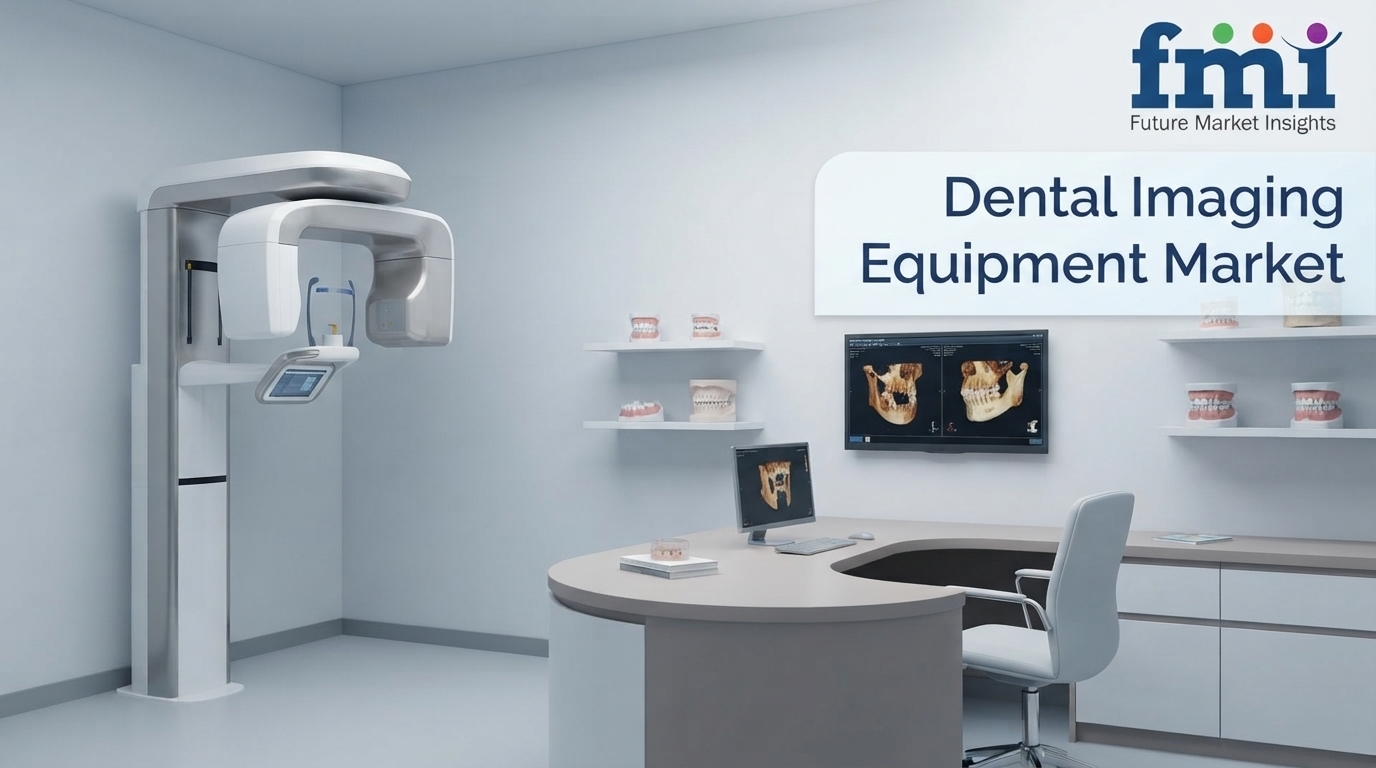
The global dental imaging landscape is undergoing a technological shift as healthcare providers increasingly prioritize accurate diagnosis, efficient treatment planning, and improved visualization of dental abnormalities. Digital dental radiography, extra oral and intramural X-ray systems, and cone-beam computed tomography (CBC) represent the principal technologies shaping modern dental imaging. While extra oral X-ray systems remain widely preferred because of their ability to capture panoramic views of the jaw and teeth, intramural radiography continues to support detailed 2D diagnosis in orthodontics and periodontics.
CBC has emerged as a major technological advancement by delivering three-dimensional images that enable dental professionals to examine abnormalities from multiple angles and improve surgical planning, particularly in implantation and orthodontics. At the same time, radiation exposure, technology costs, image distortion, and limitations in bone-density assessment remain important adoption barriers. The transition from conventional film-based imaging toward digitally enhanced systems is therefore being determined by the balance between diagnostic efficiency, workflow improvements, radiation considerations, and affordability.
Market Overview
Advanced dental imaging technologies are becoming increasingly important as demand rises for effective dental diagnosis and treatment. Dental imaging is broadly categorized into radiography and computed tomography, with extra oral and intramural X-ray systems forming the major radiography technologies and CBC representing the principal tomographic advancement.
Extra oral X-ray systems maintain a strong position because panoramic imaging provides a comprehensive view of the teeth and jaw. These systems are particularly useful in independent dental clinics, ambulatory centers, pathological dentistry, and surgical dentistry, including the identification of mandibular fractures, large pathological lesions, and mandibular abnormalities.
Intramural radiography represents another important technology, providing detailed 2D images of structures inside the mouth. Periodical, bite-wing, and occlusion imaging support applications such as periodontics treatment and periodontics.
Key Growth Drivers
- Increasing demand for accurate dental diagnosis and treatment planning.
- Wider adoption of digital dental radiography and digitally enhanced imaging.
- Growing use of 3D imaging for implantation and orthodontic procedures.
- Faster image acquisition and electronic transmission compared with conventional film systems.
- Increasing application of dental imaging in surgical and pathological dentistry.
- Greater emphasis on efficient dentomaxillofacial diagnosis and treatment workflows.
Technology & Innovation Trends
Digitization is becoming a defining trend in dental imaging. Digital intramural systems using COS sensors, plate scanners, cameras, and phosphor storage plates are enabling direct, semi-direct, and indirect imaging approaches while supporting efforts to reduce radiation exposure.
The principal technological advantage of digital imaging is its ability to produce enhanced images that can be analyzed more comprehensively during treatment planning. Digital files can also be electronically transferred, eliminating the mechanical processing and development associated with conventional film negatives.
CBC represents the strongest innovation in three-dimensional dental imaging. Its ability to produce 3D representations of dental structures allows practitioners to assess abnormalities from different angles. The technology is particularly valuable for surgical implantation, tooth-root orientation, anomalous structures, and orthodontic assessment.
Market Challenges & Restraints
Radiation exposure remains one of the most important challenges facing dental imaging adoption. Intramural radiography exposes patients to comparatively higher radiation than conventional imaging approaches, creating concerns surrounding repeated use.
CBC presents an additional challenge because its radiation exposure is considerably higher than conventional dental radiography. This concern can influence patient and practitioner preferences despite the technology’s diagnostic advantages.
Other limitations include the relatively high cost of advanced imaging equipment, geometric distortion and lower spatial resolution associated with extra oral radiography, and CBC’s inability to provide comprehensive bone-density assessment.
Segment Analysis
Extra oral X-Ray Systems
Extra oral systems continue to benefit from their panoramic imaging capability and broad clinical utility. Their application in identifying large lesions, mandibular fractures, and mandibular abnormalities supports continued preference in dental clinics and surgical settings. However, limitations in detecting tooth decay and periodontal degradation restrict their effectiveness in certain applications.
Intramural Radiography
Intramural imaging remains an important 2D diagnostic approach, particularly for orthodontics and periodontics. Although radiation exposure is a concern, technological improvements in sensors and imaging plates are creating more efficient approaches to image acquisition.
Cone-Beam Computed Tomography
CBC stands apart through its three-dimensional imaging capabilities. Its growing application in implantation and orthodontics demonstrates how 3D visualization can improve surgical planning and anatomical assessment. However, radiation exposure and the lack of bone-density assessment remain significant limitations.
Regional Analysis
The source material does not provide quantitative regional market shares, country-level forecasts, or regional CAGR figures. Accordingly, regional performance cannot be reliably ranked from the available data. Adoption is instead linked to the broader development of dental clinics, ambulatory centers, hospitals, surgical dentistry, and access to advanced diagnostic technologies.
Competitive Landscape
Competition in dental imaging is increasingly influenced by technological performance rather than imaging capability alone. Manufacturers and technology providers are positioned around image quality, workflow efficiency, digital connectivity, radiation management, and clinical applications.
The transition from conventional film systems toward digital radiography is also reshaping purchasing considerations for hospitals and dental clinics. Buyers increasingly need to balance equipment costs against faster imaging, easier electronic transmission, and improved diagnostic analysis.
Leading Companies Analysis
The provided source material does not identify specific manufacturers or company-level developments. Therefore, no individual company market share or competitive ranking can be stated without introducing information beyond the supplied data.
Investment & Strategic Developments
Investment priorities are likely to center on digital imaging platforms, lower-radiation technologies, sensor development, image enhancement, and 3D diagnostic capabilities. The evolution of COS sensors, phosphor storage plates, cameras, and plate scanners demonstrates the industry’s focus on improving imaging efficiency while addressing radiation concerns.
For healthcare providers, investment decisions increasingly depend on whether advanced imaging can shorten workflows, improve treatment planning, and provide clinically useful information without imposing disproportionate cost or radiation exposure.
Future Outlook
The future direction of dental imaging will depend on the industry’s ability to reconcile diagnostic sophistication with patient safety and affordability. Digital dental radiography is positioned to gain further relevance because of enhanced image analysis, shorter working times, and simple electronic transmission.
CBC is likely to remain strategically important for applications requiring three-dimensional anatomical visualization, especially implantation and orthodontics. Meanwhile, conventional imaging may continue to serve users that prioritize lower perceived radiation exposure and lower technology costs.
Explore More Related Studies Published by FMI Research:
FMI Custom Research: Strategic Intelligence for Confident Decision-Making
In today’s rapidly evolving business environment, leadership teams need more than market data—they need clear, actionable intelligence tailored to their strategic objectives. FMI’s Custom Research solutions are designed around the specific business questions organizations need answered, enabling executives to evaluate growth opportunities, validate investments, assess competitive dynamics, and reduce uncertainty before making critical decisions. By combining deep industry expertise, primary research, and proprietary market intelligence, FMI delivers insights that help organizations move from assumptions to evidence-based strategies with greater speed and confidence.
Key Executive Benefits
- Decision-Ready Insights: Research tailored to your specific business challenges, growth plans, and investment priorities.
- Reduced Strategic Risk: Validate market opportunities, customer demand, and competitive positioning before committing resources.
- Market Entry Confidence: Assess opportunity size, regulatory barriers, channel dynamics, and competitive landscapes with precision.
- Competitive Advantage: Gain proprietary intelligence unavailable through syndicated reports or internal datasets.
- Faster Growth Decisions: Accelerate expansion, product development, portfolio optimization, and investment planning.
- Primary Market Validation: Access real-world customer, buyer, and stakeholder insights that support high-confidence decision-making.
- Global Industry Expertise: Powered by 100+ analysts, 20,000+ published reports, and 1.6 million+ hours of research experience.
- Proven Track Record: Over 7,000 market-entry engagements completed across six regions and 14 industry sectors with strong client retention.
Business Impact
FMI helps organizations transform market complexity into strategic clarity, enabling leadership teams to identify growth opportunities faster, optimize resource allocation, strengthen competitive positioning, and make high-stakes business decisions with confidence.
About Future Market Insights (FMI)
Future Market Insights, Inc. (FMI) is an ESOMAR-certified, ISO 9001:2015 market research and consulting organization, trusted by Fortune 500 clients and global enterprises. With operations in the U.S., UK, India, and Dubai, FMI provides data-backed insights and strategic intelligence across 30+ industries and 1200 markets worldwide.
For Press & Corporate Inquiries
Rahul Singh
AVP – Marketing and Growth Strategy
Future Market Insights, Inc.
+91 8600020075
For Sales - sales@futuremarketinsights.com
For Media - Rahul.singh@futuremarketinsights.com
For web - https://www.futuremarketinsights.com/