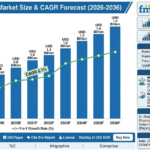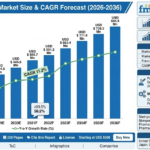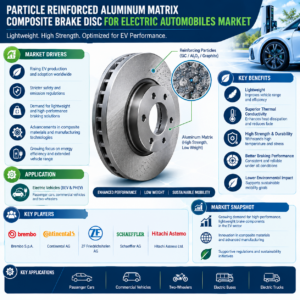


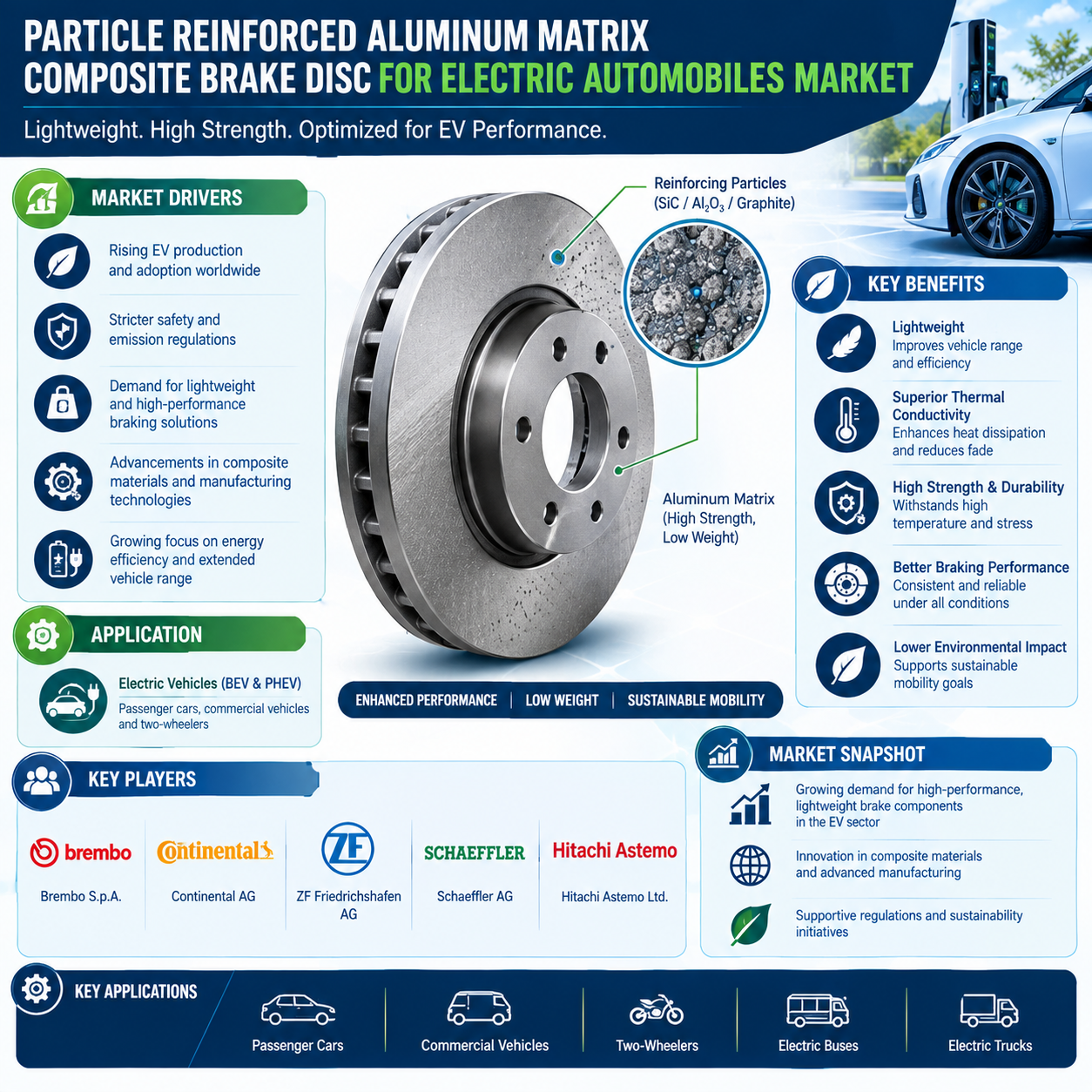
The global particle reinforced aluminum matrix composite brake disc for electric automobiles market was valued at USD 3.90 billion in 2025 and is set to reach USD 5.00 billion by 2026-end. Projected to expand at a compounding annual growth rate (CAGR) of 28.1% between 2026 and 2036, the market is on track to achieve a valuation of USD 59.44 billion by 2036. This extraordinary expansion reflects an incremental opportunity of USD 54.45 billion over the ten-year forecast period. For original equipment manufacturers (OEMs), Tier-1 automotive suppliers, and material innovators, these figures signal a structural shift away from traditional heavy grey cast iron components toward advanced lightweight composite architectures designed specifically to extend electric vehicle (EV) battery range and comply with strict environmental standards.
Get detailed market forecasts, competitive benchmarking, and pricing trends:
https://www.futuremarketinsights.com/reports/sample/rep-gb-26433
Key Market Highlights at a Glance
• 2025 Market Valuation: USD 3.90 billion
• 2026 Estimated Market Valuation: USD 5.00 billion
• 2036 Forecasted Market Valuation: USD 59.44 billion
• Forecast Period CAGR (2026-2036): 28.1%
• Total Incremental Revenue Opportunity: USD 54.45 billion
• Dominant Product Type Segment: Silicon Carbide Mixed Particle Reinforced Aluminum Matrix Composite Brake Disc (70.0% market share in 2026)
• Leading Application Segment: Electric Passenger Vehicles (75.0% market share in 2026)
• Top Country-Level Growth Drivers: USA (26.2% CAGR) and Brazil (25.5% CAGR)
• Report Scope & Analytics Coverage: Full market report spans primary end-uses, product types, and regional supply chain assessments.
Why Is the Particle Reinforced Aluminum Matrix Composite Brake Disc Market Growing?
• Sustainability-led Procurement and Lightweighting: Automotive manufacturers are actively executing material substitution strategies, replacing conventional cast iron with aluminum matrix composites (AMCs) to reduce unsprung mass, boost thermal efficiency, and lower overall vehicle weight to optimize EV driving range.
• E-Commerce and Logistics Expansion: Growing demand across modern logistics infrastructure is accelerating high-mileage EV fleet deployment, driving high-frequency procurement of durable, wear-resistant friction components across commercial supply chains.
• Strict Environmental Compliance Requirements: Regulatory shifts toward zero-emission transport and recyclable material solutions are accelerating the adoption of lightweight composite braking systems that yield lower non-exhaust particulate emissions compared to standard rotors.
“The particle reinforced aluminum matrix composite brake disc for electric automobiles market is evolving from a commodity-oriented supply category into a more defined, compliance-driven procurement category with structured buyer expectations,” notes Nikhil Kaitwade, Associate Vice President at Future Market Insights. “Adoption is surging as OEMs optimize raw material sourcing, consolidate supply chains, and leverage ongoing capacity expansions across regional manufacturing hubs to meet stringent EV performance metrics.”
Which Product Type Segment Dominates Market Share?
The Silicon Carbide Mixed Particle Reinforced Aluminum Matrix Composite Brake Disc segment leads the market, holding a dominant 70.0% revenue share in 2026. Silicon carbide (SiC) particulates provide exceptional wear resistance, high thermal conductivity, and elevated structural hardness, enabling these discs to withstand intense thermal cycles without deformation. The remaining share belongs to Other Particle Reinforced Aluminum Matrix Composite Brake Discs, which incorporate alternative ceramic or hybrid particulate reinforcements tailored for specific duty cycles.
• Silicon Carbide Mixed Discs: Accounts for 70.0% of the Product Type segment in 2026, supported by standardized procurement and volume production across manufacturing facilities.
• Other Particle Reinforced Discs: Represents the remaining 30.0% market share, catering to specialized performance applications and niche EV platforms.
What Drives Demand Across Vehicle Application Segments?
By application, Electric Passenger Vehicles lead the global market, accounting for a 75.0% share in 2026. High-volume consumer adoption of passenger EVs, coupled with aggressive automaker weight-reduction programs, drives bulk procurement of composite brake discs. Concurrently, the Electric Commercial Vehicles segment represents a rapidly growing secondary application area as fleet managers seek long-lasting friction materials that minimize downtime and maintenance costs in commercial transport.
• Electric Passenger Vehicles: Captures 75.0% of the Application market share in 2026, driven by mass-market passenger EV manufacturing and consumer demand for extended battery range.
• Electric Commercial Vehicles: Holds 25.0% of market procurement volume, supported by the electrification of urban delivery trucks, logistics fleets, and transit buses.
Speak to Analyst: Customize insights for your business strategy:
https://www.futuremarketinsights.com/customization-available/rep-gb-26433
What Dynamics Are Shaping Market Evolution?
Primary Market Drivers
Rapid expansion of global EV manufacturing hubs, coupled with aggressive vehicle lightweighting goals, serves as the primary catalyst. Furthermore, raw material sourcing optimization and technical enhancements in semi-solid vacuum casting processes are lowering production costs, making particle reinforced aluminum matrix composite discs increasingly cost-competitive against traditional solutions.
Market Restraints
High initial tooling and raw material costs, alongside complex quality control procedures required for uniform particulate dispersion, remain key barriers for small-scale manufacturers. Additionally, strict qualification timelines imposed by Tier-1 automotive OEMs can lengthen product adoption cycles.
Industry Trends
Demand is shifting rapidly toward higher-value product formats as end-users prioritize long-term operational efficiency and lifecycle cost optimization over initial purchasing price. Manufacturing capacity is expanding across key industrial regions, accompanied by strategic supply chain integration between metal composite producers and automotive OEMs.
Regional Outlook: Which Countries Are Leading Global Adoption?
The global market spans North America, Latin America, Europe, East Asia, South Asia and Pacific, and Middle East and Africa. Mature procurement standards and proactive sustainability mandates position established developed markets as core volume centers, while emerging industrial economies register the fastest expansion rates.
• USA: Projected growth rate of 26.2% CAGR through 2036.
• Brazil: Projected growth rate of 25.5% CAGR through 2036.
• India: Projected growth rate of 24.2% CAGR through 2036.
United States
The USA leads key regional growth with a 26.2% CAGR, supported by mature procurement standards, federal clean transportation mandates, and robust demand across commercial and passenger EV segments. Domestic OEMs are prioritizing composite brake discs to satisfy stringent fleet efficiency targets.
Brazil
Brazil is sustaining rapid demand with a projected 25.5% CAGR, driven by expanding domestic manufacturing capabilities, growing regional export requirements, and the adoption of standardized light-vehicle components across South America.
India
India demonstrates strong long-term expansion at a 24.2% CAGR, propelled by rapid industrialization, expanding export-oriented automotive manufacturing, and government initiatives promoting electric mobility infrastructure.
Latest Automotive Industry Analysis Reports:
https://www.futuremarketinsights.com/industry-analysis/automotive
How Is the Competitive Landscape Structured?
The particle reinforced aluminum matrix composite brake disc market is characterized by focused competition among specialized material suppliers and automotive component manufacturers. Companies that combine manufacturing scale, extensive distribution networks, and stringent regulatory compliance capabilities are capturing the majority of incremental growth. Key market participants profiled in industry research include:
• AC Floby: Renowned for high-precision automotive engineering and lightweight component manufacturing capabilities.
• Lanxide: Features high product breadth and a strong global distribution network for advanced matrix composites.
• Huaibei Jibo New Materials: Delivers extensive product breadth with strong regional distribution, specializing in reinforced composite formulations.
• Hunan Xiangtou Lightweight Material Technology: Provides specialized composite brake solutions with moderate-to-strong market reach across Asian manufacturing hubs.
• Hunan Wenchang New Material Technology: Focuses on lightweight material innovations and targeted automotive supplier partnerships.
• Kailong High Technology Co., Ltd.: Offers integrated vehicle technology solutions and expanding manufacturing footprint.
• Shanghai Ruier Industrial: Specializes in high-volume automotive component production and domestic OEM distribution.
Competitive dynamics center on technological advancements in particle bonding, scaling manufacturing throughput to lower unit costs, and securing multi-year supply contracts with global electric vehicle manufacturers.