

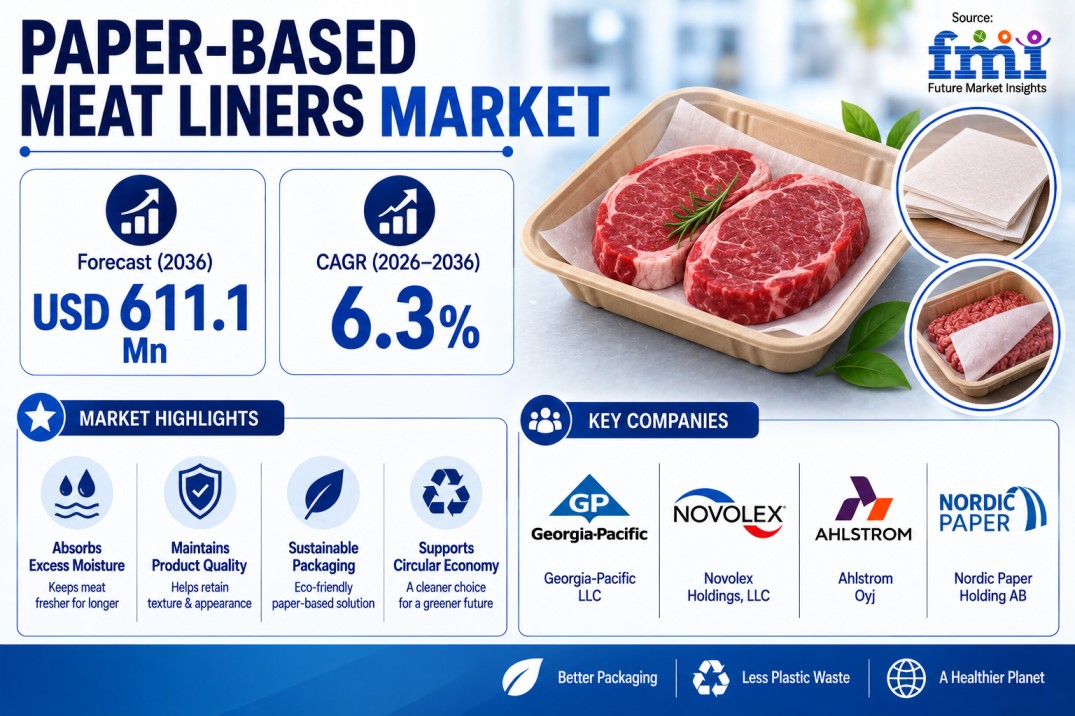
The Paper-Based Meat Liners Market is projected to reach USD 331.7 million in 2026 and expand to USD 611.1 million by 2036, advancing at a 6.3% CAGR during the forecast period. Demand is supported by recurring liner consumption across meat processing, cutting, retail display, foodservice, and seafood handling applications where papers must manage purge, grease, and moisture while maintaining clean product release. Butcher paper liners are expected to lead the product type segment with 30.0% share in 2026, while kraft-butcher paper is projected to account for 36.0% of the paper-grade segment. Brazil is forecast to be the fastest-growing country at 6.7% CAGR through 2036.
What is Driving the Paper-Based Meat Liners Market?
The market is benefiting from the continued need for purge control, product separation, and clean presentation across meat-processing and retail operations. Processing plants use liners during cutting, staging, display, and packaging, creating recurring demand as production throughput increases.
Growing investments in meat and poultry processing infrastructure are also supporting demand for food-contact liner papers. New and expanded processing facilities must qualify paper constructions for wet strength, grease resistance, release behavior, and food-contact requirements before moving to recurring supply contracts. At the same time, packaging-cost considerations and sustainability requirements are encouraging processors to evaluate paper-based alternatives for applications traditionally served by more complex packaging structures.
Butcher Paper Liners Lead the Product Type Segment
Butcher paper liners are projected to account for 30.0% share in 2026, making them the leading product category. Their flexible sizing and familiar handling characteristics allow processors and retailers to use them across cutting tables, display counters, and meat-preparation workflows. The material can be supplied in rolls or sheets and adapted to different cut sizes and processing requirements.
However, recurring orders depend on consistent dimensions, wet-strength performance, food-contact documentation, and reliable release behavior after chilled or moist product contact.
Kraft-Butcher Paper Leads the Paper Grade Category
Kraft-butcher paper is estimated to hold 36.0% share in 2026. The grade combines fiber strength, foldability, print performance, and converting economics, making it suitable for routine meat-handling operations.
Processors select basis weight and surface treatment according to purge levels, handling pressure, and required contact duration. Maintaining strength after exposure to moisture is particularly important because liner failure can result in tearing, sticking, fiber transfer, and additional cleanup requirements.
Leak & Drip Control Remains the Leading Function
Leak and drip control is forecast to represent 34.0% share in 2026. Meat liners must manage purge and grease while maintaining structural integrity and preventing unwanted adhesion to the product. Fresh meat applications require rapid fluid management, while frozen products place additional emphasis on low-temperature strength. Consequently, processors increasingly evaluate the complete liner construction under actual operating conditions, rather than relying solely on dry-paper specifications.
Direct-OEM Supply Leads the Sales Channel
Direct-OEM supply is projected to lead the sales channel with 44.0% share in 2026. Large meat processors generally qualify specific paper constructions and converted formats before establishing recurring production orders. Direct relationships allow paper manufacturers and converters to respond more quickly when plant trials identify requirements related to dimensions, moisture resistance, release, or feeding performance. Distributors remain relevant for smaller processors and mixed-volume requirements, while e-commerce supports limited-volume and foodservice demand.
Key Growth Drivers, Restraints and Opportunities
- Driver: Increasing meat-processing throughput supports recurring consumption of purge-control liners, interleaves, and display papers.
- Restraint: Moisture and grease resistance can conflict with clean release and recycling classification, extending material qualification cycles.
- Opportunity: Fluorochemical-free barrier papers with stable wet strength and grease resistance can expand paper-based liner applications.
Processing Throughput Supports Recurring Demand
Every cutting, staging, separation, or display operation can require liner consumption. As processing volumes increase, demand for sheets and rolls rises accordingly. Reliable feeding, consistent dimensions, and effective fluid management therefore remain important purchasing criteria for processors.
Qualification Requirements Can Slow Material Substitution
New liner constructions must satisfy food-contact requirements alongside physical performance testing. Barrier treatments can influence release behavior, wet strength, and recycling classification, requiring processors to conduct additional production trials before approving a new material.
Barrier Papers Create New Application Opportunities
Paper constructions with improved moisture and grease resistance can address applications involving higher purge loads or longer contact times. Suppliers capable of combining barrier development with converting and processor-trial support can expand the addressable market for paper-based meat liners.
Competitive Landscape
The Paper-Based Meat Liners Market includes integrated packaging companies, specialty-paper manufacturers, and foodservice paper converters.
Key companies include:
- Georgia-Pacific LLC
- Novolex Holdings, LLC
- Ahlstrom Oyj
- Nordic Paper Holding AB
- Twin Rivers Paper Company
- Seaman Paper Company of Massachusetts, Inc.
- Oren International, Inc.
- Handy Wacks Corporation
Georgia-Pacific and Novolex benefit from broad food-packaging relationships and manufacturing networks. Ahlstrom, Nordic Paper, and Twin Rivers compete through specialty-paper engineering and functional barrier capabilities. Seaman Paper, Oren International, and Handy Wacks focus on foodservice conversion and application-specific formats.
Key Industry Developments
- In May 2025, Ahlstrom inaugurated a new parchmentizer at its Saint-Séverin plant in France to improve grease and water resistance for food-packaging applications.
- In April 2025, Nordic Paper approved investments related to water handling at its Bäckhammar mill, with associated permitted kraft-paper output expected to increase.
- In April 2025, Novolex completed its combination with Pactiv Evergreen Inc., bringing the foodservice and food-merchandising operations under one private group.
Future Outlook
The Paper-Based Meat Liners Market is evolving toward higher-performance paper constructions that combine wet strength, grease resistance, leak control, clean release, and food-contact compliance. While qualification requirements can slow material changes, the development of fluorochemical-free barrier papers is creating opportunities for suppliers to expand paper-based solutions into more demanding meat-handling applications.
With the market expected to increase from USD 331.7 million in 2026 to USD 611.1 million by 2036, manufacturers that can provide consistent paper grades, application-specific barrier performance, converting support, and dependable regional supply are positioned to capture recurring demand across meat processing, retail, foodservice, and seafood applications.
Related Research Reports:
Paper-Based Bottle Dividers Market: USD 348.1 million in 2026 and USD 594.6 million by 2036 at a 5.5% CAGR.
Heat-Sealable Food Papers Market: USD 980.9 million in 2026 and USD 1966.0 million by 2036 at a 7.2% CAGR.
Paper-Based Produce Liners Market: USD 357.5 million in 2026 and USD 664.8 million by 2036 at a 6.4% CAGR.
About Future Market Insights (FMI)
Future Market Insights is a leading provider of market intelligence, consulting services, and syndicated research reports. FMI delivers actionable insights across packaging, logistics, industrial manufacturing, food and beverage, healthcare, chemicals, and emerging technologies, helping organizations identify growth opportunities and make informed strategic decisions in rapidly evolving markets.
Contact
Future Market Insights Inc.
Christiana Corporate
200 Continental Drive, Suite 401
Newark, Delaware 19713, USA