

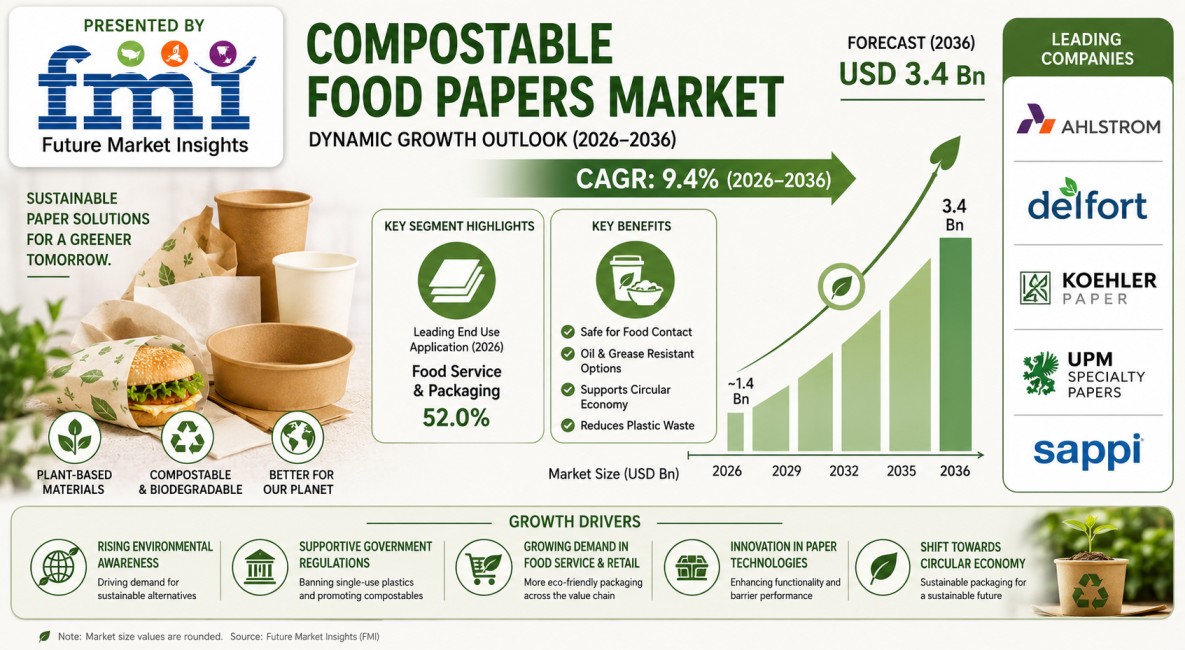
The Compostable Food Papers Market is projected to reach USD 1.4 billion in 2026 and expand to USD 3.4 billion by 2036, advancing at a 9.4% CAGR during the forecast period. Demand is increasing as food brands seek paper-based packaging that can provide grease and moisture resistance while reducing dependence on non-compostable plastic layers and legacy fluorinated treatments. Certified Compostable Coated Papers are projected to lead the product type segment with a 32.0% share in 2026, while PLA-Coated papers are estimated to account for 28.0% of coating demand. Among the profiled countries, Brazil is expected to register the fastest growth at 9.9% CAGR, followed by the United Kingdom at 9.5%.
How Big is the Compostable Food Papers Market in 2026?
The Compostable Food Papers Market is estimated at USD 1.4 billion in 2026 and is expected to reach USD 3.4 billion by 2036, growing at a 9.4% CAGR between 2026 and 2036. Food brands are increasingly replacing grease-resistant packaging structures that depend on non-compostable plastic layers or legacy fluorinated treatments. This shift is creating opportunities for paper structures capable of delivering grease resistance, moisture protection, and heat-sealing performance while supporting compostability claims.
However, market adoption depends on more than certification. Local collection systems must be capable of accepting compostable food packaging after use. Markets with dedicated organics collection and treatment infrastructure are better positioned to convert compostable packaging demand into recurring commercial orders.
What is Driving the Compostable Food Papers Market?
The market is gaining momentum as food manufacturers respond to PFAS restrictions, plastic-reduction initiatives, and changing food-packaging specifications.
Food-contact chemistry requirements are encouraging manufacturers to reformulate grease-resistant papers and develop alternative barrier systems. At the same time, foodservice operators are looking for packaging that can provide functional performance without relying on conventional plastic coatings. The commercial opportunity is strongest for products that combine food-contact compliance, compostability certification, barrier performance, and compatibility with existing production equipment.
Certified Compostable Coated Papers Lead the Product Type Segment
Certified Compostable Coated Papers are projected to account for 32.0% share in 2026, making them the leading product type.
These papers combine documented compostability claims with functional barriers designed to protect food against grease and moisture. Certification provides a clearer basis for commercial qualification, but suppliers must still demonstrate food-contact compliance and consistent performance during printing, sealing, and converting. Ahlstrom’s Australian home-compostability certification for Sulpack parchment in April 2025 highlights the expansion of certified paper solutions for fresh and greasy food applications. Regional certification can broaden market eligibility, although disposal infrastructure and commercial line performance remain important considerations.
PLA-Coated Papers Lead the Coating Category
PLA-Coated papers are estimated to capture 28.0% share in 2026. PLA provides a moisture barrier and familiar heat-seal functionality that can be integrated into established extrusion and lamination processes. Commercial adoption depends on coating weight, fold integrity, sealing performance, and the intended disposal route. Packaging manufacturers therefore need to assess both technical performance and whether local composting systems can accept the finished structure.
Industrial Compostability Leads the Certification Category
Industrial Compostable – EN 13432 – ASTM D6400 is expected to account for 58.0% share in 2026. Industrial compostability standards provide recognized criteria for assessing disintegration and biodegradation under controlled temperature, humidity, and residence-time conditions. This makes the certification route particularly relevant for food-soiled packaging that may not be suitable for conventional fiber recycling.
Certification, however, does not automatically guarantee acceptance by a municipal or commercial composting facility. Foodservice operators therefore need to verify collection contracts and treatment routes before approving compostable packaging for multiple locations.
Food Wraps & Liners Remain a Leading Application
Food Wraps & Liners are projected to lead the application category with a 28.0% share in 2026. These formats are frequently exposed to grease and moisture and require reliable stain resistance, fold strength, and release behavior during wrapping and handling. Demand is particularly relevant to foodservice, bakery, frozen food, and other direct food-contact applications.
The ability to operate compostable paper structures on existing equipment can also reduce qualification costs and simplify the transition from conventional packaging materials.
Key Growth Drivers, Restraints and Opportunities
- Driver: PFAS restrictions and plastic-reduction programs are encouraging food brands to requalify grease-resistant paper packaging.
- Restraint: Compostability certification does not guarantee acceptance by municipal composting facilities or contracted food-waste collectors.
- Opportunity: Converter-ready barrier papers can reduce qualification costs by operating on existing printing, forming, and sealing equipment.
The market is therefore shifting toward performance-ready compostable paper structures rather than certification alone. Suppliers that can combine food-contact compliance, barrier performance, compostability documentation, and stable production behavior are positioned to capture growing demand.
Country Growth Outlook
Brazil is projected to record the fastest CAGR of 9.9% through 2036. Growth is supported by organics diversion initiatives and the development of recovery infrastructure, although processing availability remains uneven across municipalities.
The United Kingdom is expected to expand at 9.5% CAGR, influenced by workplace waste-segregation requirements and the need for dedicated collection routes for compostable packaging.
Germany is forecast to grow at 9.2% CAGR, supported by established specialty-paper conversion networks and strict biowaste quality requirements.
The United States is projected to advance at 8.7% CAGR, supported by PFAS replacement efforts and investment in organics recycling infrastructure. Differences in state-level labeling and collection systems remain a challenge.
Japan is expected to grow at 7.9% CAGR. Adoption is supported by demand for alternative food packaging but remains influenced by established recycling systems and detailed packaging qualification practices.
Competitive Landscape
The competitive landscape includes specialty paper manufacturers, integrated packaging companies, and foodservice packaging platforms.
Key companies include Ahlstrom, delfort, Koehler Paper, UPM Specialty Papers, Sappi, Mondi, Vegware (Novolex), and Twin Rivers Paper.
Ahlstrom, delfort, UPM Specialty Papers, and Sappi compete through food-contact papers combining barrier functions with documented qualification routes. Koehler Paper, Mondi, and Twin Rivers Paper focus on integrated paper production and flexible packaging development for grease-resistant and heat-sealable food formats.
Vegware (Novolex) provides a foodservice-oriented platform covering compostable cups, containers, and packaging papers.
Key Industry Developments
- In April 2026, Sappi North America introduced LusterFSB OGR for bakery and quick-service packaging, providing oil and grease resistance without polyethylene film.
- In April 2025, Novolex completed its combination with Pactiv Evergreen, expanding the group’s food, beverage, and specialty-packaging capabilities, including Vegware’s compostable foodservice portfolio.
- In March 2025, UPM Specialty Papers and Orkla Suomi began a six-month paper-wrapper pilot for Panda Milk chocolate in Finland using UPM Asendo Pro with a cold-seal lacquer.
Future Outlook
The Compostable Food Papers Market is moving toward fiber-based food packaging that combines compostability with practical commercial performance. While certification remains important, food manufacturers increasingly require evidence covering food-contact safety, grease and moisture resistance, sealing behavior, and the actual disposal route available to customers.
With the market expected to increase from USD 1.4 billion in 2026 to USD 3.4 billion by 2036, opportunities are emerging for certified coated papers, PLA-coated structures, compostable heat-seal papers, and application-specific barrier solutions.
The strongest growth opportunities are likely to emerge where compostable paper performance aligns with existing converting equipment and reliable local collection infrastructure, enabling food brands to move from pilot trials to recurring commercial orders.
Related Research Reports:
Recyclable Absorbent Pads Market: USD 318.5 million in 2026 and USD 662.6 million by 2036 at a 7.6% CAGR.
Compostable Greaseproof Papers Market: USD 387.3 million in 2026 and USD 925.3 million by 2036 at a 9.1% CAGR.
Compostable Frozen Food Liners Market: USD 155.1 million in 2026 and USD 374.0 million by 2036 at a 9.2% CAGR.
About Future Market Insights (FMI)
Future Market Insights is a leading provider of market intelligence, consulting services, and syndicated research reports. FMI delivers actionable insights across packaging, logistics, industrial manufacturing, food and beverage, healthcare, chemicals, and emerging technologies, helping organizations identify growth opportunities and make informed strategic decisions in rapidly evolving markets.
Contact
Future Market Insights Inc.
Christiana Corporate
200 Continental Drive, Suite 401
Newark, Delaware 19713, USA