

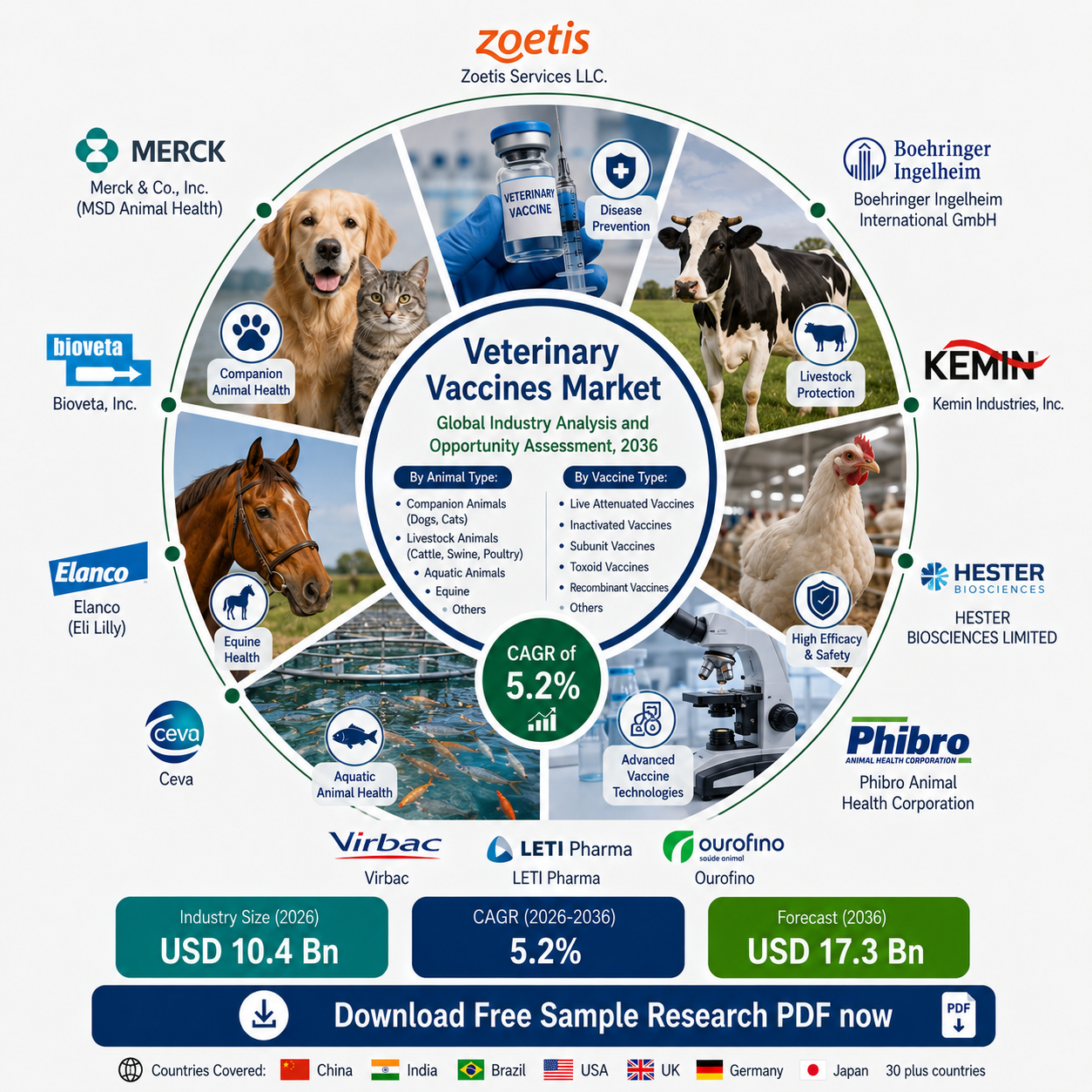
NEWARK, Del., Aug. 13, 2026 — The global Veterinary Vaccines Market is expanding as livestock producers, companion-animal owners, veterinary organizations, and governments increase investment in preventive animal healthcare. According to Future Market Insights (FMI), the market is projected to grow from USD 10.4 billion in 2026 to USD 17.3 billion by 2036, registering a 5.2% CAGR during the forecast period.
The market was valued at approximately USD 9.9 billion in 2025 and is expected to create an incremental opportunity of about USD 6.89 billion between 2026 and 2036. Rising awareness of animal vaccination, changing disease patterns, increasing prevalence of infectious and zoonotic diseases, and growing concerns surrounding antimicrobial use are supporting demand.
Veterinary vaccination is increasingly viewed as a preventive health strategy that protects animal populations while also contributing to food security and public health. Vaccination can reduce disease transmission, support livestock productivity, and decrease dependence on antibiotics in animal healthcare.
👉 Get Detailed Market Forecasts, Competitive Benchmarking, and Pricing Trends
Key Veterinary Vaccines Market Highlights at a Glance
- Market Size (2025): USD 9.9 Billion
- Market Size (2026): USD 10.4 Billion
- Forecast Market Size (2036): USD 17.3 Billion
- Forecast Period: 2026–2036
- CAGR (2026–2036): 5.2%
- Incremental Opportunity: USD 6.89 Billion
- Leading Vaccine Technology: Live Attenuated Vaccines (38.0% Share)
- Leading Animal Type: Livestock Animals (57.0% Share)
- Key Markets Covered: China, India, Brazil, USA, UK, Germany, Japan, and 30+ Countries
- Fastest-Growing Country: China (7.9% CAGR)
- India CAGR: 7.5%
- Key Companies: Zoetis, Merck Animal Health, Bioveta, Elanco, Ceva, Boehringer Ingelheim, Kemin Industries, Hester Biosciences, Phibro Animal Health, Virbac, LETI Pharma, and Ourofino
Analyst Viewpoint
“The veterinary vaccines market is increasingly moving toward a preventive-health model in which disease control, supply continuity, regulatory compliance, and vaccine effectiveness influence purchasing decisions. Manufacturers that can combine production scale with reliable distribution, documented quality, and technologies addressing emerging animal diseases are likely to strengthen their market positions. As vaccination programs expand across livestock and companion-animal populations, the ability to maintain consistent supply while meeting increasingly demanding regulatory requirements will remain a major competitive differentiator.”
Why Is the Veterinary Vaccines Market Growing?
The growing importance of preventive animal healthcare is creating new opportunities for veterinary vaccine manufacturers across livestock, companion-animal, poultry, equine, porcine, and aquaculture applications.
Veterinary vaccines help protect animals against contagious diseases while supporting herd health and productivity. Their importance extends beyond animal welfare because several animal diseases can transmit to humans through zoonotic pathways.
Vaccination can therefore contribute to both animal health and public-health protection. It can also reduce the need for antimicrobial interventions by preventing infections before they require treatment.
Increasing awareness among animal owners and livestock producers is further supporting market expansion.
Key Growth Drivers
- Rising awareness of animal vaccination.
- Increasing prevalence of infectious animal diseases.
- Growing incidence of zoonotic diseases.
- Increasing livestock populations and food-production requirements.
- Growing demand for preventive veterinary healthcare.
- Rising concerns surrounding antimicrobial resistance.
- Increasing government investment in animal-health programs.
- Advances in vaccine development technologies.
- Changing disease patterns among animal populations.
Vaccination is increasingly becoming an integral component of animal-health management as producers seek to reduce disease-related productivity losses and maintain healthier animal populations.
Which Vaccine Technology Leads the Veterinary Vaccines Market?
Live attenuated vaccines are projected to dominate the technology segment with a 38.0% market share.
Live attenuated technologies remain important because they can stimulate strong immune responses and have established applications across several veterinary disease-prevention programs.
The broader technology landscape also includes inactivated, conjugate, toxoid, recombinant, DNA, and subunit vaccines.
Increasing research into next-generation vaccine platforms is expected to expand the range of technologies available for existing and emerging animal diseases.
Why Do Livestock Animals Lead the Veterinary Vaccines Market?
Livestock animals are projected to account for 57.0% of market demand.
The large livestock share reflects the economic importance of cattle and other production animals, where disease outbreaks can affect productivity, food supply, trade, and farm profitability.
Vaccination programs can help producers maintain herd health while reducing the economic consequences associated with infectious disease outbreaks.
Increasing demand for animal-derived food products is also encouraging producers and governments to strengthen preventive-health programs.
How Are Veterinary Vaccines Supporting Zoonotic Disease Prevention?
Veterinary vaccination increasingly plays a role in One Health strategies that connect animal health, human health, and environmental considerations.
Controlling infectious diseases within animal populations can reduce opportunities for pathogens to spread between animals and humans.
This relationship is particularly important as governments and veterinary organizations monitor emerging and recurring zoonotic diseases.
Vaccination also supports food security by helping maintain healthier livestock populations and reducing productivity losses associated with preventable infections.
What Are the Latest Technology and Innovation Trends?
Innovation continues reshaping the veterinary vaccines industry.
Major trends include:
- Development of recombinant vaccines.
- Increasing research into DNA vaccines.
- Advances in subunit vaccine technologies.
- Expansion of vaccines targeting emerging diseases.
- Greater focus on companion-animal vaccines.
- Development of vaccines addressing antimicrobial-resistance concerns.
- Improvements in vaccine storage and distribution.
- Increasing investment in veterinary biotechnology.
- Greater emphasis on rapid vaccine development.
The market is gradually moving toward technologies that can address changing pathogen characteristics while improving vaccine effectiveness and deployment.
What Are the Key Market Challenges and Restraints?
High manufacturing, maintenance, and storage costs remain important challenges for the veterinary vaccines market.
Vaccines often require controlled storage and transportation conditions, increasing the complexity of distribution, particularly across regions with limited cold-chain infrastructure.
Economic conditions can also influence vaccination spending, particularly among smaller livestock producers and price-sensitive markets.
Regulatory requirements represent another important consideration. Manufacturers must maintain extensive documentation and demonstrate product quality, safety, and effectiveness before vaccines can be widely commercialized.
What Is the Regional Outlook?
Europe remains an established veterinary vaccines market, supported by advanced animal-health infrastructure, regulatory systems, veterinary awareness, and established pharmaceutical companies.
The United Kingdom represents an important market within Europe. Rising pet ownership, increased awareness of animal vaccination, changing disease patterns, and concerns surrounding zoonotic diseases are supporting demand.
The United States remains a major market because of its large livestock and companion-animal populations, established veterinary infrastructure, and significant presence of animal-health companies.
China is expected to record the fastest growth among the highlighted countries at a 7.9% CAGR, supported by expanding animal-health programs, livestock production, and increasing investment in veterinary healthcare.
India is projected to grow at 7.5% CAGR, supported by livestock development, expanding veterinary services, and increasing awareness of preventive animal healthcare.
What Is the Competitive Landscape?
Competition in the veterinary vaccines market is increasingly centered on vaccine efficacy, manufacturing scale, regulatory compliance, supply continuity, technology capabilities, and geographic distribution.
Leading manufacturers are expanding their portfolios through new vaccine technologies, product development, research partnerships, production investments, and broader distribution networks.
Companies with established regulatory capabilities and extensive veterinary distribution infrastructure are positioned to capture increasing demand across developed and emerging markets.
Key Companies
- Zoetis Services LLC.
- Merck & Co., Inc. (MSD Animal Health)
- Bioveta, Inc.
- Elanco
- Ceva
- Boehringer Ingelheim International GmbH
- Kemin Industries, Inc.
- Hester Biosciences Limited
- Phibro Animal Health Corporation
- Virbac
- LETI Pharma
- Ourofino
These companies are competing through vaccine development, broad veterinary product portfolios, manufacturing capabilities, regulatory expertise, distribution networks, and investments in next-generation animal-health technologies.
Frequently Asked Questions
- What is the projected size of the Veterinary Vaccines Market by 2036? The global market is projected to reach USD 17.3 billion by 2036, increasing from USD 10.4 billion in 2026.
- What is the expected CAGR of the Veterinary Vaccines Market? The market is forecast to expand at a 5.2% CAGR between 2026 and 2036.
- Which vaccine technology dominates the market? Live attenuated vaccines are projected to lead the technology segment with a 38.0% market share.
- Which animal type accounts for the largest market share? Livestock animals are projected to lead with a 57.0% market share.
- Which country is expected to grow fastest? China is projected to record the strongest country-level growth at a 7.9% CAGR through 2036.
- What factors are driving the Veterinary Vaccines Market? Rising animal-disease prevalence, zoonotic disease concerns, livestock production, preventive healthcare adoption, government investment, and increasing awareness of vaccination are key market drivers.
- Why are veterinary vaccines important for public health? Veterinary vaccination can reduce disease transmission among animal populations, lower the risk of certain zoonotic infections, support food-animal health, and reduce reliance on antimicrobial treatments.
About Future Market Insights (FMI)
Future Market Insights (FMI) is a global market intelligence and consulting firm providing comprehensive market research, competitive intelligence, and strategic business insights across industries. The firm delivers detailed forecasts, technology analysis, and data-driven recommendations that support informed decision-making for manufacturers, investors, distributors, and policymakers worldwide.
Related Reports:
- https://plaza.rakuten.co.jp/nk99fmi/diary/202608120002/
- https://plaza.rakuten.co.jp/nk99fmi/diary/202608120003/
- https://plaza.rakuten.co.jp/nk99fmi/diary/202608120004/
- https://plaza.rakuten.co.jp/nk99fmi/diary/202608120005/
- https://plaza.rakuten.co.jp/nk99fmi/diary/202608120006/
About Future Market Insights (FMI)
Future Market Insights (FMI) is a global market intelligence and consulting firm providing comprehensive market research, competitive intelligence, and strategic business insights across industries. The firm delivers detailed forecasts, technology analysis, and data-driven recommendations that support informed decision-making for manufacturers, investors, distributors, and policymakers worldwide.
For Press & Corporate Inquiries
Rahul Singh
AVP – Marketing and Growth Strategy
Future Market Insights, Inc.
+91 8600020075
For Sales – sales@futuremarketinsights.com
For Media – Rahul.singh@futuremarketinsights.com
For Web – https://www.futuremarketinsights.com