

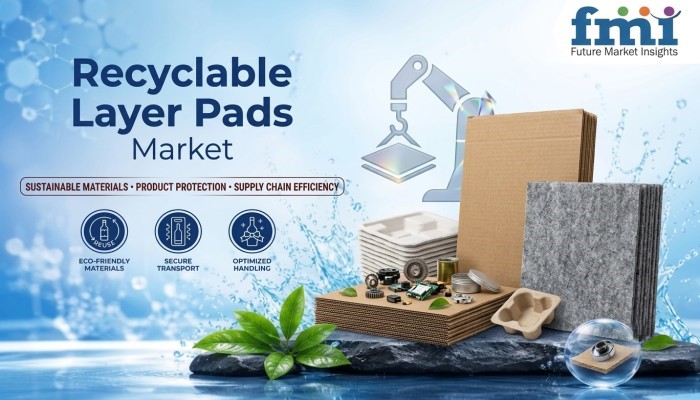
The global recyclable layer pads market is entering a period of steady expansion as packaging teams increasingly connect pallet damage prevention, operational efficiency, and end-of-life accountability in procurement decisions. According to the latest market analysis by Future Market Insights, the market is projected to grow from USD 679.7 million in 2026 to USD 1,240.4 million by 2036, registering a CAGR of 6.2% during the forecast period.
Market growth is being supported by rising demand for stable pallet loads, growing emphasis on recyclable packaging systems, and increasing pressure on brand owners and manufacturers to establish defensible recovery or reuse pathways. Recyclable layer pads help stabilize palletized products, distribute vertical pressure, reduce direct contact between product tiers, and limit damage across food and beverage, consumer goods, pharmaceutical, chemical, and industrial supply chains.
As packaging operations pursue greater material efficiency and circularity, buyers are increasingly evaluating paperboard, HDPE, PP, and molded fiber solutions based on compression performance, slip resistance, moisture exposure, cleanliness, magazine release, qualification requirements, and destination-specific recovery infrastructure.
Get detailed market forecasts, competitive benchmarking, and pricing trends:
https://www.futuremarketinsights.com/reports/sample/rep-gb-34233
Key Market Projections and Strategic Insights
- Global Market Value (2026): USD 679.7 Million
- Forecast Market Value (2036): USD 1,240.4 Million
- Forecast CAGR (2026–2036): 6.2%
- Leading Material Segment: Recyclable Paperboard
- Material Segment Share: 46.0%
Competitive Landscape and Market Share Analysis
The competitive environment is shaped by control of substrate, conversion capabilities, technical qualification, line integration, and recovery infrastructure rather than by a single universal layer-pad design.
Key companies operating in the market include:
- Smurfit WestRock
- DS Smith
- Sonoco
- International Paper
- Mondi Group
- Cascades
- ORBIS Corporation
- Georgia-Pacific
- Menasha Packaging
- Litco International
Manufacturers and packaging suppliers are increasingly focusing on:
- Fiber-based layer-pad development
- Custom conversion and pallet footprints
- Anti-slip and load-stabilization performance
- Reusable polymer and closed-loop systems
- Moisture-resistant constructions
- Line and magazine compatibility
- Take-back and pooling models
- Recyclability and recovery documentation
Companies capable of combining substrate expertise, conversion flexibility, technical qualification, and recovery solutions are positioned to strengthen their competitive standing through 2036.
Production Analysis and Manufacturing Landscape
Production and conversion activities are concentrated in regions with established paperboard, corrugated, polymer processing, and packaging-converting capabilities.
Asia Pacific continues to emerge as a major growth and manufacturing region due to:
- Expanding packaged-goods production
- High-volume beverage and food networks
- Growing manufacturing activity
- Cost-efficient local conversion
- Increasing adoption of modern palletization systems
Chinese manufacturers increasingly favor locally converted, standardized sheets capable of operating across dense can, bottle, appliance, and consumer-goods networks.
European suppliers place greater emphasis on composition, recyclability, load performance, compliance, and documented technical specifications. North American suppliers focus strongly on automation compatibility, damage prevention, packaging-engineering qualification, and destination-specific recovery.
Consumption Economy Analysis
Demand for recyclable layer pads is closely linked to palletized product volumes, packaging formats, distribution distances, automation requirements, and the cost of product damage.
Major consumption sectors include:
- Food and beverage
- Consumer goods
- Beverage and canning
- Chemicals
- Pharmaceuticals
- Industrial products
Food and beverage remains the largest end-use segment, accounting for 31.0% of market share in 2026. High pallet throughput and the sensitivity of glass bottles, cans, PET containers, and printed multipacks to shifting and abrasion create a strong operational case for tier separation.
Load stabilization represents the leading application, holding 35.0% share in 2026, as layer pads distribute point loads, increase friction, maintain container alignment, and create a more uniform surface between pallet tiers.
Access full Report in PDF Format:
https://www.futuremarketinsights.com/reports/brochure/rep-gb-34233
Country Opportunity Assessment
India
India is projected to record the fastest growth among the profiled countries, expanding at a CAGR of 8.3% through 2036. Growth is supported by expanding packaged-goods production, increasing palletized distribution, and rising adoption of modern packaging systems, while buyers continue to emphasize strict unit-cost targets.
China
China is expected to expand at a 7.5% CAGR through 2036. Manufacturers favor locally converted, consistent sheets that can operate at high speeds across dense beverage, appliance, consumer-goods, and industrial networks.
United States
The U.S. market is projected to grow at a 5.8% CAGR. Large beverage, food, consumer-goods, and industrial shippers typically qualify layer pads through packaging-engineering trials, with emphasis on automation, damage claims, and cost per trip.
Germany
Germany is projected to expand at a 5.6% CAGR. Buyers increasingly require evidence covering composition, recyclability, load performance, and compliance before approving new layer-pad specifications.
Japan
Japan is expected to grow at a 5.0% CAGR. Procurement emphasizes dimensional precision, clean handling, stable quality, and tightly controlled changeovers, supporting repeat specifications after qualification.
United Kingdom
The UK market is projected to expand at a 5.8% CAGR. Buyers increasingly connect packaging specifications with data reporting, fee exposure, and recyclability assessments used by brand owners and compliance teams.
Brazil
Brazil is projected to grow at a 6.5% CAGR from 2026 to 2036. Buyers balance national account requirements with long transportation distances, regional converter availability, and uneven recovery infrastructure.
Technology and Innovation Outlook
Technology development is reshaping recyclable layer pads through:
- Advanced recyclable paperboard constructions
- Recyclable HDPE and PP solutions
- Molded fiber pad development
- Anti-slip surface technologies
- Lightweight high-strength structures
- Moisture-resistant formulations
- Custom-cut pallet geometries
- Automated magazine feeding compatibility
- Pooling and closed-loop recovery systems
Future innovation is expected to focus on material reduction, mono-material designs, improved moisture performance, automated handling, and recovery systems that make circularity commercially viable.
Market Drivers Accelerating Industry Expansion
Primary growth drivers include:
- Rising focus on pallet damage prevention
- Growing demand for recyclable packaging components
- Increasing packaging circularity requirements
- Expansion of food and beverage distribution
- Growth in palletized consumer-goods networks
- Increasing automation in packaging operations
- Demand for load stabilization and tier separation
- Greater emphasis on end-of-life accountability
The central growth driver is the convergence of operational loss prevention and packaging accountability. Layer pads are increasingly purchased when they can prevent dented cans, broken bottles, crushed cartons, scuffed packs, and unstable transfers at a lower total cost than competing alternatives.
Related Reports:
https://www.openpr.com/news/4596615/bio-based-cold-chain-insulation-packaging-market-size-to-reach
https://www.openpr.com/news/4596631/utility-cases-market-size-to-reach-usd-62-1-billion-by-2036-as
https://www.openpr.com/news/4596632/time-temperature-indicator-labels-market-size-to-reach-usd-1-8
FMI Custom Research: Strategic Intelligence for Confident Decision-Making
In today’s rapidly evolving business environment, leadership teams need more than market data—they need clear, actionable intelligence tailored to their strategic objectives. FMI’s Custom Research solutions are designed around the specific business questions organizations need answered, enabling executives to evaluate growth opportunities, validate investments, assess competitive dynamics, and reduce uncertainty before making critical decisions. By combining deep industry expertise, primary research, and proprietary market intelligence, FMI delivers insights that help organizations move from assumptions to evidence-based strategies with greater speed and confidence.
Business Impact
FMI helps organizations transform market complexity into strategic clarity, enabling leadership teams to identify growth opportunities faster, optimize resource allocation, strengthen competitive positioning, and make high-stakes business decisions with confidence.
To explore how FMI Custom Research can support your strategic priorities, please connect with our team at – sales@futuremarketinsights.com
About Future Market Insights (FMI)
Future Market Insights, Inc. (FMI) is an ESOMAR-certified, ISO 9001:2015 market research and consulting organization, trusted by Fortune 500 clients and global enterprises. With operations in the U.S., UK, India, and Dubai, FMI provides data-backed insights and strategic intelligence across 30+ industries and 1200 markets worldwide.
Contact Us:
Future Market Insights Inc.
Christiana Corporate, 200 Continental Drive,
Suite 401, Newark, Delaware – 19713, USA
T: +1-347-918-3531
For Sales Enquiries: sales@futuremarketinsights.com
Website: https://www.futuremarketinsights.com
LinkedIn| Twitter| Blogs | YouTube