

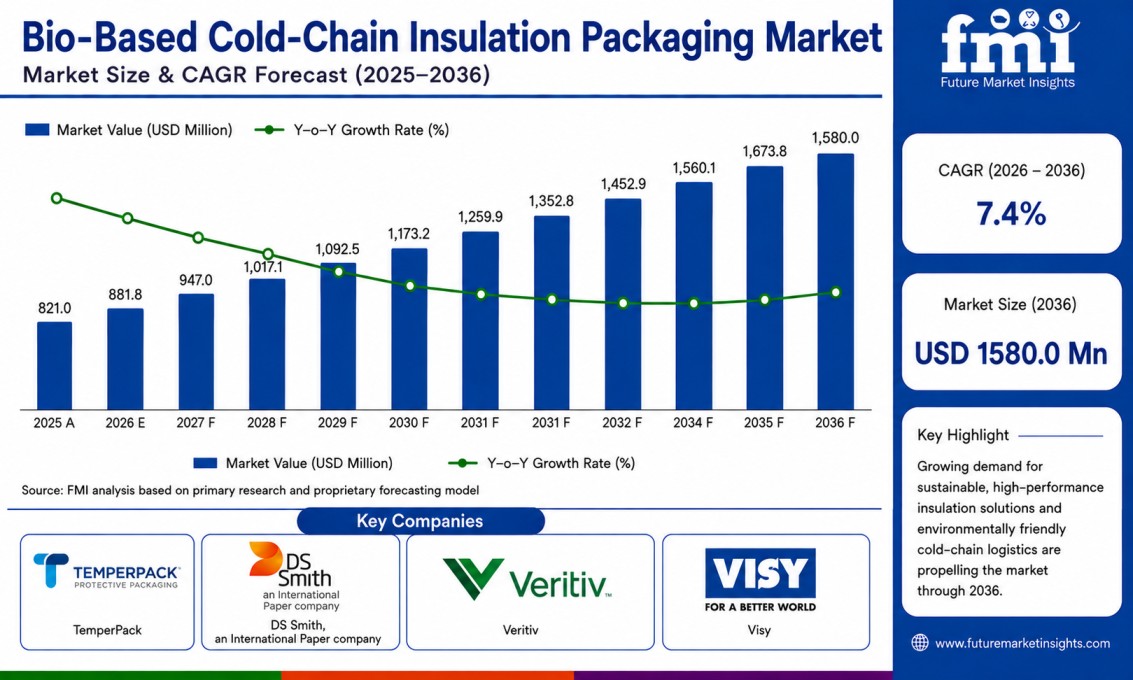
The global bio-based cold-chain insulation packaging market is gaining momentum as food, pharmaceutical, and e-commerce companies seek temperature-controlled packaging solutions with lower environmental impact. The market is projected to reach USD 773.8 million in 2026 and is expected to grow to USD 1,580.0 million by 2036, expanding at a 7.4% CAGR from 2026 to 2036.
The market is being shaped by increasing demand for renewable insulation materials that can protect temperature-sensitive products while reducing dependence on conventional rigid foam packaging. Paper, molded fiber, plant-based polymers, wool, and other renewable materials are increasingly being evaluated as alternatives for cold-chain applications. Companies are focusing not only on sustainability but also on thermal performance, pack-out efficiency, moisture resistance, recyclability, and compatibility with existing logistics infrastructure.
Market Overview and Key Growth Trends
Bio-based cold-chain insulation packaging is increasingly being adopted across food delivery, pharmaceutical distribution, e-commerce, and other temperature-sensitive supply chains. Food and pharmaceutical shippers require packaging systems that maintain validated temperatures while offering practical disposal options after delivery.
Paper is expected to remain the leading material segment, accounting for 38.0% of market demand in 2026. Its established connection with corrugated packaging, familiar converting processes, and relatively straightforward integration into existing shipping systems support its adoption. However, moisture exposure remains an important consideration, particularly for longer routes and refrigerated environments.
The cold-chain end-use segment is projected to hold a 42.0% share in 2026, reflecting recurring demand for qualified temperature-control systems. Pharmaceutical applications require stringent temperature validation, while food delivery programs are increasingly evaluating fiber-based liners and flexible insulation formats for shorter and moderate-duration routes.
North America is anticipated to account for 35.0% of regional demand in 2026, supported by established cold-chain infrastructure, qualification capabilities, and dense parcel distribution networks.
Why Is the Bio-Based Cold-Chain Insulation Packaging Market Growing?
The market is being driven by the convergence of sustainability requirements and the need for reliable temperature protection. Food and pharmaceutical companies are increasingly looking for packaging systems that can replace conventional foam without compromising thermal performance.
Regulatory developments are also influencing material selection. Packaging manufacturers are under increasing pressure to reduce difficult-to-recycle materials and improve the recyclability of complete packaging structures. This is encouraging the development of fiber-based insulation, recyclable paper systems, biodegradable cushioning materials, and other renewable alternatives.
Another important growth factor is the expansion of cross-border e-commerce. Longer shipping distances and multiple handling points increase the risk of product damage and temperature excursions. As a result, packaging suppliers are developing systems that combine insulation, coolant placement, protective structure, and repeatable pack-out instructions.
The transition is therefore moving beyond simply replacing one material with another. Packaging teams increasingly evaluate the complete shipping system, including thermal performance, moisture resistance, storage requirements, handling conditions, recovery options, and total cost.
Segment Analysis
By material, paper is projected to lead with a 38.0% share in 2026. Paper-based insulation can be integrated with corrugated cases and familiar converting processes, reducing changes required during packaging operations. However, humid conditions can affect paper performance, making barrier and seal testing essential for demanding routes.
By format, pouches are projected to account for 23.0% in 2026. Flexible insulated pouches are particularly useful for smaller chilled shipments because they require less storage space and can accommodate changing order configurations. Their adoption is strongest across predictable routes with moderate coolant requirements. Longer routes, compression exposure, and fragile products can favor more rigid formats.
By barrier or feature, grease resistance is expected to represent 25.0% of demand in 2026. Grease-resistant structures are particularly relevant to chilled and fatty food applications, where oils and moisture can weaken paper surfaces and seals. Packaging manufacturers are increasingly developing PFAS-free barrier technologies to support food-contact requirements while maintaining functional performance.
By end use, cold chain is expected to lead with a 42.0% share in 2026. Pharmaceutical distributors require documented seasonal temperature profiles and repeatable pack-out procedures, while food delivery operators generally have greater flexibility for shorter routes. In both applications, thermal qualification and moisture control remain important purchasing criteria.
Drivers, Restraints, and Opportunities
Sustainability regulations and corporate environmental targets remain major drivers for bio-based insulation packaging. Food and pharmaceutical companies are increasingly examining renewable materials as part of broader packaging reduction and recyclability initiatives.
However, thermal qualification represents a significant restraint. Renewable materials can respond differently to humidity, coolant placement, compression, and extended transit conditions. Smaller shippers may find the cost of seasonal testing and validation difficult to absorb.
There is also a major opportunity for suppliers that can offer validated, application-specific packaging systems. Regional production capabilities, standardized pack-out instructions, recyclable material structures, and documented thermal performance can help manufacturers convert trials into recurring commercial programs.
Returnable and reusable packaging systems may also provide opportunities in pharmaceutical and food distribution networks where packaging can be recovered and redeployed.
Country Outlook
India is expected to record the fastest growth at a 10.0% CAGR through 2036, supported by expanding healthcare logistics, temperature-controlled food distribution, and e-commerce delivery networks. Increasing cold-storage capacity and organized supply chains are creating additional opportunities for sustainable insulation solutions.
The United States is projected to grow at 9.3% CAGR, driven by pharmaceutical home delivery, specialty medicines, food distribution, and increasing corporate sustainability requirements. The country’s established qualification infrastructure supports commercial adoption of bio-based systems.
Japan is expected to register an 8.5% CAGR, supported by established cold-chain networks, specialty food distribution, and healthcare applications. Compact packaging formats and flat-packed fiber liners can provide advantages in dense urban fulfillment environments.
The United Kingdom is projected to grow at 7.8% CAGR, supported by pharmaceutical distribution, e-commerce cold-chain operations, and sustainability initiatives. France and Germany are expected to expand at 7.0% and 6.3% CAGR, respectively, with recyclability requirements and mature collection systems influencing material selection.
Competitive Landscape
The competitive landscape includes packaging manufacturers, insulation technology developers, cold-chain specialists, and distribution companies. TemperPack, DS Smith, Veritiv, Visy, Storopack, Woolcool, Cold Chain Technologies, and Ranpak are among the notable companies operating across the market.
TemperPack and Cold Chain Technologies have a strong focus on qualified temperature-controlled systems for life-science applications. DS Smith and Visy combine fiber-based insulation with established corrugated packaging capabilities, while Ranpak provides paper-based solutions for parcel and food applications. Woolcool focuses on natural-fiber insulation, while Storopack offers plant-starch and paper-based solutions for temperature-sensitive shipments.
Competition is increasingly centered on thermal performance, sustainability credentials, qualification support, material recovery, design integration, and geographic service coverage rather than material cost alone.
Future Outlook
The bio-based cold-chain insulation packaging market is expected to maintain strong growth through 2036 as sustainability requirements increasingly intersect with temperature-controlled logistics. The market will expand from USD 773.8 million in 2026 to USD 1,580.0 million by 2036, representing an absolute opportunity of approximately USD 806.2 million during the forecast period.
Future adoption will depend on suppliers’ ability to demonstrate measurable thermal performance while simplifying pack-out procedures and end-of-life handling. Companies that combine renewable materials with validated temperature protection, scalable production, regional supply capabilities, and clear recovery instructions are likely to gain stronger positions as food, pharmaceutical, and e-commerce companies transition toward lower-impact cold-chain packaging.
Related Research Reports:
Industrial Safety Products Market: The industrial safety products market grow at a CAGR of 7.1% between 2026-2036 to reach USD 39.6 billion by 2036.
Fiber-Based Beverage Multipack Carriers Market: fiber-based beverage multipack carriers USD 668.3 million in 2026 to USD 1,610.0 million by 2036.
Active Packaging (Freshness Ripening Control) Market: The active packaging (freshness / ripening control) market are projected to rise from USD 8.5 billion by 2036 at 5.9% CAGR from 2026 to 2036.
About Future Market Insights (FMI)
Future Market Insights is a leading provider of market intelligence, consulting services, and syndicated research reports. FMI delivers actionable insights across packaging, logistics, industrial manufacturing, food and beverage, healthcare, chemicals, and emerging technologies, helping organizations identify growth opportunities and make informed strategic decisions in rapidly evolving markets.
Contact
Future Market Insights Inc.
Christiana Corporate
200 Continental Drive, Suite 401
Newark, Delaware 19713, USA