

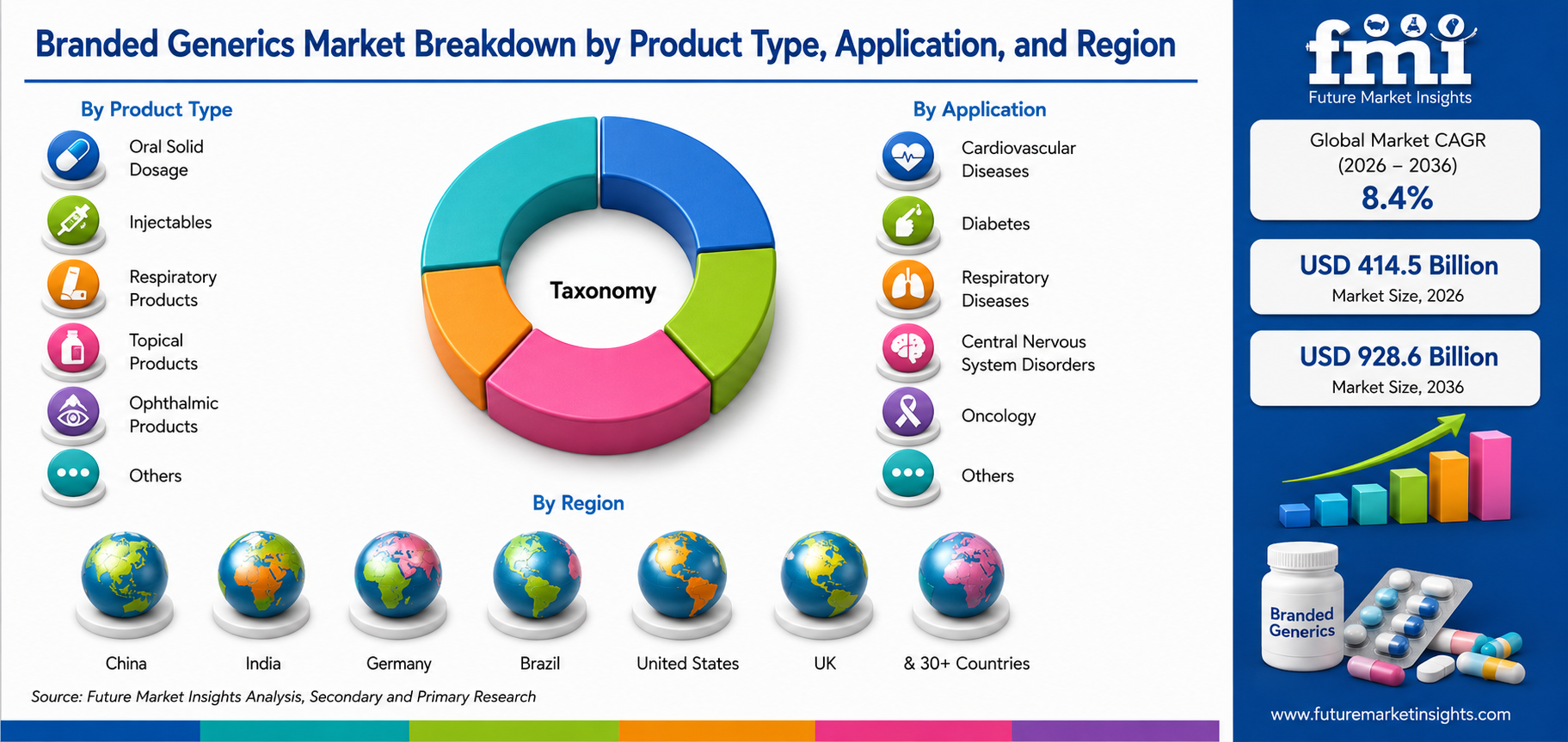
NEWARK, Del., Aug. 7, 2026 — The global Branded Generics Market is expanding as healthcare providers, hospitals, and patients seek affordable medicines that combine established brand recognition with the cost advantages of off-patent therapies. According to Future Market Insights (FMI), the market is projected to grow from USD 414.5 billion in 2026 to USD 928.6 billion by 2036, registering an 8.4% CAGR during the forecast period. Rising chronic disease prevalence, increasing healthcare expenditure, expanding hospital formularies, and continued demand for accessible medicines are supporting market growth worldwide.
Branded generics occupy an important position between conventional unbranded generics and innovative branded medicines. These products typically contain active pharmaceutical ingredients that are already established in clinical use while being marketed under recognizable brand names. Their combination of physician familiarity, broad distribution, and competitive pricing makes them particularly relevant in long-term therapies such as cardiovascular disease, diabetes, and other chronic conditions.
👉 Get Detailed Market Forecasts, Competitive Benchmarking, and Pricing Trends:
https://www.futuremarketinsights.com/reports/sample/rep-gb-1260
The market is expected to create an incremental opportunity of USD 514.1 billion between 2026 and 2036. Growth is supported by increasing demand for affordable chronic disease medicines, expanding pharmaceutical manufacturing, wider hospital procurement, and growing access to essential therapies across emerging healthcare markets.
Key Branded Generics Market Highlights at a Glance
- Market Size (2026): USD 414.5 Billion
- Forecast Market Size (2036): USD 928.6 Billion
- Forecast Period: 2026–2036
- CAGR (2026–2036): 8.4%
- Incremental Opportunity: USD 514.1 Billion
- Leading Formulation Type: Oral Formulations (65.0% Market Share in 2026)
- Leading End User: Hospitals (48.0% Market Share in 2026)
- Key Growth Markets: China and India
- Key Segments Covered: Formulation Type, Therapy Area, Drug Type, End User, Distribution Channel, Region
Analyst Viewpoint
“Branded generics remain an important part of the pharmaceutical market because they combine established product familiarity with greater affordability than many innovative medicines. Hospitals and physicians continue to value reliable supply, consistent quality, and recognizable products, particularly in chronic therapies requiring long-term treatment. Manufacturers with strong regulatory capabilities, broad product portfolios, and dependable distribution networks are likely to capture sustained demand as healthcare systems face increasing cost pressure.”
Why Is the Branded Generics Market Growing?
Increasing demand for affordable medicines, rising chronic disease prevalence, and continued pressure to control healthcare expenditure are strengthening demand for branded generic products.
Key Growth Drivers
- Rising prevalence of chronic diseases.
- Increasing healthcare expenditure and cost-containment initiatives.
- Growing demand for affordable prescription medicines.
- Expansion of hospital formularies.
- Increasing use of long-term cardiovascular and diabetes therapies.
- Growing pharmaceutical manufacturing capacity in emerging markets.
- Wider availability through retail and hospital pharmacy networks.
Branded generics provide healthcare systems with established treatment options while supporting affordability, making them increasingly relevant as governments, hospitals, insurers, and patients seek to manage medicine costs.
Which Formulation Type Leads the Branded Generics Market?
Oral Formulations dominate the market, accounting for 65.0% of formulation type demand in 2026.
Tablets and capsules remain widely used because they are convenient for patients, easy to distribute, and well suited to long-term treatment regimens.
Formulation Segment Highlights
- Oral formulations remain the leading category.
- Tablets and capsules support long-term treatment.
- Routine prescriptions generate recurring demand.
- Established oral dosage forms simplify distribution and patient administration.
Why Do Hospitals Dominate Branded Generics Demand?
Hospitals are forecast to account for 48.0% of end-use revenue in 2026, reflecting their role in high-volume medicine procurement and chronic disease treatment.
Hospital formularies increasingly consider cost, product availability, regulatory compliance, and supplier reliability when selecting branded generic medicines.
End User Highlights
- Hospitals remain major branded generic buyers.
- Formulary management influences product selection.
- Reliable supply supports uninterrupted treatment.
- Hospital pharmacies strengthen controlled medicine distribution.
How Are Chronic Diseases Supporting Market Adoption?
Chronic diseases represent a major demand base for branded generics because patients often require medicines over extended periods.
Cardiovascular diseases, diabetes, gastrointestinal disorders, hypertension, and lipid-related conditions create recurring prescription demand, encouraging healthcare providers to consider cost-effective medicines with established clinical use.
Therapeutic Demand Highlights
- Cardiovascular therapies support recurring medicine demand.
- Diabetes treatment creates sustained prescription volumes.
- Chronic therapies benefit from affordable long-term treatment.
- Established medicines remain important across hospital and retail channels.
How Are Pharmaceutical Companies Strengthening Competition?
Competition in the branded generics market increasingly depends on regulatory capabilities, product breadth, manufacturing efficiency, supply reliability, and access to hospital and pharmacy distribution networks.
Sandoz, Viatris, and Teva demonstrate different approaches to maintaining pharmaceutical portfolios across established generics, complex products, and recognized brands. Sandoz reported USD 11.1 billion in sales in 2025, with biosimilars contributing 30%, highlighting the growing importance of diversified pharmaceutical portfolios.
Companies are also responding to competitive pricing pressure by expanding complex generic portfolios, improving manufacturing efficiency, and strengthening regulatory filing capabilities across international markets.
Market Dynamics
Market Drivers
Growing chronic disease prevalence, healthcare cost-containment efforts, rising demand for affordable medicines, expanding hospital procurement, increasing pharmaceutical production, and wider access to essential medicines continue driving the global branded generics market.
Market Restraints
Pricing pressure from unbranded generics, regulatory compliance costs, competition among manufacturers, supply-chain disruptions, changing reimbursement policies, and increasing pressure on pharmaceutical margins continue presenting challenges to market expansion.
Market Trends
Innovation and market competition continue reshaping the branded generics industry.
Major trends include:
- Expansion of complex generics.
- Growing hospital procurement.
- Increased demand for oral formulations.
- Expansion across emerging pharmaceutical markets.
- Greater focus on supply-chain reliability.
- Portfolio diversification by pharmaceutical companies.
- Increasing regulatory harmonization.
Regional and Country Outlook
China is expected to remain a key growth market as healthcare reforms, hospital purchasing initiatives, and expanding access to chronic disease treatments support demand for branded generic medicines.
India continues to represent an important market due to its extensive pharmaceutical manufacturing base, broad retail pharmacy network, physician-led prescribing, and growing demand for affordable medicines.
The United States and European markets remain important through established regulatory frameworks, large healthcare systems, and continued demand for cost-effective pharmaceutical therapies.
Emerging markets across Asia, Latin America, and other regions are also expected to contribute to growth as healthcare infrastructure expands and access to essential medicines improves.
Competitive Landscape
Competition remains focused on pharmaceutical portfolio breadth, regulatory approvals, manufacturing efficiency, pricing strategies, brand recognition, supply reliability, and distribution reach.
Leading manufacturers are expanding their portfolios across conventional generics, complex formulations, and higher-value pharmaceutical products while strengthening relationships with hospitals, pharmacies, distributors, and healthcare providers.
Key Companies
- Sandoz
- Viatris Inc.
- Teva Pharmaceutical Industries Ltd.
- Sun Pharmaceutical Industries Ltd.
- Lupin Limited
- Cipla Limited
- Dr. Reddy’s Laboratories Ltd.
- Aurobindo Pharma
- Zydus Lifesciences
- Torrent Pharmaceuticals
Frequently Asked Questions
- What is the projected size of the Branded Generics Market by 2036?
The global Branded Generics Market is projected to reach USD 928.6 billion by 2036, growing from USD 414.5 billion in 2026. - What is the expected CAGR of the Branded Generics Market?
The market is forecast to expand at an 8.4% CAGR between 2026 and 2036. - Which formulation type dominates the Branded Generics Market?
Oral Formulations lead the market, accounting for 65.0% of formulation type demand in 2026. - Which end user holds the largest market share?
Hospitals are expected to account for 48.0% of end-use revenue in 2026. - What factors are driving market growth?
Rising chronic disease prevalence, increasing demand for affordable medicines, healthcare cost-containment initiatives, expanding hospital formularies, growing pharmaceutical manufacturing, and wider access to long-term therapies continue driving the global Branded Generics Market.
Related Reports:
- https://sites.google.com/view/healthcarewellnessinsights/spinal-cord-injury-venture-funding-market
- https://sites.google.com/view/healthcarewellnessinsights/kidney-transplant-rejection-biomarker-market
- https://sites.google.com/view/healthcarewellnessinsights/neuro-restoration-spinal-cord-injury-market-is
- https://sites.google.com/view/healthcarewellnessinsights/wearable-medical-device-market
- https://sites.google.com/view/healthcarewellnessinsights/liquid-biopsy-market
About Future Market Insights (FMI)
Future Market Insights (FMI) is a global market intelligence and consulting firm providing comprehensive market research, competitive intelligence, and strategic business insights across industries. The firm delivers detailed forecasts, technology analysis, and data-driven recommendations that support informed decision-making for manufacturers, investors, distributors, and policymakers worldwide.
For Press & Corporate Inquiries
Rahul Singh
AVP – Marketing and Growth Strategy
Future Market Insights, Inc.
+91 8600020075
For Sales – sales@futuremarketinsights.com
For Media – Rahul.singh@futuremarketinsights.com
For Web – https://www.futuremarketinsights.com