

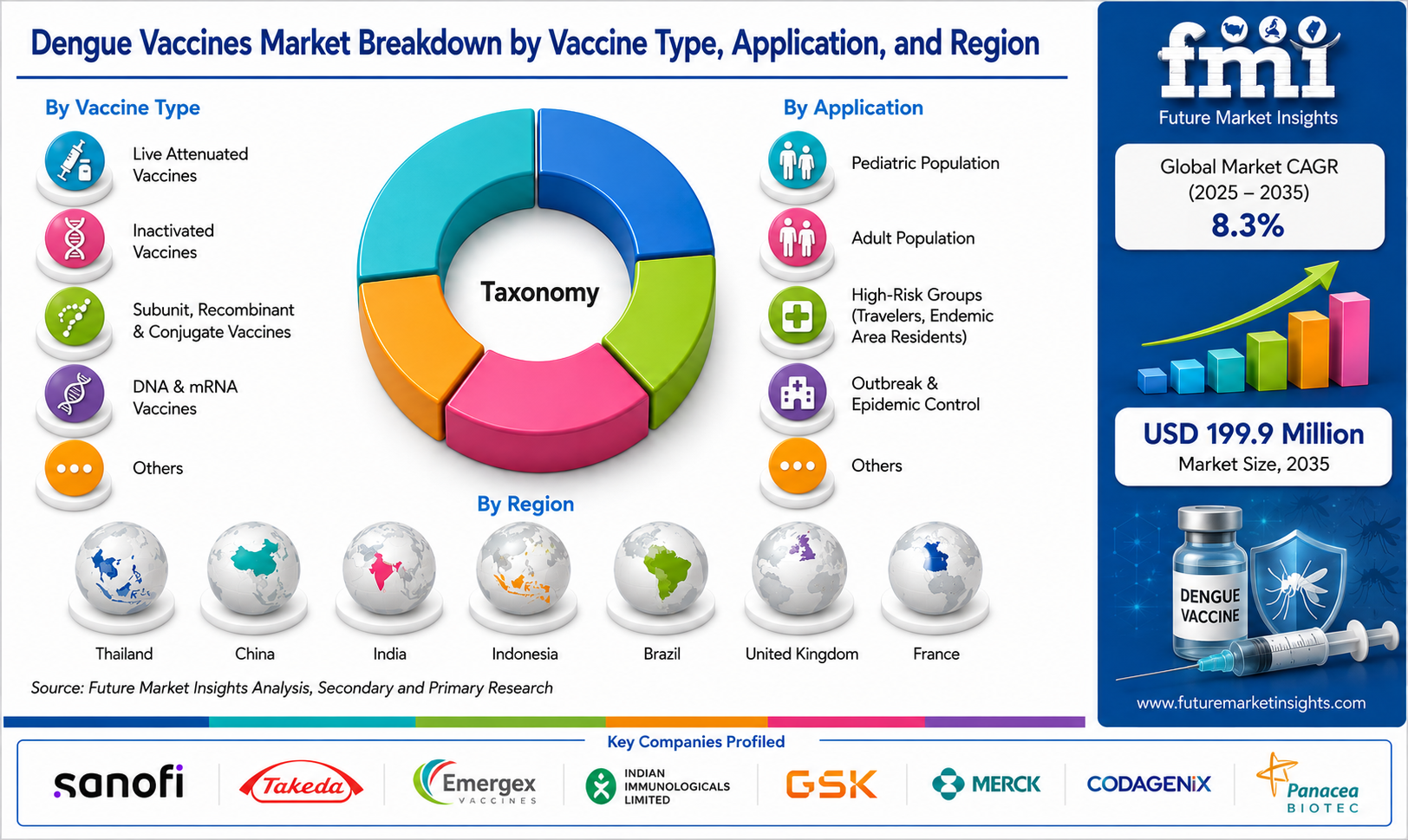
The global Dengue Vaccines Market is entering a new phase of growth as governments intensify immunization efforts to combat the rising burden of dengue across tropical and subtropical regions. According to Future Market Insights (FMI), the market is projected to expand from USD 97.5 million in 2026 to USD 216.3 million by 2036, registering a CAGR of 8.3% during the forecast period.
The increasing incidence of dengue fever, growing hospitalization rates, and expanding public immunization initiatives are accelerating vaccine procurement by national healthcare agencies. With more than 5 million reported dengue cases globally, public health authorities are prioritizing preventive vaccination strategies to reduce disease burden and healthcare costs.
Among product categories, Dengvaxia is expected to account for 47.8% of market demand in 2026, maintaining its position as the leading commercially available vaccine. Meanwhile, the paediatric population is projected to represent 53.7% of vaccine demand owing to higher infection rates and hospitalization among children in endemic regions.
Market expansion is also supported by WHO prequalification initiatives, GAVI-backed immunization programs, improved vaccine accessibility, and growing investments in next-generation tetravalent dengue vaccines capable of providing broader protection without extensive pre-vaccination screening.
What Is Driving Growth in the Dengue Vaccines Market?
The rapid increase in dengue outbreaks across Asia-Pacific, Latin America, and other tropical regions continues to strengthen long-term demand for preventive vaccination programs.
Unlike symptomatic treatments, vaccination offers a sustainable strategy for reducing hospitalization, severe dengue complications, and mortality. Governments are increasingly allocating healthcare budgets toward routine immunization programs as dengue evolves from a seasonal outbreak into a year-round public health challenge.
International organizations including the World Health Organization (WHO), UNICEF, and PAHO are expanding procurement frameworks to improve vaccine availability in high-risk populations.
Growing urbanization, climate change, increasing mosquito habitats, and international travel further contribute to expanding disease transmission, creating sustained demand for effective vaccination programs.
How Are Technological Advances Improving Dengue Vaccine Development?
Modern vaccine research has shifted toward developing safer and more broadly protective tetravalent vaccines capable of protecting against all four dengue virus serotypes.
Key innovation trends include:
- Improved live-attenuated tetravalent vaccines
- Recombinant vaccine platforms
- DNA and mRNA vaccine research
- Enhanced immunogenicity profiling
- Simplified vaccination protocols
- Reduced dependence on seroprevalence screening
- Improved cold-chain stability
- AI-supported vaccine candidate discovery
- Advanced clinical trial analytics
- Biomarker-driven efficacy assessment
Manufacturers are focusing on vaccines that can provide durable immunity while minimizing the risk associated with secondary dengue infections.
Why Government Immunization Programs Are Reshaping Market Demand
Government-funded procurement programs remain the largest revenue contributor within the dengue vaccines industry.
National immunization agencies increasingly negotiate long-term procurement agreements with vaccine manufacturers to ensure consistent vaccine availability.
Mass vaccination campaigns across endemic countries improve economies of scale while encouraging manufacturers to expand production capacity.
International funding organizations further accelerate vaccine access through subsidized procurement initiatives for low- and middle-income countries.
What Challenges Continue to Limit Market Expansion?
Despite strong long-term prospects, several factors continue to restrain market adoption.
Pre-vaccination serological testing requirements for certain vaccines increase implementation complexity and healthcare costs. Limited diagnostic infrastructure in many endemic countries restricts broad vaccination coverage.
Other market restraints include:
- High vaccine development costs
- Regulatory complexity
- Limited commercial vaccine availability
- Cold-chain logistics challenges
- Variable serotype prevalence across regions
- Public awareness gaps
- Reimbursement limitations
- Long clinical development timelines
Expanding access will require simplified vaccination protocols alongside continued investment in healthcare infrastructure
Which Market Segments Are Leading Revenue Generation?
By Product
Dengvaxia is projected to capture 47.8% market share in 2026, supported by established regulatory approvals and continued procurement within eligible seropositive populations.
Manufacturers continue investing in next-generation vaccine candidates designed to broaden eligibility while reducing reliance on serological screening.
By Age Group
The Paediatric segment is expected to account for 53.7% of total demand during 2026.
Children remain disproportionately affected by dengue infections and hospitalization, encouraging governments to prioritize pediatric vaccination under national immunization schedules.
By Distribution Channel
Government procurement programs are forecast to dominate with 61.6% market share owing to centralized purchasing by national health ministries, UNICEF, PAHO, and other international procurement agencies.
Public-sector purchasing remains significantly larger than private vaccination demand across endemic countries.
Which Regions Are Creating the Strongest Growth Opportunities?
Thailand
Thailand is forecast to record the fastest market expansion with a 13.1% CAGR, driven by continued expansion of national dengue vaccination initiatives and high disease prevalence.
India
India continues to represent one of the world’s largest dengue patient populations. Increasing government awareness campaigns, stronger disease surveillance, and expanding vaccination programs are expected to support future market growth.
Brazil
Brazil remains among Latin America’s largest dengue vaccine markets as recurrent outbreaks encourage greater investment in public immunization and vector-control programs.
China
China continues strengthening infectious disease prevention programs while expanding vaccine research capabilities and domestic manufacturing infrastructure.
Europe
Countries including the United Kingdom and France primarily generate demand through travel medicine clinics, imported dengue prevention strategies, and ongoing vaccine research collaborations.
How Competitive Is the Dengue Vaccines Market?
Competition remains concentrated among pharmaceutical companies with established vaccine development expertise and global manufacturing capabilities.
Leading companies continue expanding clinical trials, regulatory approvals, production capacity, and government procurement partnerships.
Major market participants include:
- Sanofi
- Takeda Pharmaceuticals
- Emergex Vaccines
- Indian Immunologicals Ltd.
- GSK
- Merck
- Codagenix
- Panacea Biotec
Competitive differentiation increasingly depends on broader serotype protection, simplified vaccination schedules, regulatory approvals, manufacturing scalability, and cold-chain efficiency.
Recent Industry Developments
Recent developments influencing market growth include:
- Expansion of national immunization programs across endemic countries.
- Continued WHO support for dengue vaccination strategies.
- Increasing investment in tetravalent vaccine development.
- Growing collaboration between governments and global procurement agencies.
- Advances in recombinant and next-generation vaccine technologies.
- Strengthening vaccine manufacturing capacity across Asia.
What Does the Future Hold for the Dengue Vaccines Market?
The outlook for the Dengue Vaccines Market remains highly positive as governments increasingly recognize vaccination as the most effective long-term strategy for reducing dengue-related healthcare burdens.
Future growth will be supported by expanding pediatric immunization, improved vaccine accessibility, broader regulatory approvals, next-generation tetravalent vaccines, and stronger public health funding.
Manufacturers capable of delivering vaccines with broad serotype coverage, simplified administration, and scalable manufacturing will be well positioned to capitalize on increasing global demand through 2036.
Conclusion
The global Dengue Vaccines Market is expected to nearly double over the next decade, reaching USD 216.3 million by 2036 at a CAGR of 8.3%. Rising dengue incidence, government immunization programs, WHO-supported initiatives, and advances in vaccine technology continue to reshape the industry landscape. As countries strengthen disease prevention strategies, demand for safe, effective, and broadly protective dengue vaccines is expected to accelerate, creating significant opportunities for vaccine developers, manufacturers, and healthcare stakeholders worldwide.
Frequently Asked Questions (FAQs)
- What is the projected size of the Dengue Vaccines Market by 2036?
The market is projected to reach USD 216.3 million by 2036. - What CAGR is expected for the Dengue Vaccines Market between 2026 and 2036?
The market is forecast to grow at a CAGR of 8.3%. - Which product segment leads the market?
Dengvaxia is expected to lead with 8% market share in 2026. - Which age group dominates vaccine demand?
The Paediatric segment is projected to account for 7% of market demand. - Which country is expected to experience the fastest growth?
Thailand is forecast to register the highest CAGR of 1% through 2036. - Who are the major companies operating in the market?
Leading companies include Sanofi, Takeda Pharmaceuticals, Emergex Vaccines, Indian Immunologicals Ltd., GSK, Merck, Codagenix, and Panacea Biotec.
Related Reports:
- https://sites.google.com/view/healthcarewellnessinsights/proteomics-market
- https://sites.google.com/view/healthcarewellnessinsights/surface-disinfectant-market_1
- https://sites.google.com/view/healthcarewellnessinsights/pancreatic-beta-cell-therapy-market
- https://sites.google.com/view/healthcarewellnessinsights/herbal-medicinal-products-market
- https://sites.google.com/view/healthcarewellnessinsights/egg-freezing-embryo-banking-market
About Future Market Insights (FMI)
Future Market Insights (FMI) is a global market intelligence and consulting firm providing comprehensive market research, competitive intelligence, and strategic business insights across industries. The firm delivers detailed forecasts, technology analysis, and data-driven recommendations that support informed decision-making for manufacturers, investors, distributors, and policymakers worldwide.
For Press & Corporate Inquiries
Rahul Singh
AVP – Marketing and Growth Strategy
Future Market Insights, Inc.
+91 8600020075
For Sales – sales@futuremarketinsights.com
For Media – Rahul.singh@futuremarketinsights.com
For Web – https://www.futuremarketinsights.com